
Image © Adobe Images
Key Takeaways
- The Pound-to-Dollar rate's advance is likely limited to around 1.36 because the U.S. Dollar "is not quite ready to make a sustained break lower," ING tells Pound Sterling Live.
- Higher energy prices and rising 30-year Treasury yields could put a September Federal Reserve rate hike back on the agenda, ING warns, with markets lifting September hike pricing to 9 basis points from 7 this week.
- Record U.S. corporate bond issuance is lifting long-term yields, with investment-grade supply hitting an August record of $145 billion and hyperscalers including Microsoft, Amazon and Meta projected to issue $250-280 billion in 2026 to fund AI infrastructure.
Update from ING says it's too soon to be chasing the dollar lower.
The pound-to-dollar rate has risen 2.0% in value since the current impulse move higher began on July 26, but this is not necessarily the start of a sustained uptrend.
That's the warning from ING Bank, where strategists advise they're not chasing dollar weakness from here.
That in itself is an admission that pound-dollar remains a dollar story, with the recent setback for the Greenback having roots in a number of developments stateside.
"The dollar is not quite ready to make a sustained break lower just yet," says a daily note from ING, released Tuesday 18.
The analysis finds there are two factors providing near-term support: higher energy prices and rising 30-year Treasury yields.
"Both of these, should they extend, could put a September hike from the Federal Reserve back on the agenda," says ING.
The Fed channel is relevant: August's softer-than-expected jobs print provided some impetus to a trend of economic downside surprises out of the states:
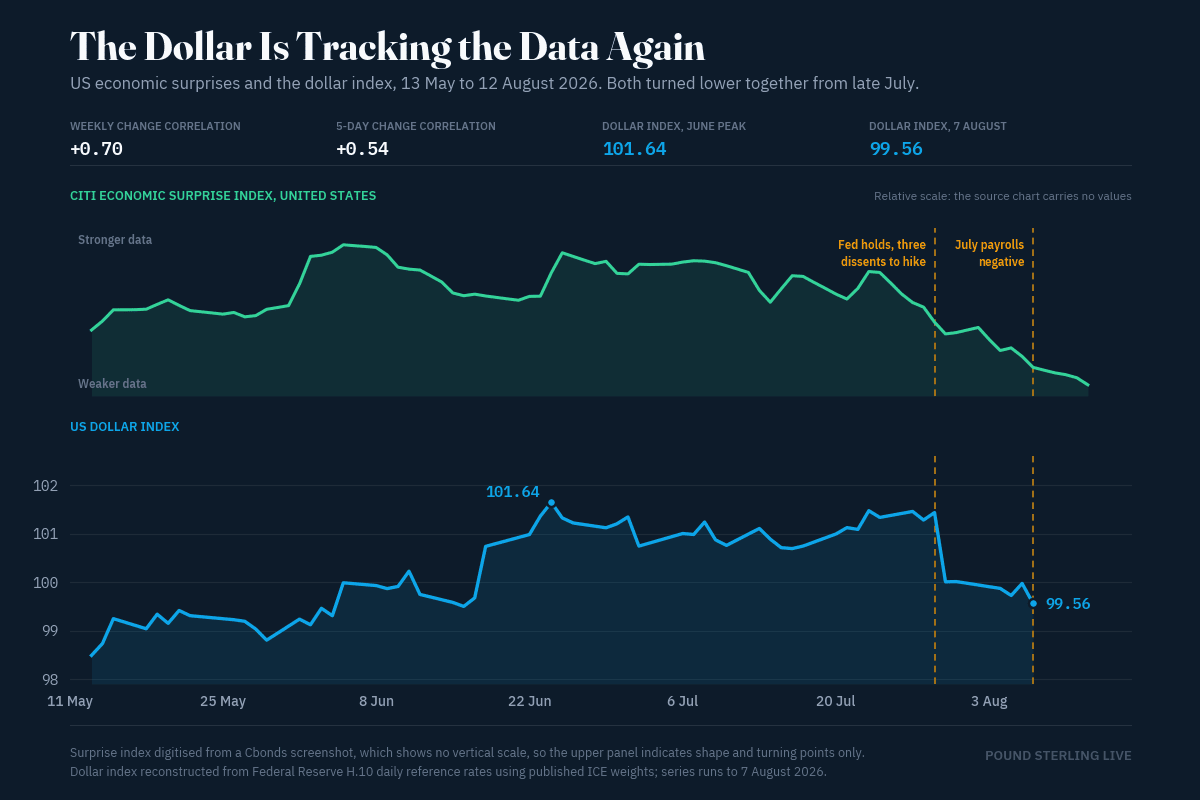
Near-term direction is nevertheless likely to be swayed by rising oil and bond prices, which analysts pin on news that Washington seemingly has little interest in extending the 60-day ceasefire with Iran.
That's seen oil and gas prices creep higher again.
"In which direction the next big leg for energy prices emerges is anyone's guess. But higher energy is a dollar positive – both through US energy independence and the Fed's reaction function," points out ING.
Regarding long-end yields, ING's Rates Strategy team suggest that the fact the 30-year US Treasury swap spreads have not widened suggests that it isn't fiscal concerns driving the move.
"More compelling is the heavy investment-grade issuance from the US hyper-scalers," shows the research.
Here, U.S. investment-grade issuance has just hit a new record for August at $145bn.
Hyperscaler bond issuance is surging as top technology companies such as Microsoft, Alphabet, Amazon, Meta, and Oracle issue record amounts of debt to fund massive capital expenditures in artificial intelligence (AI) infrastructure and data centres.
Issuance is pacing far ahead of historical figures, with major U.S. hyperscalers projected to issue roughly $250 billion to $280 billion in bonds in 2026 alone.
That comes up against elevated sovereign issuance from the likes of Japan, France, the U.S. and UK, just to name a few.
That's a lot of debt that the market must hoover up, pushing the supply-demand dynamic in favour of lower bond prices (i.e. higher yields).
"A big sell-off in the long-end of the Treasury market is typically bad news for emerging market currencies and risk in general. We are not quite at that point yet, but a further rise in yields may increase the pressure on the Fed to act, and this week has seen the pricing of a September Fed hike rise to 9bp from 7bp," says ING.
Rising support for USD limits the ability of the pound-dollar exchange rate to advance much beyond 1.36, which would be in keeping with 2026's price action playbook.