
Image © Adobe Images
The UK labour market's stabilisation can extend, with Friday's PMIs the next test, say analysts.
The UK labour market's gradual stabilisation should extend through the autumn, according to analysts reacting to the latest official figures, although fading wage dynamics mean households will be squeezed further.
Today's ONS report revealed employment rose 84K on a three-month-on-three-month basis, the unemployment rate held at 4.9%, and annual wage growth ran at 4.3% including bonuses and 3.4% on the regular measure.
Vacancies continued to fall, at 712K they sit below pre-pandemic levels, and the employment reading came in slightly softer than markets expected.
"Clearly there is a soft hue to the employment side still, but the rate deterioration is far milder than it was earlier in the year," says Sam Hill, Head of Market Insights at Lloyds Bank.
That reading underpins our house view that the economy is defying expectations for a second-half fade, a stance reinforced by last week's stronger-than-expected GDP figures, which could underpin the pound.
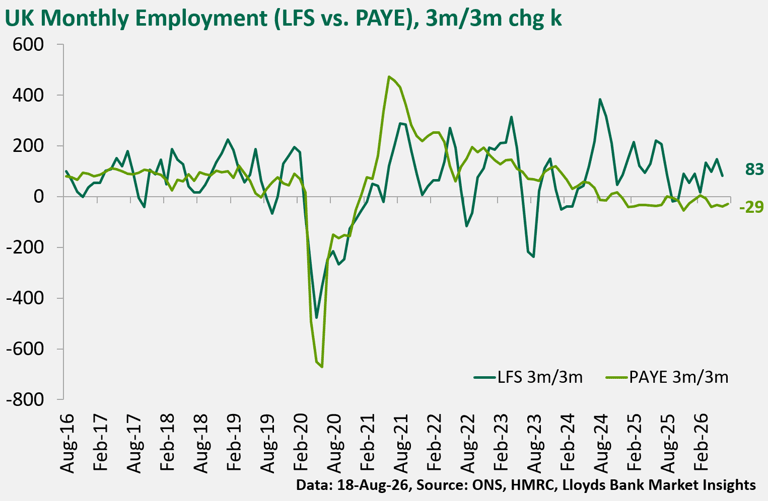
Hill expects the improvement to continue.
"Resilient demand plays into that with activity continuing to expand across manufacturing and services, which Friday's preliminary August PMIs ought to corroborate. We'd thus expect this gradual stabilisation trend to extend," he says.
Wage Slide Means a Squeeze Can't be Avoided
Falling wages might be welcome news to the Bank of England, however, for households it points to potential pain in the outlook.
"The worst of the labour-market deterioration may have passed, but consumers still face an uncomfortable period in which wage growth struggles to keep pace with prices," says Martin Beck, Chief Economist at WPI Strategy.
Real regular pay is growing at just 0.4% a year once inflation is accounted for, leaving little margin for the price pressures still working through the system.
"The inflationary fallout from the Iran conflict is likely to squeeze real incomes during the second half of 2026, although the fall in oil prices since late July should ease some of that pressure," adds Beck.
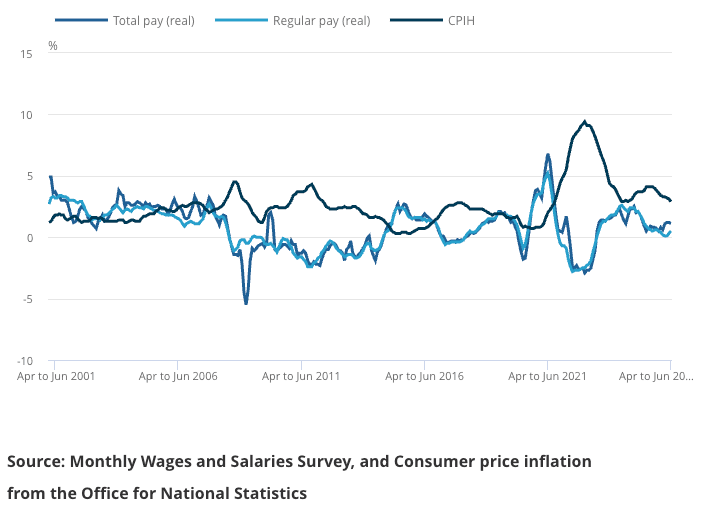
The data lands ahead of the midweek ONS inflation report, that consensus expects to have risen to 3.0% in July, confirmation inflation is running ahead of pay.
"Slower private-sector wage growth is encouraging for the inflation outlook, but less so for households," says Beck.
Cooling pay pressures give the Bank of England room to stay patient while the economy runs, the combination that has underpinned Sterling's data-driven support this month.
Business Says the Damage is Policy-Made
Employer groups read the report as further evidence of a jobs market held back by government-imposed costs.
"Today's data reflects a stagnant labour market," says Alex Hall-Chen, Principal Policy Advisor for Employment at the Institute of Directors. "If the Government is to deliver on its promise of growth and prosperity in every postcode, it must take concrete steps to restore employer confidence and support job creation."
The IoD points at the Employment Rights Act's compliance costs, the hike in employer National Insurance contributions, and successive above-inflation increases to the minimum wage as direct contributors to the labour market's woes.
The postcode language is a deliberate echo of Andy Burnham's signature growth pledge, placing the jobs market on the Prime Minister's own scorecard.
"With economic uncertainty so high, and payroll taxes increasingly onerous, it's not surprising many UK employers are staying cautious, and unwilling to take the risk of hiring new staff. The trend is showing up once again in the latest labour market snapshot from the ONS," says Susannah Streeter, Chief Investment Strategist at Wealth Club.