Image © House of Commons
With Liz Truss in mind, Burnham must be aware that any meaningful help with winter bills would prove too costly for bond markets to absorb.
Energy bills are heading higher into winter and the political pressure to do something about them will build with every degree the temperature drops.
Ofgem confirmed the October to December price cap at £1,723 a year for a typical dual fuel household on 26 August, a 4% rise driven almost entirely by wholesale gas.
Cornwall Insight put the January to March cap at £1,872 when it published the same day, a further 9% and £149 a year.
That forecast predates the Saudi pipeline closure and Brent's move back above $107, and the suppliers running numbers since have landed well above it, with E.ON and Sainsbury's Energy at £2,027, EDF at £2,046 and British Gas at £2,065.
On an average of the three, January bills rise 19% from October, and Ofgem confirms the figure on or before 25 November using an assessment window that captures the entire current energy shock.
Burnham Will Feel Pressure to Act
The government has already shown it feels the pull of rising energy costs, having taken VAT off household electricity from 1 October at a cost of around £850m for six months, a measure that expires at the end of March 2027.
Any sum larger than that stops being a rounding exercise and starts making real asks on financing requirements.
"The UK is especially vulnerable because of the combination of oil prices at $100-110 a barrel and concerns about the credibility of the public finances," says Anthony Brinkman, High Yield Portfolio Manager at Principal Asset Management.
"The risk for credit in a market like this is not so much the absolute level of rates, but more the velocity with which they are moving," he adds.
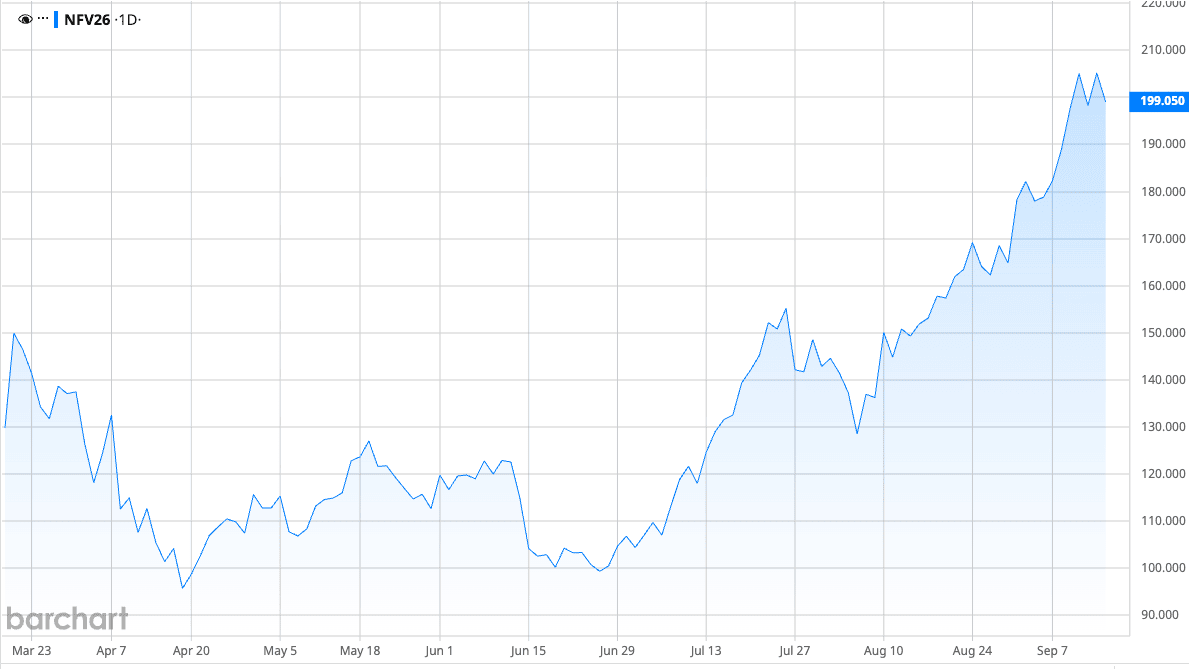
Above: Price of UK wholesale gas for delivery in November.
Memories of Truss
When discussing energy risks, it's important to go back to Liz Truss' ill-fated mini-budget.
Bond markets sold off and yields surged on the day, but it's important to note that the foundations for the debacle were sown before the mini-budget itself, when the government said it would spend billions of pounds subsidising gas bills.
The Energy Price Guarantee was announced on 8 September 2022, capping the typical annual dual fuel bill at £2,500 for two years from 1 October, with an equivalent scheme for business alongside it.
The Institute for Fiscal Studies put a possible first-year cost at £100bn, Deutsche Bank estimated the energy offset and the promised tax cuts together at £179bn, and the Office for Budget Responsibility initially costed the household guarantee at £24.8bn for 2022-23 with a further £18.4bn for the business scheme.
When Truss' mini-budget landed with significant tax cuts attached, the market fell out of bed as the scale of new borrowing required was enormous.
Acute Pressures on Government Borrowing
As we enter a tough winter for energy bill payers, it must be noted that the cost of borrowing now is far worse than that faced by Truss and the UK's debt dynamics are more precarious.
UK ten-year gilt yields hit a 19-year high near 5.40% on 10 September, the 30-year has been trading close to 5.93%, and UK yields are now the highest in the G7:
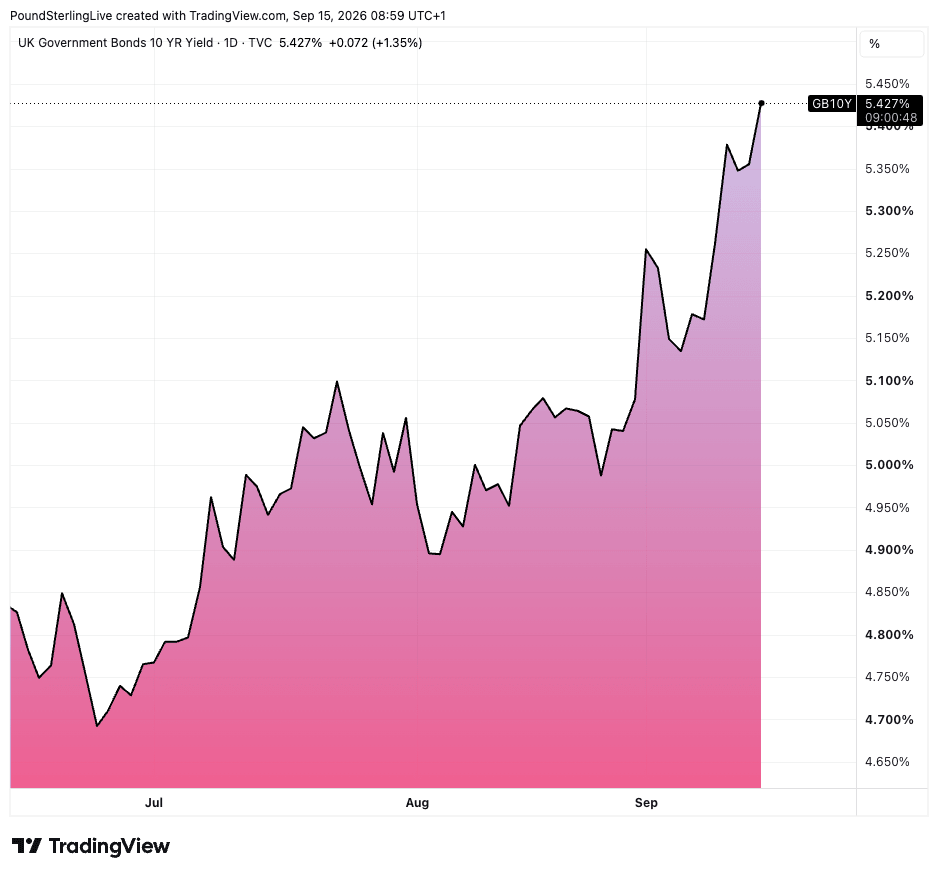
The UK sovereign debt market looks to be the most vulnerable among major economies and has experienced the most extreme deterioration of any of them, according to TS Lombard.
Goldman Sachs has lifted its end-2026 ten-year gilt forecast to 5% from 4.4% and identifies the UK's largest increase in duration-weighted bond supply of any market, alongside fiscal headroom too thin to absorb rate and energy volatility, as two of the four reasons gilts carry one of the highest betas to energy prices in the G10.
Burnham Should Sit this One Out
In the wake of Truss, Jeremy Hunt cut the guarantee from two years to six months on 17 October, and the scheme's final cost came in near £27bn as wholesale prices fell.
Bond markets stabilised.
Energy bills are nowhere near 2022 levels, with October's £1,723 sitting against the £3,549 cap Truss overrode and forecasts that had been running above £4,300, so any package now would be a fraction of the size of the one that broke the market four years ago.
However, the market's capacity to absorb it is now a fraction of what it was in 2022.
Gilt issuance is already running at the heaviest duration-weighted increase of any major market, the Bank of England is still shrinking its balance sheet through quantitative tightening, and national debt sits near 95% of GDP.
Goldman Sachs warns that reliance on near-term borrowing through a substantial increase in FY 2027 gilt issuance would likely pressure the gilt risk premium, which is the same transmission that ran in September 2022 and would run faster now.
For Burnham, the best option for his political career and the country's bond market is to sit this one out and avoid the temptation to offer support.