
Image © Adobe Images
EUR/USD challenges its 100-day average, ensuring the coming sessions settle the recovery's major test.
The euro-to-dollar exchange rate has pushed to a fresh recovery high, confirming the break of the downtrend that capped it from February through July and answering the question we posed a week ago.
The pair has pushed beyond the point where the first recovery attempt was rejected a week ago, buyers have defended every dip since, and the advance from July's base is developing the higher-low structure that separates a recovery from a bounce.
From a tactical perspective everything now hangs on the 100-day moving average, the line the market closed the week sitting on, with the August flash PMIs on Friday the main scheduled test and European Central Bank rate expectations supplying the underlying support.
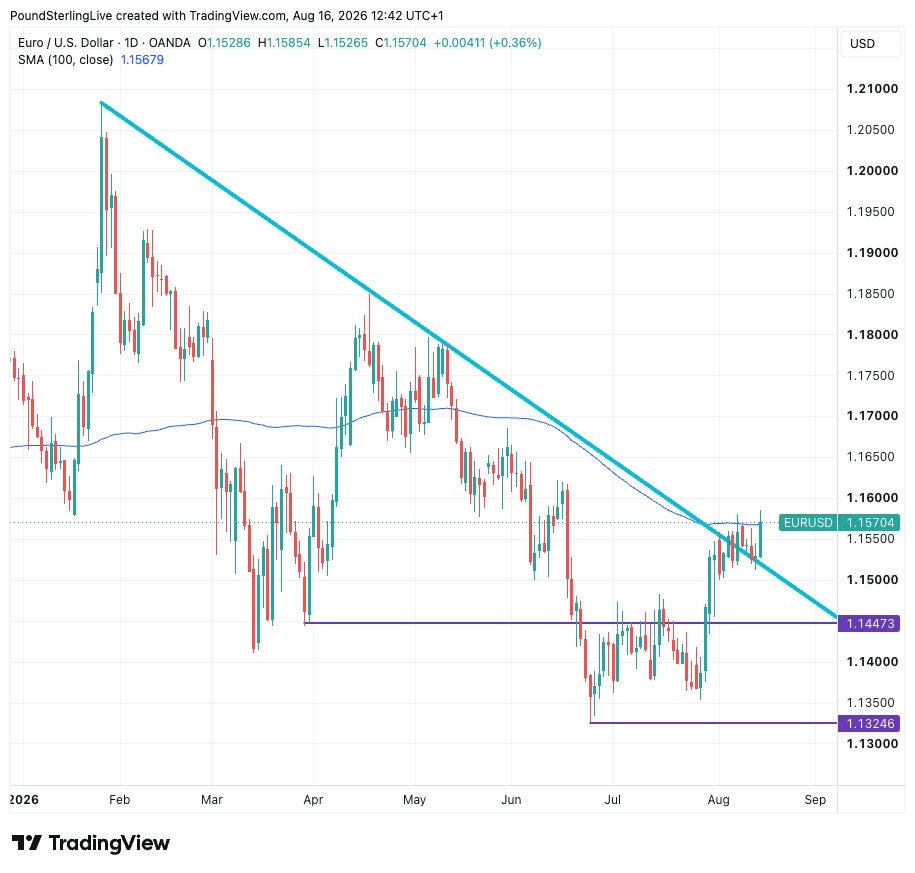
Above: EUR/USD daily chart. Image © Pound Sterling Live, chart created with TradingView.
Spot at 1.15704 is sitting directly on the 100-day moving average at 1.15679, the level where the recovery's first attempt was rejected a week ago.
The average is still falling, which means holding here is enough for the market to break above it in the coming sessions even without further gains, but the significance belongs to a daily close and the market has not yet delivered one with any margin.
The session high at 1.15854 is the loftiest this market has traded since June, evidence that buyers are willing to probe above the average even if they have not yet held the ground.
Last week's forecast called for consolidation with an upward bias while the test at the 100-day moving average was resolved, and that test has now been joined in earnest: the average sits at 1.15679 and the market closed the week at 1.15704, a margin of barely three pips.
Friday's session straddled the line, ranging from 1.15265 below it to 1.15854 above, which makes the coming week's opening sessions the decider.
A daily close clearly above 1.15679 would be the pair's first sustained break of the 100-day MA since the spring, and it would complete the set: trendline broken, higher low in place, and the last of the major averages reclaimed.
The broken downtrend line from February's high near 1.2060 continues to fall away beneath the market and converges on the horizontal support at 1.14473, which stacks the trendline and the old range ceiling into a single band of support in the mid-1.14s.
That band is now the line in the sand: the recovery thesis survives any dip that holds above it and dies on a daily close below.
The obstacle overhead is the congestion around 1.1600, where the market repeatedly stalled through May and June, and beyond it the June spike high near 1.1655.
Our Euro to Dollar forecast is for a decisive daily close above the 100-day average at 1.15679 to be secured early in the week, opening a test of 1.1600, with dips towards 1.1500 likely to find buyers.
The medium-term downtrend is broken but not yet reversed: the pair needs to clear 1.1600 and hold it before the advance graduates from recovery to trend, and the structure below makes clear where the argument fails.
PMIs Test the Growth Story on Friday
The main Eurozone release of the week is the August flash PMI on Friday.
July's composite reading of 52.0 signalled a return to growth after stagnation in June and contractions in April and May, so the question is whether the momentum survives the energy shock.
"However, renewed upward pressure on energy prices is likely to weigh on activity, and we expect the survey to point to a slower pace of expansion in August," says a note from Lloyds Bank.
The market looks for the services PMI to fall to 51.0 from 51.7, the manufacturing PMI to edge down to 51.5 from 51.9 and the composite to decline to 51.4 from 52.0.

The Bank Consensus, Without the Terminal
The median, mean, highest and lowest from the October survey update, plus named point forecasts out to 2027.
Free information pack, issued by World Wide Currencies.
Those forecasts describe a slowdown rather than a stall, and readings in line with them would leave the Euro's recovery intact.
A slip back towards the 50 boundary would be the outcome that hurts, because it would strike at the data resilience on which the hawkish ECB case is built.
The Rate Story Working in the Euro's Favour
Working in the Euro's favour is the increased tempo in expectations for a rate hike at the European Central Bank, which has underpinned Eurozone bond yields; something that supports the Euro in a rate-focused foreign exchange market.
"We are seeing ongoing upside surprises to euro area data and sticky inflationary pressures, leading to a more hawkish ECB reaction function," says Dominic Bunning, FX Strategist at Nomura.
"The European Central Bank appears more firmly on course to raise interest rates next month following its previous increase in June," says Lloyds Bank, citing Eurozone headline CPI, which edged up to 2.9% in July.
"Inflation could move above 3% in the coming months," says Lloyds.
The week offers plenty for the market to test that thesis against, with the ECB's negotiated wage indicator and household inflation expectations both due, and President Lagarde and chief economist Lane making public appearances.
Sunshine in Europe Eclipses U.S. Exceptionalism
It has been a scorching summer in Europe, and European equities are basking in the sun.
It's a point raised by Chris Iggo, Chair of the Investment Institute at AXA, and it offers some relevance for currency market dynamics:
"European equities have beat US returns as investors have re-calibrated valuations for the big US technology companies given their capital expenditure.
"For Europe, the autonomy theme continues to be powerful, supporting sectors like defense, technology, energy, and finance. And investors are less concerned about inflation and fiscal risks in Europe, at least on a relative basis."
Remember the U.S. exceptionalism trade that means the Dollar benefits from a combination of outperforming stocks, fixed income and economic data?
Well, the outperformance of European stocks on a relative basis forms the third count against that theme:
The data leg weakened as U.S. surprises faded through August, the fixed income leg is compromised by receding Fed hike expectations, and the equity leg has now turned as well.
U.S. exceptionalism has certainly been eclipsed, and for euro-dollar that is supportive.
For those with Dollar payment requirements, the Euro is in its strongest technical position of the year, and the medium-term Euro to Dollar forecast turns constructive on a weekly close above 1.1600, a level the coming days will likely put to the test.