
Image © Adobe Images
GBP/NZD's recovery has been rejected at the 200-day moving average, and a falling U.S. Dollar is working for the Kiwi.
The pound-to-new-zealand-dollar exchange rate has recovered strongly from the early August low, but the advance has run directly into the 200-day moving average and the first attempt to reclaim it has been turned back.
Overcoming that average was the task we set the market a week ago, and the rejection there keeps the medium-term trend pointing lower even as the near-term price action has improved.
From a tactical perspective the coming week is a contest between two forces pulling the cross in opposite directions: a falling U.S. Dollar that helps the New Zealand Dollar more than it helps the Pound, and a fading Reserve Bank of New Zealand tightening story that cuts the other way.
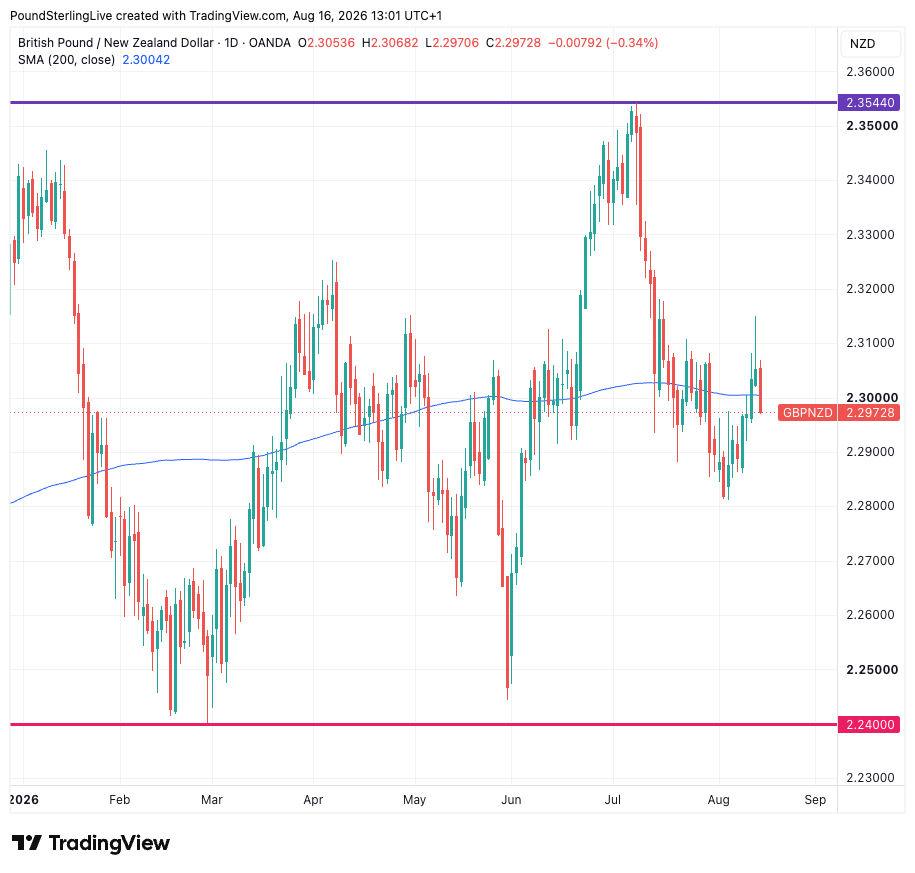

Above: GBP/NZD daily chart. Image © Pound Sterling Live, chart created with TradingView.
Spot at 2.29728 sits just below the 200-day moving average at 2.30042, having traded as high as 2.30682 in the latest session before sellers forced it back beneath the line.
That is a rejection, and it arrives exactly where the bearish reading required it: the market probed above the average, could not hold the ground, and closed back below with the session finishing in the red.
The average itself has rolled over and is falling, which compounds the significance, because a market rejected at a declining 200-day is fighting both the level and its direction.
The recovery from the 2.2830 area has nevertheless been sharp, and the sequence off that low means the bears have not had things all their own way either.
Resistance is the average at 2.30042, then the session high at 2.30682, with the July failure zone above and the range top at 2.35440 beyond.
Support starts at the early August low at 2.2830, then June's spike low near 2.2450, and beneath those the range floor at 2.24000.
Our Pound to New Zealand Dollar forecast is for the rejection at 2.30042 to hold and for the pair to drift back towards 2.2830, with a daily close above the average the development that would force a rethink.
The medium-term Pound to New Zealand Dollar forecast remains bearish while the 200-day caps the market, and this week's failure at the line is the trend behaving as it should.
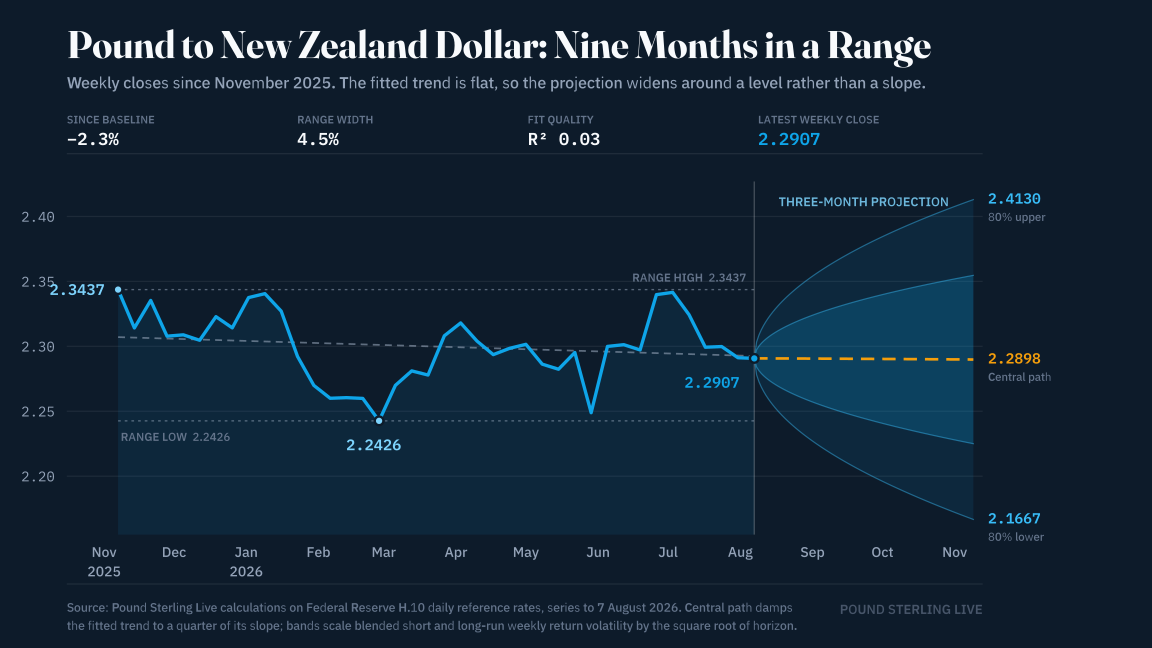
More U.S. Dollar Weakness to Help NZ Dollar
Overarching the domestic stories inherent in GBP/NZD is the U.S. Dollar, which has fallen through August and looks vulnerable to further weakness as Federal Reserve rate hike expectations recede.
That matters for this cross because of how it is constructed: GBP/NZD is simply GBP/USD divided by NZD/USD, so when the Dollar falls, both legs rise, and the cross moves according to which rises more.
The answer is consistently the Kiwi - it has a higher beta to the U.S. Dollar than Sterling does.
This means NZD amplifies moves in the broader Dollar trend, a property it owes to its commodity linkages, its sensitivity to global risk appetite and its relative illiquidity.

The Bank Consensus, Without the Terminal
The median, mean, highest and lowest from the October survey update, plus named point forecasts out to 2027.
Free information pack, issued by World Wide Currencies.
The Pound responds to the same forces, but with domestic drivers, gilt yields, Bank of England expectations and politics, diluting the Dollar signal.
The consequence is mechanical: in a falling-Dollar environment the Kiwi outruns the Pound, and GBP/NZD declines even when nothing has changed between the two economies themselves.
That dynamic is precisely what the past fortnight has delivered, and it is why analysts positioning for further Dollar weakness are expressing it through this cross.
"We have generally favoured stories where we see macro divergence but with some positive beta to a weaker USD… we retain those views in the form of short GBP/NZD," says Dominic Bunning, FX Strategist at Nomura.
"For the former we see ongoing underlying disinflationary pressures persisting in the upcoming data, while NZD can continue to benefit from RBNZ's ongoing tightening cycle and large residual short positioning," adds Bunning.
The positioning point is worth drawing out: if the market remains short the New Zealand Dollar in size, then Dollar weakness forces those shorts to cover, adding fuel to the Kiwi's outperformance.
NZD Momentum Challenged by Faded RBNZ Hike Expectations
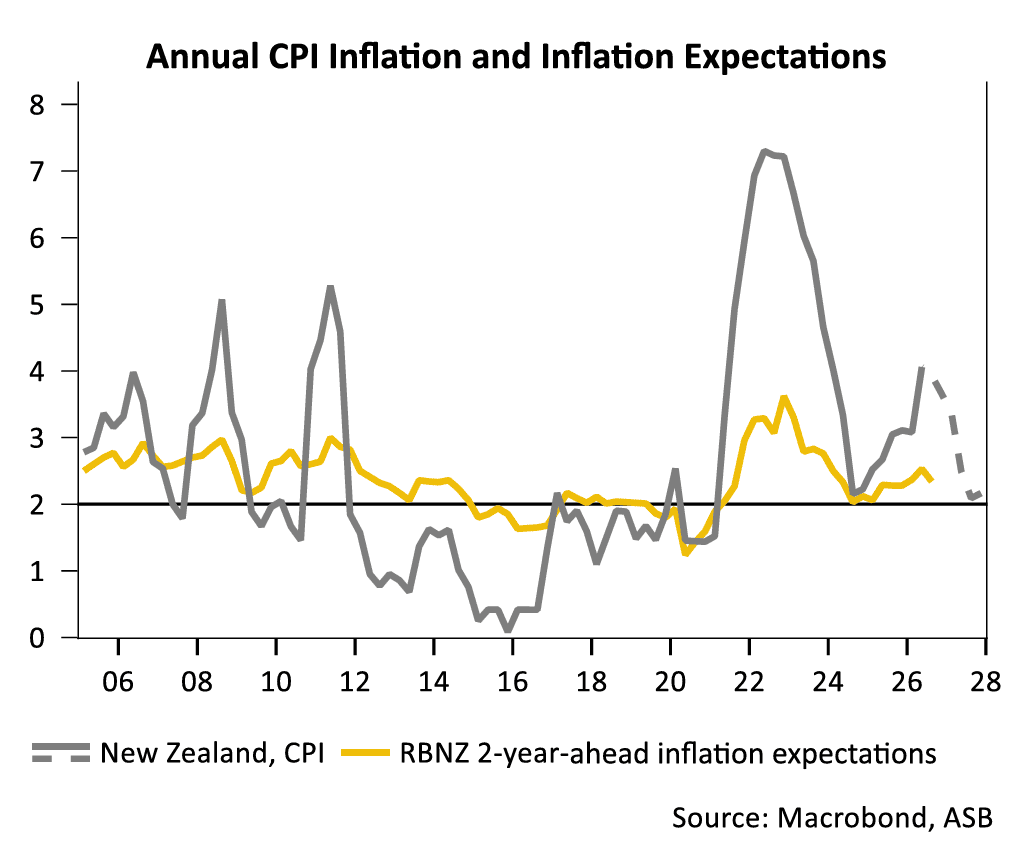
The complication for the Kiwi arrived in last week's data.
The RBNZ's household survey reported that the median one-year ahead inflation expectation declined by 0.5 percentage points to 4.5%, while the two-year ahead expectation fell 0.6 points to 3.4%.
"At the margin these results might ease the RBNZ's concerns about the potential for second-round inflation impacts," says Darren Gibbs, Senior Economist at Westpac.
We wrote last week that a softer set of expectations would be the more interesting outcome, because it would suggest the oil-driven rise in inflation is not feeding into pricing behaviour and would give the Reserve Bank room to slow down.
That is the outcome that landed, and it punctured the bullish New Zealand Dollar thesis that had been built on the tightening cycle extending.
The Kiwi's rate support has therefore softened at exactly the moment its Dollar-beta support has strengthened, which is the tension that defines the week ahead.
Sterling has its own opportunity to tip the balance, with UK labour market figures on Tuesday, inflation on Wednesday and the flash PMIs on Friday, and a hot inflation print that firms Bank of England hike bets is the clearest route to the Pound forcing that daily close above the 200-day.
For those with New Zealand Dollar payment requirements, the failure at the average argues against waiting for materially better levels in the near term, while the fading RBNZ story means the downside should be slower than the beta dynamic alone would suggest.