
Above: File image of Huw Pill. Image © Global Utmaning, Lasse Skog. Modified from original, reproduced under CC licensing, non-commercial.
The British pound can hold its recovery if Bailey validates the hawkish case Pill made on Thursday.
Bank of England Chief Economist Huw Pill has called for a "prompt" interest rate rise to counter the risk that the Iran energy shock leaves price pressures embedded in the UK economy.
Pill made the case at an Edinburgh Chamber of Commerce roundtable on Thursday evening.
Pill was one of three Monetary Policy Committee (MPC) members voting to hike in July, and he argued yesterday that an increase need not mark the start of a prolonged tightening cycle.
That looks to be an overture to other members of the MPC who worry that hikes will hit economic growth; his argument is that a hike in September limits the need for further hikes in the future.
"A prompt increase in Bank Rate may serve to head-off some of the potential insidious ‘catch up’ nominal dynamics that threaten to make temporary departures of inflation from target more persistent," he said.
The Sterling Exchange Rate Context
These rate signals are typically very important for the pound sterling, which has tended to outperform when the focus is on the UK's elevated rates.
Pill's speech didn't have a significant impact on near-term price action: the pound-to-euro rate has extended a recovery from Thursday's lows at 1.1622 to 1.1642 ahead of the weekend.
The pound-to-dollar rate is down from 1.3650, the Aug. 25 high, to 1.3542, here, the dollar leg of the trade remains dominant
Despite a recent soft patch, I would anticipate the interest rate story to percolate into ongoing support for sterling over the coming months.
The Market Expects
Markets now discount roughly two and a half further Bank of England hikes by mid-2027, and sterling's rate support is currently built on that pricing holding.
The downside risk for the pound is that the Bank doesn't deliver that, meaning a period of fading rate hike expectations await.
Bailey in Focus
Next up is the final arbiter of UK interest rate settings: Governor Andrew Bailey. He speaks at 09:50, and his caution has consistently sat at odds with Pill's position.
"We consider current market pricing of about 2½ more BoE rate hikes by mid‑2027 too aggressive," says Carol Kong, Currency Strategist at Commonwealth Bank of Australia.
"In our view, the risk lies towards Bailey using his speech to hose down expectations for interest rate hikes a little and therefore a modestly weaker GBP/USD," she adds.
Waller Pushes Against the Dollar
The pound receives a 'hawkish' tailwind from the Bank of England's Chief Economist as the dollar receives a headwind from influential Fed policy setter Waller.
"The tailwind to market sentiment from yesterday’s comments by Fed Governor Waller, indicating that he is leaning towards holding rates at the September vote, carried through to the overnight session," says Sam Hill, Head of Market Insights at Lloyds Bank.
The pushback on September hike bets bolsters global investor sentiment and helps a host of currencies recover against the dollar.
Some recover faster though: "High-beta currencies AUDUSD and NZDUSD capitalised on the weaker dollar, rising 0.35% to 0.7193 and 0.58% to 0.5882, respectively," says a daily markets briefing from Natixis.
British Debt Concerns Build
Rate hike talk aside, pound sterling remains the second-worst performing G10 currency on a five-day view, and we are told by one analyst that the reason is to do with concerns over bond markets.
"The proportion of UK government debt owned by foreign investors is relatively high compared with other G10 countries. This increases the likelihood that any gilt market jitters will also be reflected in a weaker pound," says Rabobank.
The context is a surge in global bond yields over the course of the week, with UK bond yields surging faster than comparable developed nations owing to concerns about the country's ability to service that debt longer-term.
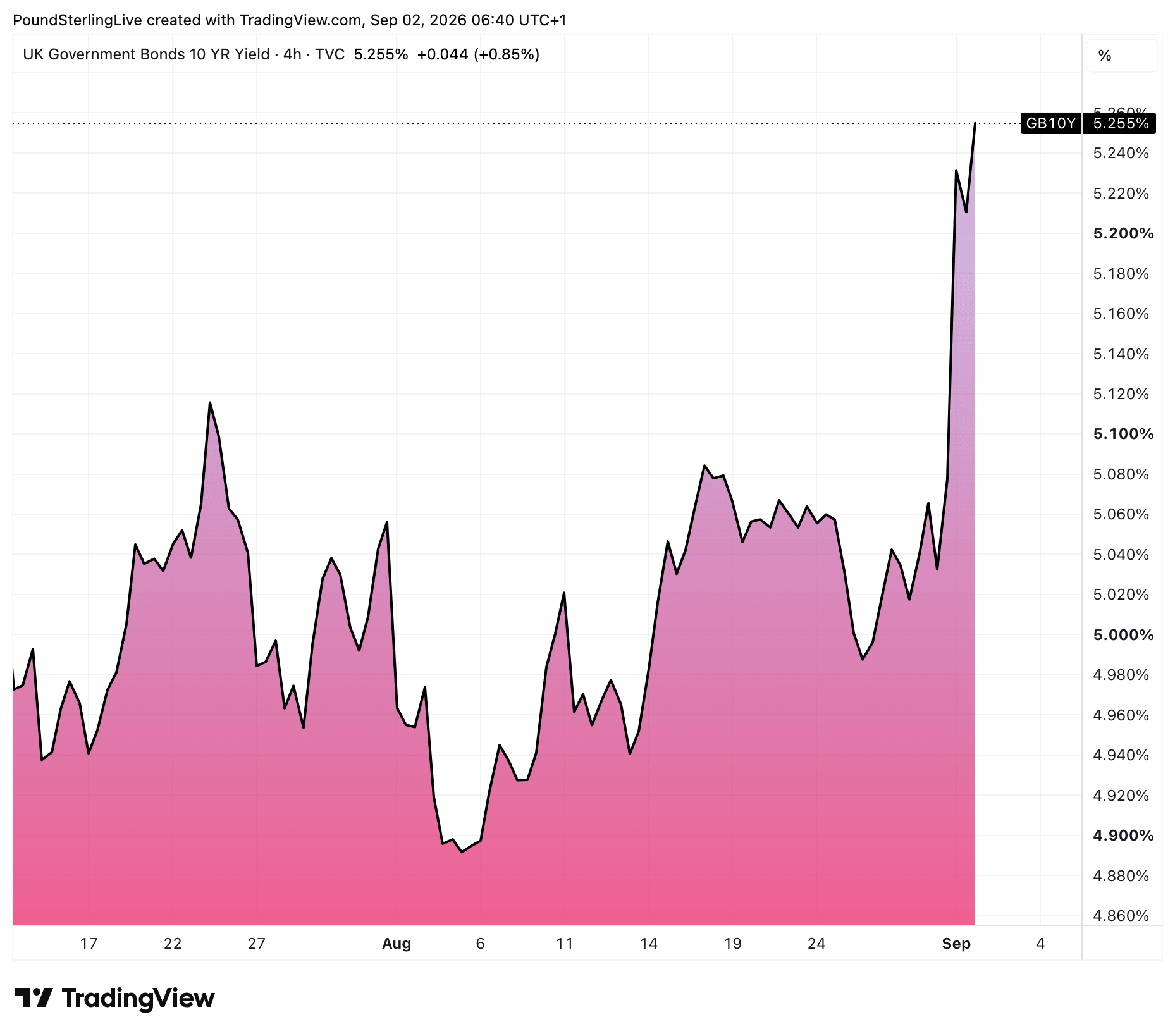
Above: UK ten-year bond yields surged this week.
Foreign investors hold around 30% of gilts according to the OBR, and the Bank of England has been shrinking its own holdings since 2022, leaving a larger share of the market with price-sensitive owners.
Rabobank looks for EUR/GBP to be biased towards 0.87 on a three-month view, equivalent to roughly 1.1494 in pound-euro terms, with the October 28 budget the anchor for that call.
"He did not rule out further tax rises or additional borrowing, and markets appeared unconvinced by the answers he gave," says Neil Parker, Head of Economics and Market Strategy at Moneycorp, of Burnham's first Prime Minister's Questions.
"Political risk now seems to be grossly underappreciated ahead of the Autumn Budget. We see it as inevitable that the Autumn Budget will bring with it a combination of higher ancillary tax rates and an increase in debt issuance in order to fund Burnham’s spending ambitions. We know that Burnham favours a heavier burden on assets and a lighter one on labour, so we could see changes to stamp duty and council tax, an introduction of a mansion tax and tighter pension and ISA relief," says Matthew Ryan, Head of Market Strategy at Ebury.

The Bank Consensus, Without the Terminal
The median, mean, highest and lowest from the October survey update, plus named point forecasts out to 2027.
Free information pack, issued by World Wide Currencies.