Image © Pound Sterling Live
The Japanese yen is entering a critical period as investors push USD/JPY into territory that could force Tokyo to respond.
According to Crédit Agricole, a break in USD/JPY above 162 has opened what it describes as the market’s "key battleground", with authorities facing growing pressure to demonstrate they will defend the currency.
"With USD/JPY clearing the important 162 level, there has been the opening of what we see as the key battleground in the exchange rate, the 162-164 region."
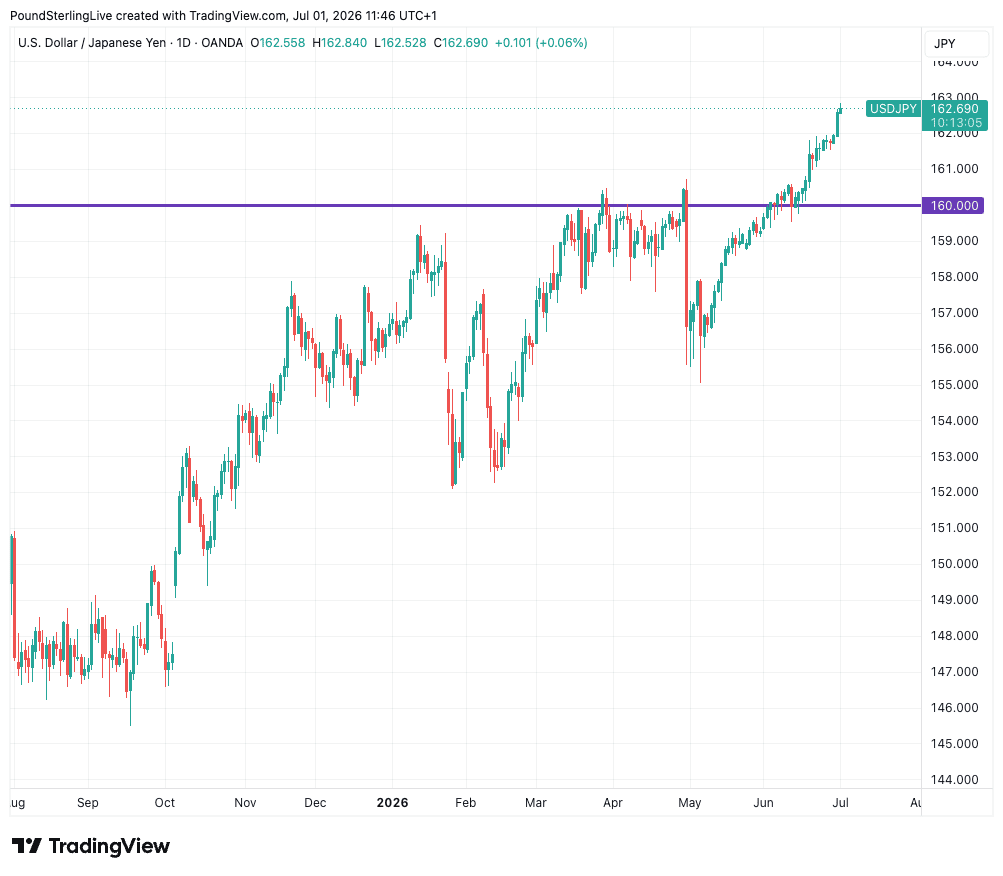
Above: I'm old enough to remember when 160 was 'the line in the sand' for authorities.
Unlike previous episodes of yen weakness, the Crédit Agricole says the exchange rate is not obviously overvalued.
"Our short-term FAST FX model suggests USD/JPY is trading around its fair value of about 162.50."
That fair value has risen alongside widening interest rate differentials between the United States and Japan, reflecting the Federal Reserve's increasingly hawkish stance.
In the near term, Crédit Agricole sees few obvious catalysts for a stronger yen; "in absence of BoJ FX intervention, it would take FOMC Chair Kevin Warsh sounding less hawkish and/or softer US economic data this week to reverse USD/JPY’s gains.”
Authorities will be uncomfortable with yen weakness as it raises import costs, adding to inflation at a time when households are already relying on government support to offset higher energy bills.
"The decline in USD/JPY… has now reached double digits accelerating its upward pressure on inflation. This will anger voters," says the Crédit Agricole analysis.
That leaves Prime Minister Sanae Takaichi facing an increasingly delicate balancing act.
While her government continues to enjoy solid public support, Crédit Agricole believes political pressure could mount if the currency weakens much further:
"The government could be forced into showing that it is doing something about the weak currency."
The stakes become even higher above 164.50.
"Above 164.50, the technical analysis picture for USD/JPY becomes even more bullish as the post-Plaza Accord collapse in the exchange rate begins to be unwound."
Such a move could also complicate relations with Washington.
The bank notes that Japan remains on the U.S. Treasury’s currency watch list, while Treasury Secretary Scott Bessent has previously argued Japan should support the yen by normalising monetary policy rather than relying on intervention.
Indeed, with the government subsidising citizens to cushion against inflation, the Bank of Japan's base rate should be far higher. That it isn't is the yen's real handicap.