
Image © Adobe Stock
Sterling has been dragged to a 2026 low against a yen now trading on rate expectations that leave little room for disappointment.
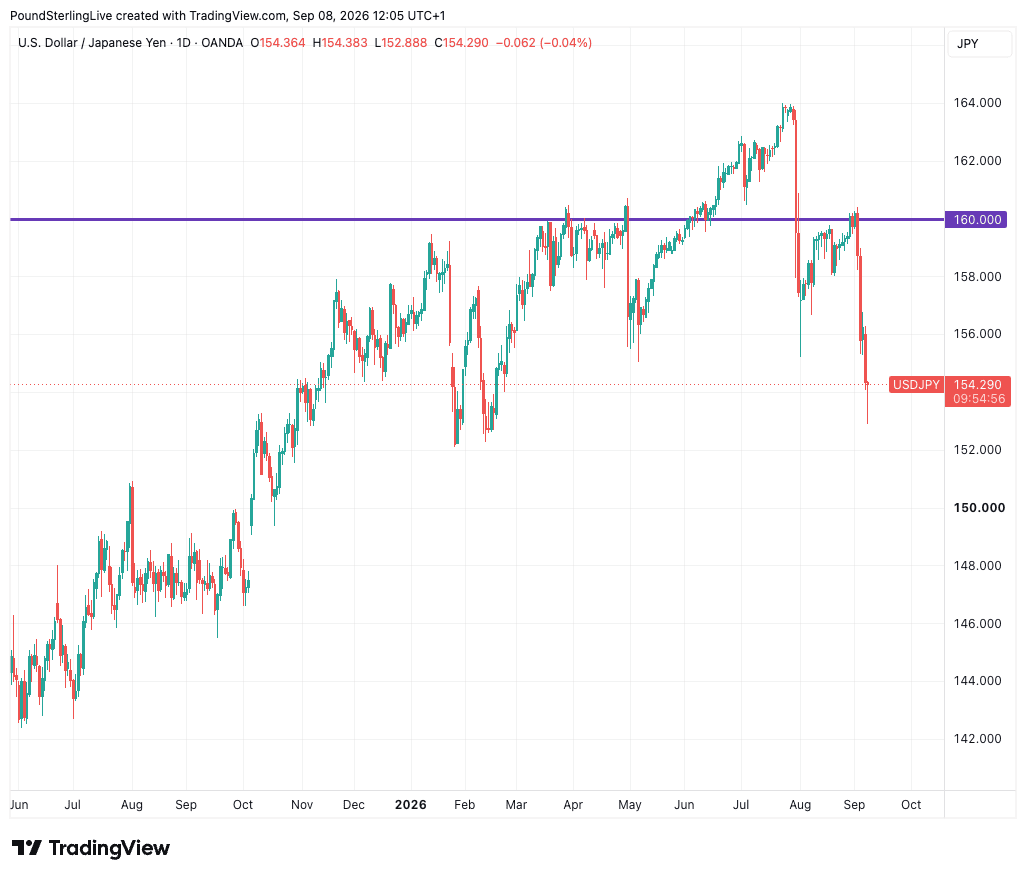
The yen is dictating terms across the currency board on Tuesday: dollar-yen fell to 152.89 overnight, its weakest since February, before recovering towards 154.
The pound-to-yen exchange rate went with it, printing a fresh 2026 low at 207.00 before steadying near 208.20.
That is a fall of close to four per cent for the pound since September 1, while euro-yen has broken below 178 for the first time since November.
The rate story
The cleanest reading behind the yen's advance is the widening gap between what is priced for the Bank of Japan and what is priced for the Federal Reserve and other central banks.
"Markets assign an 80% chance of a BoJ move on September 18, and 111bps of total tightening until end-2027, compared to just 50bps of hikes over the next 16 months in the case of the Fed, with the chances of a rate hike next week being split," says Achilleas Georgolopoulos, Senior Market Analyst at XM.
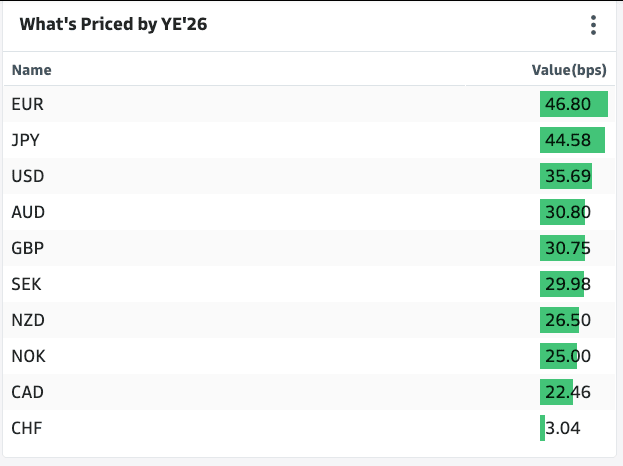
The market looks for the Bank of Japan to hike more than most.
Tuesday's Japanese data reinforced that divergence, with second-quarter GDP revised higher and July total nominal wage growth quickening to 4.7% year-on-year against a consensus of 3.8%, the fastest pace since 1997.
The detail was less emphatic, with scheduled pay growth for full-time workers unexpectedly slowing to 2.7% from 2.9% in June.
Danske Bank notes that Takuji Aida, economic adviser to Prime Minister Takaichi and among the most vocal opponents of tightening, now expects a hike at the 17-18 September meeting and another by January.
"Upward momentum extends further lowering USD/JPY back below 153.00," says Lee Hardman, Senior Currency Analyst at MUFG, which on Monday said was JPY risks are tilted upward as momentum turns.
The flow story
Brown Brothers Harriman reads sees additional drivers behind the Japanese yen's advance.
"JPY's recent overshoot has come despite no meaningful hawkish BOJ repricing and a modest pullback in longer term JGB yields," says Elias Haddad, Global Head of Markets Strategy at BBH.
"This points to a flow driven JPY rally, supported by possible repatriation flows by Japan's government pension fund (GPIF), and amplified by an unwind of speculative net short JPY positions," he adds.
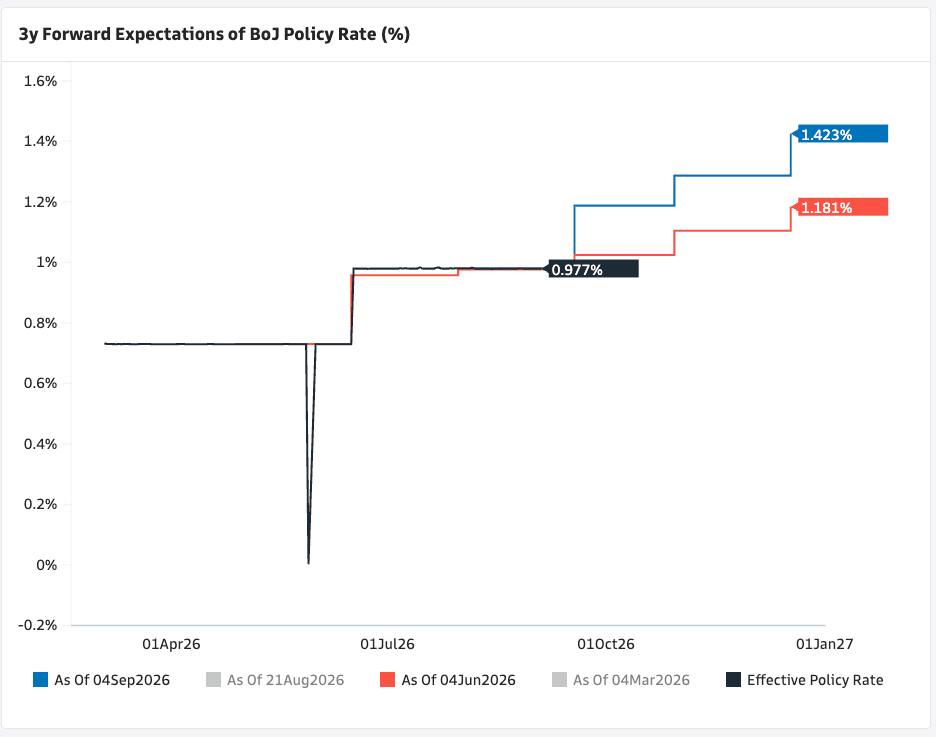
Above: The market has lifted the amount of tightening expected from Japan this year.
Japan's health minister Ueno said on Tuesday that GPIF is still considering whether a review of its asset allocation is needed.
BBH puts USD/JPY support at 152.00, the January-February double bottom, with resistance at 155.00, and sets out four outcomes for next week's central bank pairing.
"In our view, a jumbo 50bps BOJ hike next week cannot be ruled out," says Haddad.
That's an eye-opening call in the context of Japan's long-established ultra-low interest rate environment which has for so long proven a headwind to JPY upside.
The intervention story
Meanwhile, intervention by authorities is the whisper on analyst desks.
"The yen has been rising in recent weeks due to a mixture of intervention and US official pressure to strengthen the Japanese currency," says Kathleen Brooks, research director at XTB.
"This move has the signs of hidden intervention because this move is not supported by a move higher in bond yields," she adds, noting the 10-year JGB yield has fallen below 3% this week and that Japan's Ministry of Finance has sold $90bn in Treasuries in recent weeks to fund intervention.
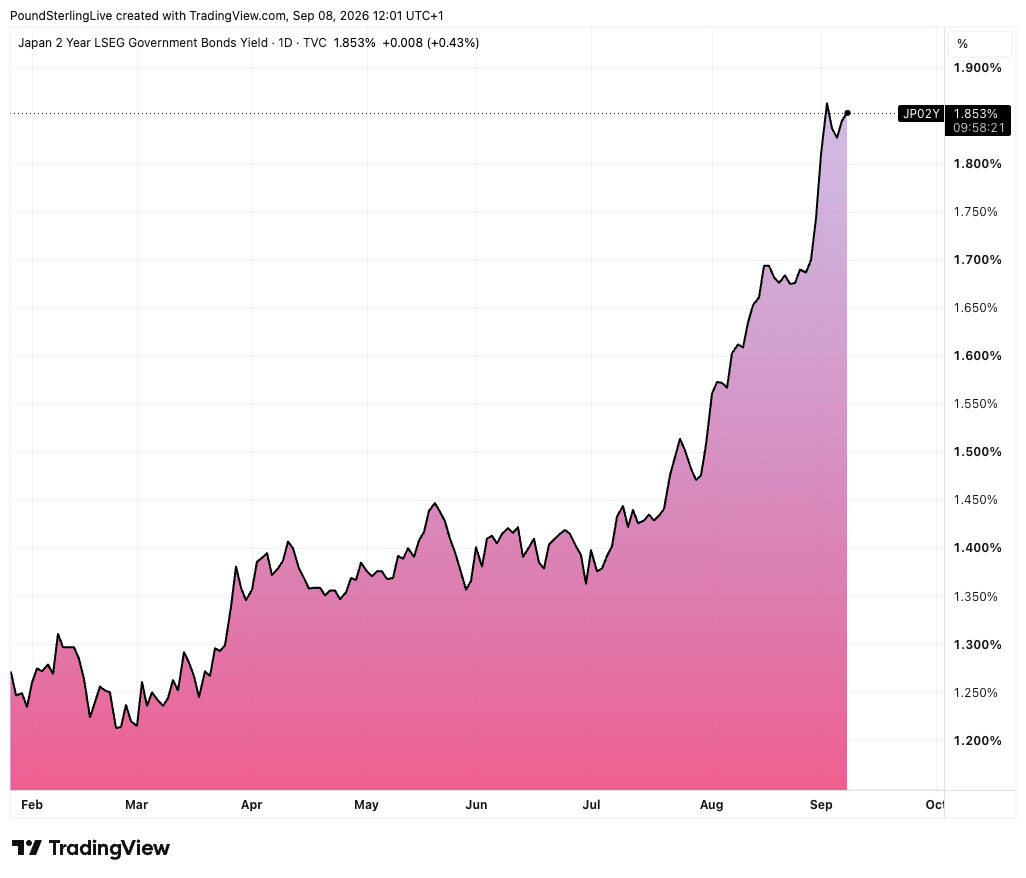
Above: Once negative, Japan's two-year bond now offers Japanese investors real returns, lowering the need to chase foreign investment opportunities.
Finance Minister Katayama said Tuesday that Japan's stance on currencies has not shifted since the joint intervention with the US, and that the aim is an orderly market.
"Without a move higher in JGB yields, it is hard to see how the yen can organically maintain its recent bout of strength," says Brooks.
"It would appear that official sources are unwilling to allow the USD/JPY to rise above 160, so this week's move could be designed to anchor this pair well below this key level," she adds, concluding that a break below 150 is now more likely than a return above 160.
The carry unwind
For deVere Group the mechanism is the forced closure of one of the largest borrowed-money trades in markets, worth an estimated 360 trillion yen, or around $2.35 trillion.
"Right now, that trade is unravelling fast, and when a trade this size unwinds, it shows up in ordinary portfolios around the world," says Nigel Green, CEO of deVere Group.
"It was set off by automatic sell orders built into trading systems, designed to fire once the currency hit certain levels," he adds.
"Moves like this tend to overshoot before they calm down, and this overshoot is where the real damage to portfolios often happens."
The yen has gained close to 5% this month against the Mexican peso and Turkish lira, the two other favoured funding-trade destinations.
Not 2024
Societe Generale has gone back to the summer of 2024 for a template and found the comparison breaks down.
The near 7% correction in dollar-yen since the start of August is roughly half the 2024 collapse, and the surrounding conditions are absent.
US chipmakers rallied by almost 20% in August and European shares are up just over 6%, where the 2024 unwind followed a $1 trillion drawdown in AI and technology valuations.
"The muted reaction so far in the VIX suggests there has no urgency to cover leveraged positions through outright sales to meet margin calls," says Kenneth Broux, FX Strategist at Societe Generale.
Broux also questions how much further repricing is available, with close to four BoJ hikes already priced by mid-2027, which puts the onus on pension rebalancing flows and the Fed's chosen path.
"For now, monthly MoF flow data track closely with our rebalancing estimates and do not point to a meaningful change in investor behaviour," he says.
JPY Rally Could Disappoint
ING titled Tuesday's FX Daily "Fight the yen at your own risk", judging the rally to be leaning on optimistic assumptions about tightening and GPIF reallocation, amplified by thin liquidity over the US holiday.
The Dutch bank doubts the move is sustainable beyond the near term but says "it remains risky to stand in its way", flagging 152.00 as the next meaningful support and 150.00 beyond it.
Bank J. Safra Sarasin reaches a similar landing point by a different route.
"In spite of a number of bullish yen catalysts, we caution that headwinds persist, including strong US data, high energy prices, and concerns over the sustainability of Japanese debt, implying that the yen's rebound is built on shaky ground," says Claudio Wewel, FX Strategist at Bank J. Safra Sarasin.
Bank of America is on the other side, having dropped its dollar bullishness while retaining conviction on the yen.
"Short USD/JPY an exception on our bullish yen conviction," the bank says, adding that "JPY sentiment has turned as flow of funds backdrop improves".
BofA opened a short CHF/JPY on 9 June at 201.15 targeting 190.00, reached that target this week and has reset the objective at 180.50 with a stop at 196.
Where GBP/JPY sits
The pound's problem is that none of these explanations requires sterling to do anything wrong.
Tuesday's break to 207.00 took out the February 27 low and confirmed a decisive move through the 209.20 neckline of the head and shoulders pattern that had defined the summer range.
The daily RSI has entered oversold territory near 26, which argues for corrective bounces without changing the direction of travel.
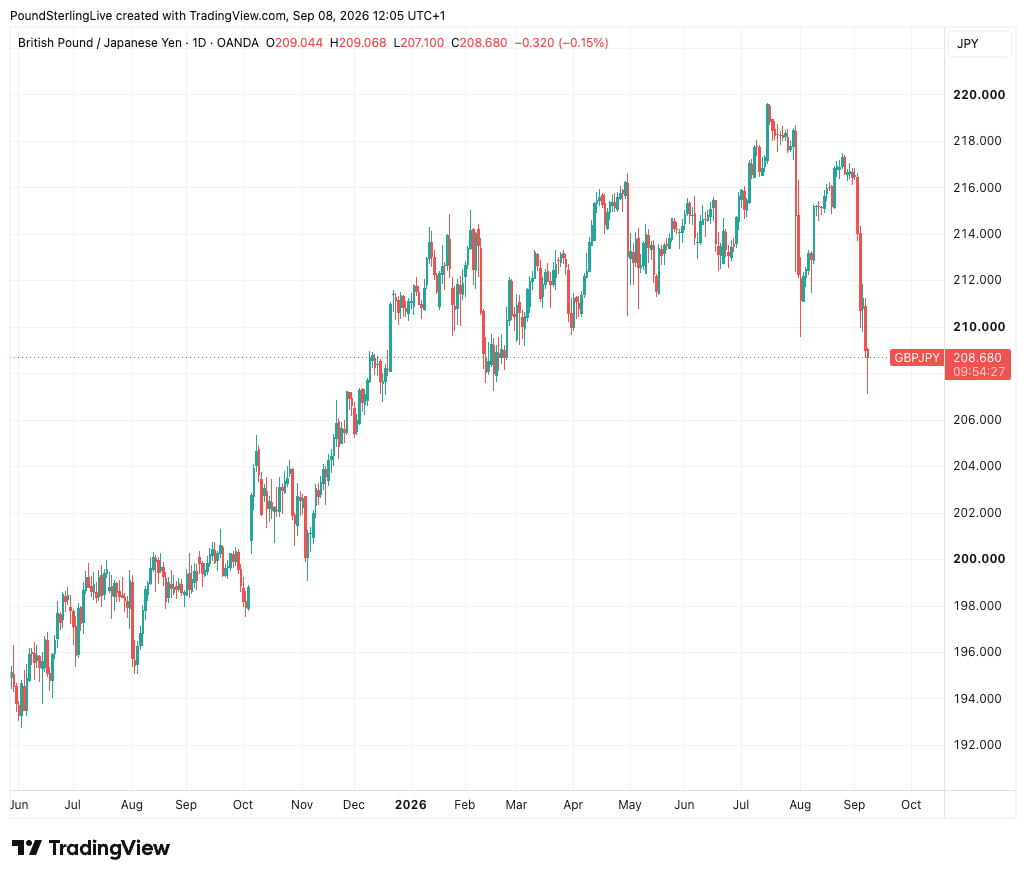
Above: GBP/JPY at daily intervals.
Sterling has held its own elsewhere, with the pound to dollar exchange rate idling around 1.3550 ahead of Governor Bailey's Treasury Select Committee testimony, the Bank of England's first policy update since the 30 July meeting.
Brent crude within a whisker of $100 has pushed the UK 10-year gilt yield to within basis points of a fresh 18-year high and the two-year to 4.5%, which raises the odds of a Bank of England hike before year-end even as XTB expects a hold in September.
That matters because the pound needs its own repricing story to keep pace, and Bank J. Safra Sarasin does not expect one, forecasting sterling to soften as UK policy rate differentials shrink.
Should the Bank of Japan deliver 25 basis points on 18 September and the Fed hold two days earlier, the 152.00 floor in dollar-yen gives way and the pound's next reference point below 207.00 is the 200 handle it has not traded under since January 2025.