
Picture by Simon Dawson / No 10 Downing Street
Alongside the central bank calendar, pound sterling is on the lookout for Andy Burnham to announce new spending giveaways this week.
The Prime Minister has established a clear operating rhythm in his first days in office, delivering three giveaways in three days: a VAT cut on electricity bills, a cap on bus fares and a business rates cut for pubs and entertainment venues.
Economists judged those measures too small to shift the fiscal dial, describing them as political messaging designed to generate friendly headlines, but what's reported to be coming next is in a different weight class.
National media report the Prime Minister is due to unveil his flagship social care plans, a massive expansion of care housing and nursing homes under the National Care Service concept he has championed since serving as Health Secretary in 2010, with the Health Foundation estimating the measure would cost £18.5BN a year.
Housing looks queued behind it: Burnham made a homeless shelter his first visit as Prime Minister, has pledged an expansion of publicly owned housing, and is being pressed by think tank IPPR North to take his 'A Bed Every Night' programme nationwide.
The funding side is also being briefed, with Burnham having floated a 'care levy' on inheritances to fund the care service, and the Mail on Sunday reporting he could lower the mansion tax threshold from £2 million to £1.5 million.
Hovering above it all is the personal allowance question, which the Prime Minister has kept deliberately alive with a yes-no-maybe routine that guarantees the topic stays in the headlines until the budget.
The Bills are Adding Up
Each announcement, however individually modest, contributes to the same macro direction of travel: an easier fiscal stance that feeds the UK's higher inflation run rate and, through it, the lift in UK yields.
That connects directly to the rates channel underpinning our constructive Pound-Euro view: the UK's high beta to inflation means spending headlines translate into firmer UK short rates faster than equivalent news moves European ones.
The rule for the week is therefore straightforward: anything inflationary means higher yields and a higher Pound.
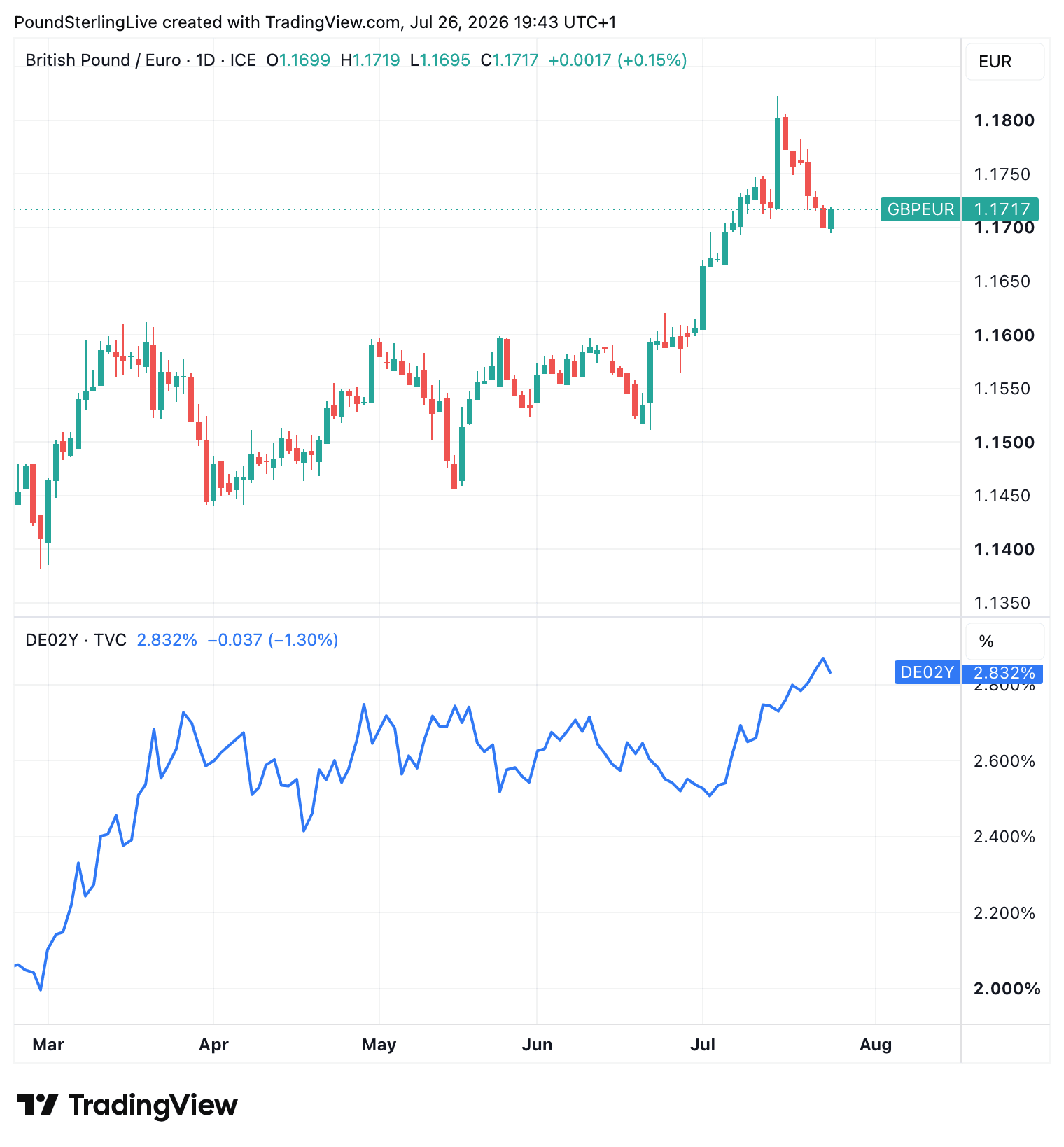
Above: GBP/EUR top is supported by the faster rise in UK short-term yields relative to elsewhere (in the case of the chart, it's against Germany, see lower panel.
But the rule carries a BIG RISK on its other side.
The support for the pound only holds while markets believe the giveaways will ultimately be funded, and an £18.5BN-a-year care commitment is exactly the scale at which the yield rise can mutate from a rate expectation story into a risk premium story; whether the accompanying levy and property tax reports read as credible funding will decide which.
We know what that looks like because we saw it last Monday in miniature, when Burnham's fiscal-rules "flexibility" comments sent gilts and Sterling lower in tandem, and we have seen its full force before, from the Truss mini-budget to the 2025 welfare rebellion.
When bonds and the currency fall together, the market is no longer pricing the Bank of England; it is pricing Britain.
So the week's watchlist is really one question asked repeatedly: does each Burnham headline read as funded generosity or fiscal drift?
The first keeps the Pound's yield support intact and the 1.1750-1.1800 targets in play; the second is the scenario in which gilts and Sterling fall sharply together, and no technical support level argues with that.

The Bank Consensus, Without the Terminal
The median, mean, highest and lowest from the October survey update, plus named point forecasts out to 2027.
Free information pack, issued by World Wide Currencies.