
Image © Adobe Images
Energy prices and the Trump-Xi summit will steer currencies in a week short of tier-one central bank decisions.
None of the Bank of England, European Central Bank, Federal Reserve, Reserve Bank of Australia, Bank of Canada or Reserve Bank of New Zealand sets policy in the coming week, leaving global drivers to direct the major currencies.
The Dollar was the best-performing major currency last week, lifted by the Fed's first rate hike since 2023 and a slump in the Yen, while the New Zealand Dollar was the weakest of the six currencies covered here.
Investment bank analysts expect the September flash PMIs, due Wednesday, to show how far the renewed rise in energy prices is biting into activity across the major economies.
"Next week's September S&P Global PMI readings will likely show US maintaining its growth edge over the Eurozone, UK, and Japan," says Elias Haddad, Global Head of Markets Strategy at BBH.
Oil Prices Will be the Main Global Driver
The weekend delivered the first test for markets: oil and liquefied natural gas shipments through the Strait of Hormuz over the past fortnight reached their highest level in six months, according to US Central Command.
"Clearly, momentum is building," said Admiral Brad Cooper, head of US Central Command, in a video message on Saturday.
Iran maintains it has closed the strait, and regional talks on agreed shipping routes have stalled.
Brent crude remains above $100 a barrel, and the energy shock from the Iran war has already pushed the Fed, the ECB and the Bank of Japan into rate hikes this month.
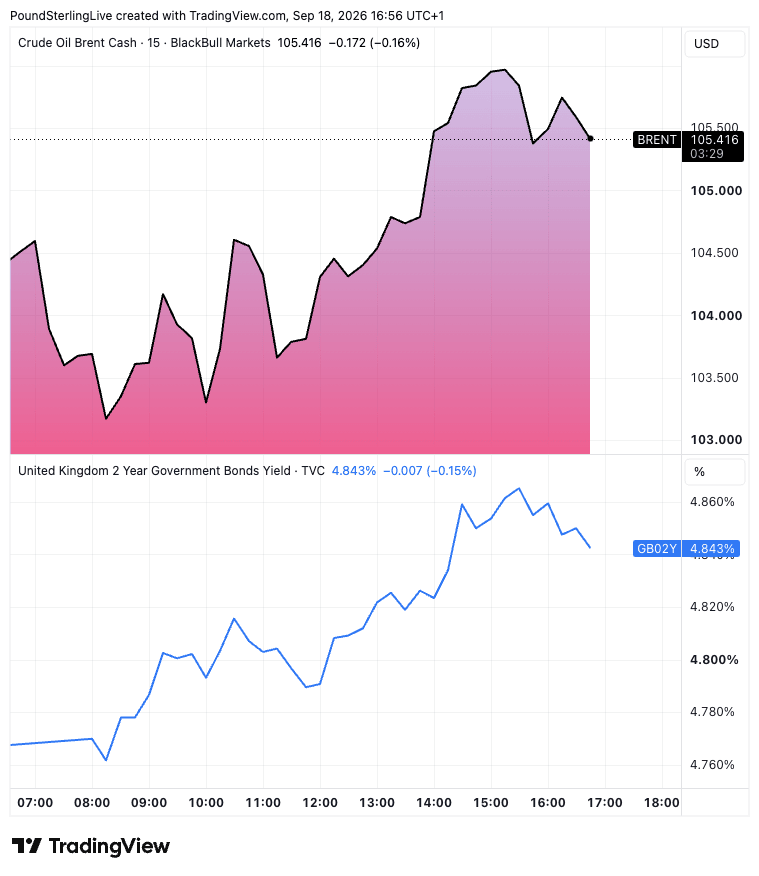
Above: Brent crude pushed bond yields higher on Friday, that drove GBP higher against EUR.
A sustained rise in Hormuz flows would ease the pressure behind the hawkish repricing of global interest rates that has lifted the Dollar.
The Fed is counting on lower oil prices ahead "from some progress in getting tankers moving through the Straits," says Avery Shenfeld, Chief Economist at CIBC Capital Markets.
Yet, "with no negotiations underway to end the Persian Gulf impasse, and some downside uncertainties about the pace of AI capital spending, we see growth risks tilted downward, and inflation risks from energy prices tilted higher," he adds.
Trump-Xi
Thursday's meeting between Presidents Trump and Xi in Washington is the week's second global trigger.
"The timing matters: the current US-China trade truce expires on 10 November, putting an extension at the top of the economic agenda," says UniCredit.
UniCredit judges a grand trade deal unlikely and sees an extended truce with a few tangible wins for both sides as the realistic goal, with pre-summit talks centred on lower or zero tariffs on roughly $30BN of non-strategic goods from each side.
🇬🇧 Pound Sterling: Surprising Resilience
The Pound fell 0.98% against the Dollar last week after the Bank of England held Bank Rate at 3.75% while the Fed, ECB and Bank of Japan all hiked; its decision to halt sales of its longest-dated gilts added further weight on Sterling.
The pound-to-dollar rate closed Friday at 1.3395, while the pound-to-euro rate held flat at 1.1661, reflecting near-identical losses for both currencies against the Dollar.
The GBP's losses against EUR would have been more severe were it not for a late-Friday rally, linked to a jump in global bond yields, which were in turn a result of rising oil and gas prices.
The key data event for the coming week are PMIs for September, where we could get further evidence the UK economy continues to weather the energy storm.
"We nevertheless forecast the UK Composite PMI to edge up to 52.7 from 52.5, indicating resilient business activity despite a more uncertain backdrop," says Lloyds Bank's Market Insights team.
The Bank of England's 6-3 vote to hold rates hit the pound on Thursday, although the pair largely saw much of the weakness reversed by the close of the week, pointing to enduring resilience in sterling.
MPC members Swati Dhingra, Sarah Breeden and Clare Lombardelli speak this week, and Sanjay Raja, Chief UK Economist at Deutsche Bank, says their remarks matter mainly for how convinced the committee is of a November move.
Governor Andrew Bailey said last week a hike hinges on whether "the Middle East persists for an extended period, as appears to be the case, and the risk of second-round effects emerging increases."
"We remain comfortable forecasting two 25bp hikes to Bank Rate, in November and February 2027," says Rob Wood, Chief UK Economist at Pantheon Macroeconomics.
Tuesday's public finance figures open the countdown to Chancellor Healey's first Budget, with Deutsche Bank expecting August borrowing to jump to £17.3BN and warning the Chancellor's headroom has shrunk as 10-year gilt yields hold above 5%.
The budget remains the single most important near-term headwind to the pound.
🇪🇺 Euro: Struggling for Traction, PMIs in Focus
The Euro fell 0.97% against the Dollar last week as rising US yields and renewed energy pressure on the Eurozone's terms of trade pushed the euro-to-dollar rate below 1.15, despite the ECB's hike to 2.5% the week before.
ING now expects a further ECB hike after this month's hawkish decisions, putting Wednesday's PMIs at the centre of the Euro's week. "That will be especially interesting in the euro area, where surprisingly strong growth over the summer has made it easier for the ECB to tighten monetary policy," says Danske Bank. UniCredit forecasts the composite PMI easing to 51.5 from 52.0 as higher energy costs take some shine off new orders, with Germany's Ifo survey to follow.
Sunday's state elections in Mecklenburg-Western Pomerania and Berlin land ahead of Monday's open, while Italy's 2025 deficit revision on Tuesday and Moody's review on Friday put Eurozone fiscal risk back in view.
Rate decisions from the Swiss National Bank and Riksbank on Thursday and from Norges Bank will steer Euro crosses.
"We believe that strong underlying US growth momentum, the Fed's continuing tightening cycle and persistently elevated energy prices will maintain EUR/USD on a declining trend, targeting 1.12 in 12M," says Danske Bank.
🇺🇸 US Dollar: Risks to the Upside
The Dollar outperformed every major currency last week after the Fed raised rates by 25 basis points to 3.75-4.00% in a unanimous vote and its dot plot signalled another hike in the fourth quarter.
A 2.1% gain against the Yen, after the Bank of Japan's cautious hike, turbocharged the move.
Markets assign a probability of just over 50% to an October hike, shortly before the November 03 midterm elections, according to Lloyds. "Going forward, tightening by other major central banks limits policy divergence with the Fed and suggests USD is unlikely to make new cyclical highs," says Haddad. "But the US growth advantage relative to other major economies skews USD risk to the upside," he adds.
The US calendar is light, with Thursday's new home sales the highlight alongside durable goods orders, regional manufacturing surveys and Fed speakers, and Wells Fargo expects sales to rise 2.6% to a 623K pace in August. USD/JPY near 157 is a cross-market risk, with BBH warning that intervention risk rises as the pair nears 160.
🇦🇺 Australian Dollar: Labour Force Survey
The Australian Dollar was the best performer of the non-US currencies covered here, slipping just 0.64% against the Dollar as elevated energy prices and firm rate hike expectations cushioned it, leaving the pound-to-Australian dollar rate 0.3% lower at 1.8800. "The market was only too happy to add a little more to September hike pricing, now sitting at 90%, with plenty of pressure now on the RBA to deliver," says Commonwealth Bank of Australia.
Thursday's August labour force survey is the domestic highlight for the coming week. "Consensus expects Australia's August employment report to show a rebound in hiring after July's decline, which would reinforce our call for the RBA to raise the Cash Rate by 25 bps in September," says Wells Fargo.
Westpac has also brought its RBA call forward to September, while CBA says the jobs data may carry more weight for November.
Governor Michele Bullock, the Assistant Governor (Economic) and a Monetary Policy Board member all speak during the week, and Thursday's Trump-Xi summit adds a China-facing risk for the Aussie.
🇨🇦 Canadian Dollar: Macklem Speaks
The Canadian Dollar fell 0.81% against the Dollar last week, with higher oil prices limiting its losses, and the pound-to-Canadian dollar rate eased 0.2% to 1.8732.
Bank of Canada Governor Tiff Macklem speaks in Halifax on Monday, and National Bank of Canada expects him to offer insight into how tariffs and rising energy prices bear on the policy path.
Canadian inflation held at 3.0% in August, with the preferred core measures, CPI-median and CPI-trim, at 2.0% and 1.9%."Headline sales may have fallen by 0.8% month-on-month, as consumers were probably forced to reduce discretionary spending in order to cope with rising energy costs," says National Bank of Canada of July's retail sales report.
The Loonie's support from oil leaves it exposed to any sustained recovery in Hormuz flows.
🇳🇿 New Zealand Dollar: Reliant on Risk Sentiment
The New Zealand Dollar was the weakest of the six currencies last week, falling 1.57% against the Dollar, and the pound-to-New Zealand dollar rate rose 0.6% to 2.3406.
Danske Bank says the risk-off backdrop has weighed on high-beta currencies, leaving the Kiwi among the weakest G10 performers over the past month, even as second-quarter GDP data firmed expectations for an RBNZ rate hike. The domestic calendar offers little beyond Westpac-McDermott Miller employment confidence.
The Kiwi therefore rests on global risk sentiment and Thursday's Trump-Xi summit, where an extension of the US-China truce is the likeliest trigger for recovery.