

Image © Adobe Stock
The euro risks further losses against the dollar this week as France's private sector shrinks and the Federal Reserve keeps raising interest rates.
The euro-to-dollar exchange rate's direction this week depends on whether Wednesday's U.S. inflation figures keep the Federal Reserve on course to raise interest rates again in December, while France's shrinking private sector and Friday's review of its credit rating keep the focus on the euro's weaknesses.
Last week the pair fell from 1.1033 to a 2026 low of 1.0953 on 18 November and starts this week at 1.0973, as Fed officials including Christopher Waller argued the central bank may need to act more aggressively against inflation. Higher expected Fed rates lift U.S. bond yields and draw in foreign investors who need dollars to buy those bonds, which pulls EUR/USD lower.
The recent selling has kept EUR/USD well beneath its 21-day moving average, which has fallen steadily since early September to 1.1100, the level that held the pair up through October:
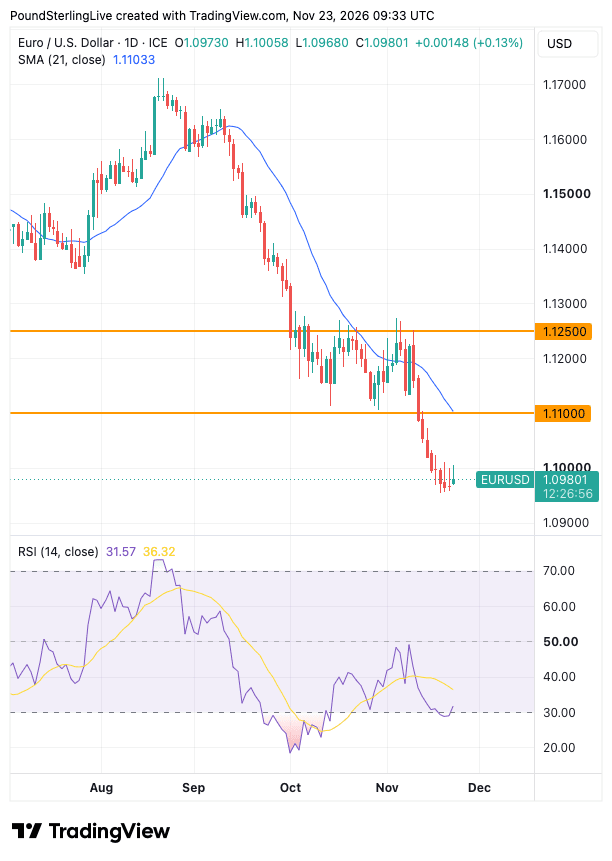
Above: EUR/USD at daily intervals with the 21-day moving average (blue), the 1.1100 and 1.1250 levels (orange) and the RSI in the lower panel.
The 21-day moving average, the blue line, is the pair's average closing price over the past 21 trading days, roughly a month of trade. Pound Sterling Live's mean-reversion modelling treats it as the level the pair tends to return to after a large move away from it.
EUR/USD has narrowed its gap to the average to 1.2% from 1.5% on 18 November, because the falling average has come down towards spot during a week of sideways trade. That is the consolidation the modelling looks for after a sharp fall.
What does the RSI in the lower panel tell us? It measures the speed of recent price moves on a scale of 0 to 100, and a reading below 30 marks a pair as oversold and due a pause. EUR/USD's RSI fell below 30 last week but has since edged back to 32.
The last oversold reading, in early October, gave way to a month of sideways trade between 1.1100 and 1.1250 before the next leg lower.
Pound Sterling Live expects the current pause to end the same way.
Resistance sits at 1.1100, where the falling 21-day average meets the floor of the old October range, so a rebound to that level would run into the short-term downtrend, making it a level that can frustrate recoveries.
Support sits at last week's low of 1.0953, a floor the pair tested and held on three consecutive days, and UOB, the Singapore-based bank, says a daily close below 1.0950 would open the way to 1.0925.
Pound Sterling Live looks for EUR/USD to stay below 1.1100 this week, although a break of 1.0950 may have to wait until the dollar has cleared a holiday-shortened week.
A daily close above 1.1100 would change the near-term Euro to Dollar forecast, because it would lift the pair back above its falling 21-day average and into the old October range, a sign buyers had absorbed the selling.
On a medium-term view, the falling 21-day average confirms the downtrend that has taken EUR/USD down from 1.1711 on 21 August.
"Stronger domestic demand will allow the Fed to extend its hiking cycle further than peers, and we drop our 6-12M EUR/USD forecast down to 1.07," says Danske Bank in a recent update.
Last week's Week Ahead Forecast looked for a break below 1.10 with 1.1100 capping any rebound: the pair fell to 1.0953 on 18 November and traded no higher than 1.1033 all week.
The Euro Faces France's Downturn and an S&P Ratings Review
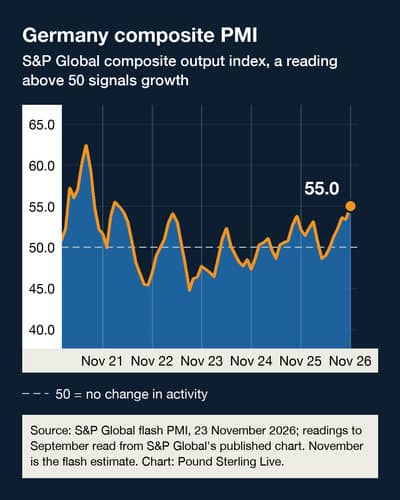
Beyond the chart, Monday's November business surveys showed France's private sector shrinking at its fastest pace since May, with the composite PMI at 46.2 against the 47.8 economists expected, according to S&P Global's flash data.
Purchasing managers' indices are monthly business surveys, the earliest read on an economy, in which a reading above 50 signals growth and one below 50 contraction.
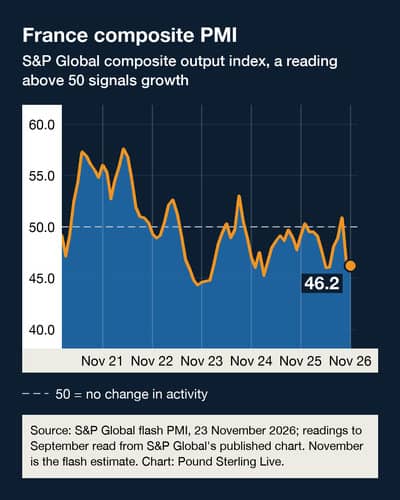
Germany's composite index rose to 55.0, its highest since March 2022, but the euro area as a whole held at 51.7, short of the 51.9 expected.
"We expect French-specific risks to sustain the EUR as the market's preferred funder for a while," says a new FX market analysis from Barclays.
Investors borrow a funding currency to buy higher-yielding assets elsewhere. Borrowing euros for that purpose means selling them.
S&P Global Ratings reviews France's A+ credit rating on Friday, after Fitch Ratings moved its own outlook on France to negative, a warning that a downgrade may follow, on 30 October.
"Weak growth, widening fiscal deficits, and political gridlock raise the risk of a downgrade or a shift to a negative outlook. That would widen French 10-year bond yield premium over Germany and undermine EUR," says Brown Brothers Harriman.
France pays more than Germany to borrow for ten years. Investors read a wider premium as stress in France's public finances and sell euros in response.
Under the playbook, a downgrade or a move to a negative outlook would weigh on the euro.
The European Central Bank offers the euro some support, with money markets attaching a probability of more than 90% to a December rate rise.
Because that rise is already expected, the euro gains only if the ECB signals further rises to come.
The ECB's minutes of its October meeting and Germany's Ifo business survey are second-tier releases.
U.S. Inflation Must Cool for the Euro to Recover
On the dollar side, EUR/USD will take its lead from Wednesday's PCE inflation figures for October, the Federal Reserve's preferred inflation measure, due at 13:30 UK time.
Economists expect core prices, which strip out volatile food and energy costs, to rise 0.3% on the month, lifting the annual rate to 3.2% from 3.1%.
Under the playbook, a reading above economists' forecasts would add to bets on a December Fed hike and push EUR/USD lower.
A reading below forecasts would weigh on the dollar and give the euro room to recover.
"Based on the already released CPI, we estimate US PCE inflation increased by 0.2%/mth, below the consensus estimate of 0.3%/mth. Weaker US inflation will weigh on US interest rates and the USD," says Commonwealth Bank of Australia.
A soft reading would catch out a market heavily positioned against the euro: Goldman Sachs's measures show it is the most heavily bet against of 24 currencies, measured against its own history.
When too many investors hold the same bet against a currency, a surprise forces them to buy it back at once, which makes any rally sharper.
Monday's U.S. flash PMIs for November come first, at 14:45 UK time, after October readings of 56.1 for services and 54.9 for manufacturing.
Under the playbook, a slowdown in U.S. activity would weigh on the dollar and lift EUR/USD.
Commonwealth Bank of Australia also expects the dollar index, a measure of the dollar against six major currencies, to stabilise this week as safe-haven demand from last week's sell-off in technology stocks fades.
Investors move money into assets they regard as safe, such as the dollar, when stock markets fall, and that demand eases once markets steady.
Brown Brothers Harriman expects the dollar's rally to lose steam this week, because the dollar index has risen further than the gap in interest rates between the U.S. and its peers justifies.
U.S. markets are closed on Thursday for Thanksgiving.
Pound Sterling Live sees room for a bounce in GBP/USD as the dollar steadies.
The euro's French troubles leave it less able to recover against a softer dollar, so a pullback in the dollar would favour the pound over the euro and lift the pound-to-euro exchange rate from 1.1945.
Pound Sterling Live's Euro to Dollar forecast looks for EUR/USD to stay below 1.1100 this week, with France's shrinking private sector and Friday's S&P review keeping the euro behind other currencies in any dollar pullback.