
Image © Adobe Images
Pound sterling's selloff against the euro should fade this week as Bank of England rate hike bets hold up and French political risk keeps the euro on the back foot.
The pound-to-euro exchange rate's direction this week depends on whether Monday’s UK business surveys and Wednesday’s Bank of England testimony to MPs revive December rate hike bets, while Friday’s French inflation figures and France’s political troubles keep the focus on the euro’s weaknesses.
Last week the pair fell from a 2026 high of 1.2020 on 18 November to start the week at 1.1925, its first weekly loss in eight weeks. The pound fell after October's UK inflation figures undershot the Bank of England's forecast and money markets pared the odds of a December rate rise to around 75% from 80%; higher expected Bank of England rates lift UK bond yields and draw in foreign buyers who need pounds, so softer expectations take away part of that support.
GBP/EUR’s
The recent selling has taken GBP/EUR beneath its 21-day moving average, which has flattened after rising steadily from late September. The 21-day is the pair's average closing price over roughly the past month of trade, and Pound Sterling Live's modelling treats it as the level the pair tends to return to after a move away from it.
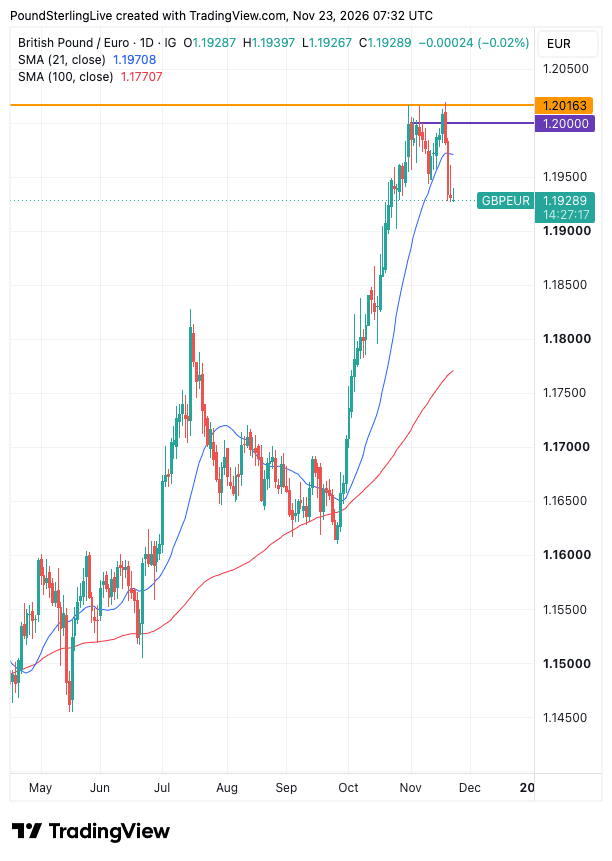
Above: GBP/EUR at daily intervals with the 21-day (blue) and 100-day (red) moving averages, and resistance at 1.20 (purple) and 1.2016 (orange).
That makes a recovery towards 1.1970, where the average, the blue line, now sits, the near-term Pound to Euro forecast once the selling eases.
Buyers stepped in at 1.1926 on Friday, which makes it the first support. Beneath it, the 26 October low at 1.1902 is the last support before the 1.1850s.
A deeper fall would bring the rising 100-day average, the red line, into view: the bulls would prefer the average to catch up with the market, and should GBP/EUR fall to meet it instead, the 1.1850s become possible. A daily close beneath 1.1850 would change the near-term Pound to Euro forecast from bullish to neutral.
On the way back up, the purple line at 1.20 is the first resistance, and the pair has closed above it only once, on 17 November.
The orange line just above it, at 1.2016, marks the 30 October high.
Those two lines mark the top of a multi-month range, the 1.20 to 1.2160 zone that capped the pound from November 2024 to March 2025.
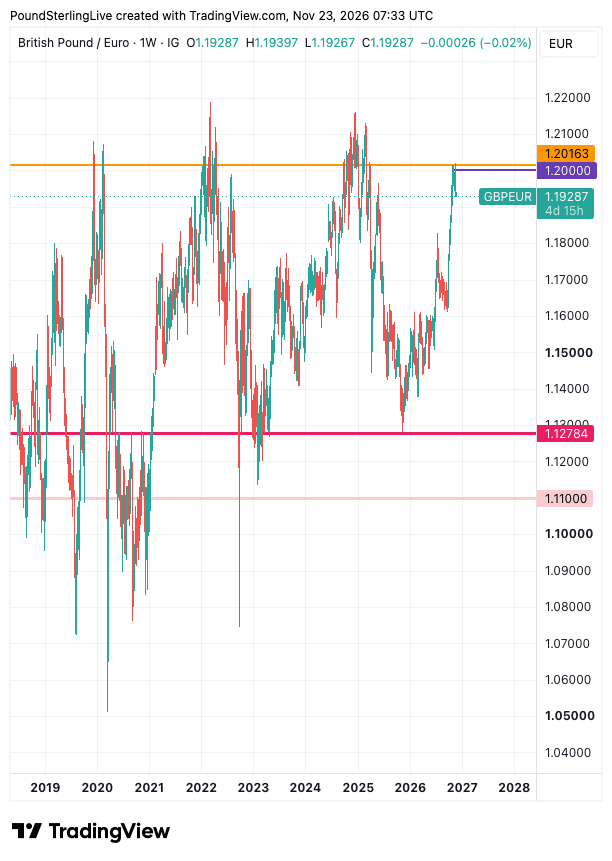
Above: GBP/EUR at weekly intervals, back at the 1.20 (purple) and 1.2016 (orange) levels at the top of its multi-month range.
Pound Sterling Live's House View modelling holds that the UK's economic outperformance and a Bank of England keeping rates higher for longer give GBP/EUR the fuel to break above that ceiling on a sustained basis, and the current selling should mark the base of an emerging medium-term range.
Last week's call ran into the ceiling: the Week Ahead Forecast looked for a first daily close above 1.20, which came on Tuesday at 1.2008, before GBP/EUR closed at 1.1934 on Thursday, beneath the 1.1942 level that changed the near-term view.
The Bank of England Must Keep December in Play for the Pound to Recover
The pound's recovery depends on the Bank of England keeping a December rate rise on the table, and the appearance by MPC members before the Treasury Committee at 14:15 on Wednesday is the week's main test.
"A key focus for sterling markets will be the appearance by BoE MPC members before the House of Commons Treasury Committee on Wednesday. Governor Andrew Bailey is due to attend alongside Deputy Governor Clare Lombardelli and external members Swati Dhingra and Catherine Mann. Remarks from Bailey and Lombardelli, who occ upy relatively centrist positions on the Committee, could be particularly informative," says Jeavon Lolay, Head of Market Insights at Lloyds Bank.
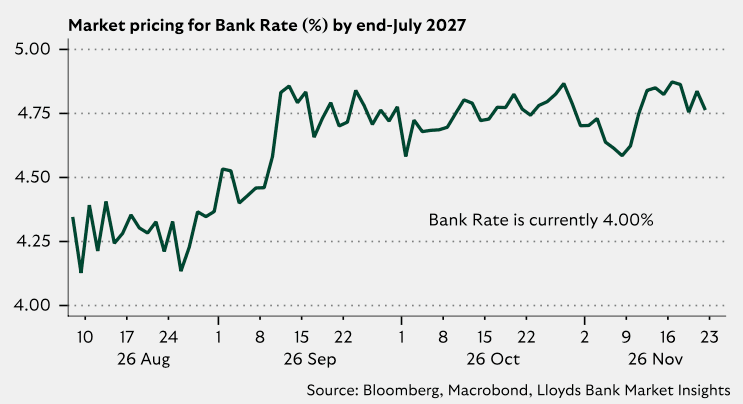
Under the playbook, hawkish signals, those leaning towards higher interest rates, would lift the pound, and dovish ones would weigh on it.
Pantheon Macroeconomics expects the Bank to act and has brought forward its hike calls to December and March, "we put a 60% probability on December, interpreting Bailey and Lombardelli as inclined to act unless inflation pressures soften," says Rob Wood, Chief UK Economist at Pantheon Macroeconomics.
Monday's flash UK purchasing managers' indices, monthly business surveys where a reading above 50 signals expansion, offer the first fresh evidence at 09:30, with consensus, the typical forecast of economists, looking for the services and manufacturing indices both to rise to 53.0 from 52.8.
Under the playbook, a beat would lift the pound by supporting December hike bets and a miss would weigh on it, with Goldman Sachs and Deutsche Bank both forecasting the services index below consensus at 52.5.
However, "upside to GBP is limited because pricing for several interest rate hikes by the Bank of England are already priced," says Commonwealth Bank of Australia. A move is priced in when investors have already bought the currency in anticipation, so the pound gains only if the Bank delivers more than expected.
Crédit Agricole goes further: its models show the pound overbought, meaning many investors already hold it and could sell to take profits, and the French investment bank has a new trade on the euro rising against the pound that targets EUR/GBP at 0.8479 (GBP/EUR 1.1794).
Chief Economist Huw Pill speaks on Monday and MPC member Megan Greene on Tuesday, second-tier events ahead of Wednesday's hearing.
French Risk Keeps the Euro on the Back Foot
Turning to the euro, France's political and fiscal troubles remain the drag analysts expect to persist into the spring, and political risk ahead of France's presidential election "may keep the EUR on the back foot," says Rabobank.
Barclays expects the same troubles to keep the euro as the currency investors borrow in to buy higher-yielding currencies, "we expect French-specific risks to sustain the EUR as the market's preferred funder for a while," says a new FX market analysis from the British bank. Borrowing euros to buy other currencies means selling euros, which weighs on the single currency.
France's drag on the bloc shows in Monday's eurozone flash PMIs at 09:00, where consensus looks for the composite index, which combines services and manufacturing, to rise to 51.9 from 51.7, but for France's services index to stay in contraction at 47.5.
French inflation figures follow at 07:45 on Friday, with consensus looking for the EU-harmonised rate to ease to 3.6% from 3.7%, and money markets put the odds of a December ECB rate rise above 90%.
Under the playbook, stronger surveys or firmer French inflation would support the euro by adding to ECB hike bets, and misses would weigh on it.
However, "short EUR positions are now the largest positions held by leveraged funds," says MUFG, which judges them the most stretched relative to their two-year range. When too many investors hold the same bet against a currency, a surprise forces them to buy it back at once, which sharpens any rebound in the euro.
Germany's Ifo business climate survey on Tuesday, final German growth figures on Wednesday and French growth figures on Friday are second-tier releases.
A Spring Election in the UK Is the Main Risk to a Sustained Break Above 1.20
Beyond this week, the pound's ability to hold above 1.20 depends on UK politics, and Prime Minister Andy Burnham admitted Friday's UK-EU summit deal was likely the limit of what could be achieved in this parliament.
Burnham has ruled out an early election, although polling expert John Curtice has advised him to "keep next May open as an option."
Should Burnham call a spring election Burnham's gamble must pay off and he must win a majority to keep markets on side, as the big downside risk presented by an election is Labour failing to secure a majority and going into coalition. Markets would demand a higher risk premium under such a scenario, which would weigh on the pound.