

Image © Adobe Images
The Australian dollar risks a weaker 2027 as the labour market cools and the RBA ends its rate-hiking cycle.
This week's labour market print could be something of a watermark moment for the Aussie dollar as it points to a loosening jobs market that will ease the pressure on wages and inflation and allow the RBA to lower interest rates next year.
That in turn erodes the yield advantage that has for so long supported the Australian dollar against the pound and the U.S. dollar.
"The report marks a potential turning point for the Australian labour market, suggesting that its resilience in the face of persistent headwinds may be beginning to wane," says Noah Siaw, Macro Research Analyst at OCBC, the Singapore-headquartered bank.
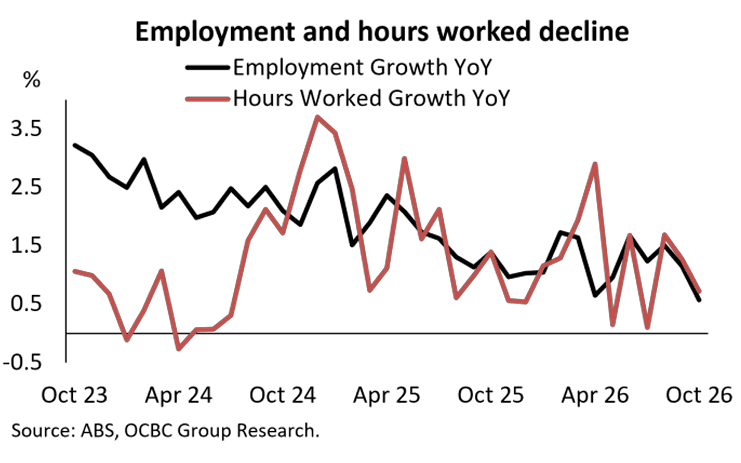
Thursday's release of October labour force data showed employment fell by 43,500, the third decline in four months, and the unemployment rate rose to 4.9%, up 0.6 percentage points on a year earlier.
The odds of an RBA rate cut in 2027 rose on the release, with pricing for easing by November 2027 doubling to around 30 basis points and a full cut now priced by September 2027.
Unemployment now sits above 4.75%, the RBA's estimate of the jobless rate consistent with stable inflation, and Commonwealth Bank of Australia says the threshold has been crossed "whether on seasonally adjusted or trend measures."
"The data directly challenges the RBA's assessment that the labour market is 'a little tight', reinforcing our view that it is done hiking," says Westpac, the Australian bank.
Westpac has raised its forecast for the peak in unemployment to 5.2% by mid-2027 from 4.8%, saying "the housing downturn is deeper than expected and is set to spill over more materially to the broader economy."
"Slower hiring is now being compounded by more firing. Retrenchments have lifted significantly in recent months," Westpac adds.
ANZ's Jasmine Zheng says the trend measures, which smooth out month-to-month volatility, "point to a loss of momentum in employment growth, with the average monthly increase in trend employment slowing from around 17k in the first half of 2026 to around 6k in the second half to date."
"Australia's economy is responding to the RBA's rate hikes as well as the clampdown in the residential property market brought on by tax changes," says David Forrester, Senior FX Strategist at Crédit Agricole CIB.
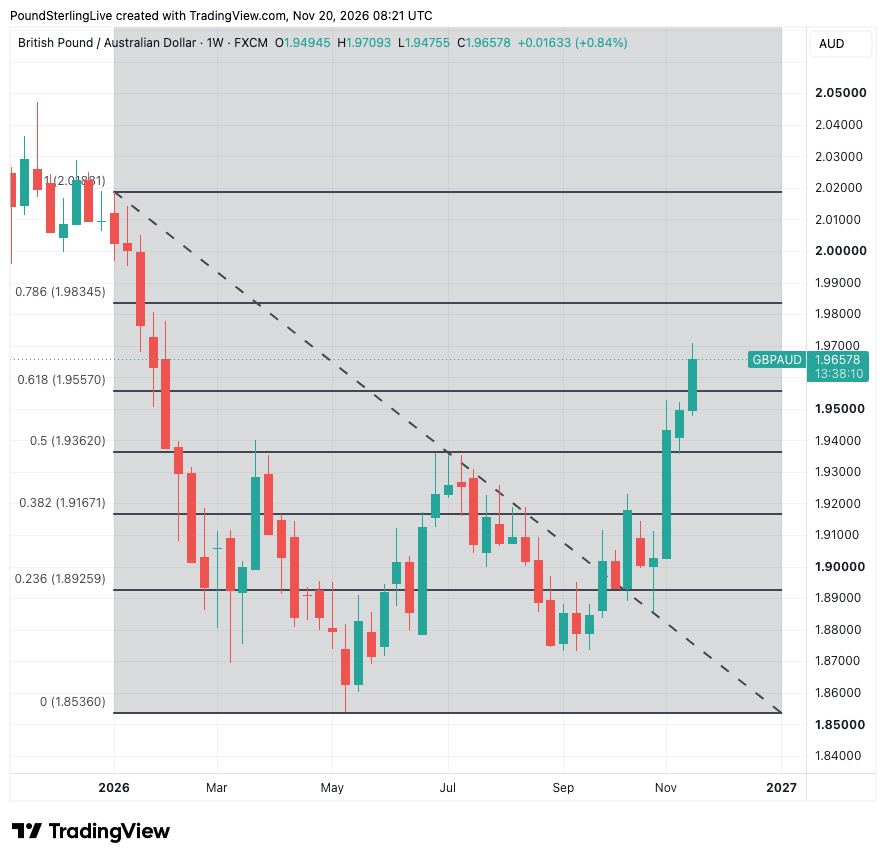
Above: GBP/AUD has recovered more than half of 2026's peak decline.
Thursday's jobs data followed Wednesday's release of third-quarter wage price index figures showing wages rose 1.1%, the strongest quarterly gain since late 2023.
"The ongoing softness in the labour market is a stronger signal for the RBA than the higher-than-expected WPI, given that wages tend to lag labour market trends," says ANZ's Zheng.
OCBC says the wage figures captured the September quarter, before October's deterioration, and that part of the gain reflected scheduled increases in award wages and public-sector pay agreements.
"Taken together, the WPI release does not materially alter the broader assessment that the labour market is weakening," says OCBC's Siaw.
"While wages growth for Q3 was strong, a weakening labour market in Q4 will see it come off. But this will likely be a gradual easing in wages growth and upward pressure on inflation," says Crédit Agricole's Forrester.
The RBA's Next Move Is Tipped to Be a Cut
Turning to the Australian central bank, minutes of the November meeting published on Tuesday showed the three Monetary Policy Board members who opposed the rate hike were concerned "the economy might be near the point of entering a materially sharper downturn."
"The labour market data will strengthen the hand of the three dissenters on the MPB expressing concern about a weakening in the economy and calling for rates to stay on hold," says Crédit Agricole's Forrester.
Commonwealth Bank of Australia says the risk has shifted from another hike to "a prolonged hold, removing lingering upside above 4.85%."
Goldman Sachs expects Australian growth to slow to 1.3% in 2027, from 2.4% this year: "The weaker growth outlook reflects the cumulative, lagged effects of five interest rate hikes so far in 2026, our forecast of a historically large 12% peak-to-trough decline in house prices, slower growth in real incomes and migration, and less supportive fiscal policy," says a new outlook from the U.S. investment bank.
Goldman sees the RBA holding the cash rate at 4.85% until the fourth quarter of 2027 and lowering it to 3.6% by the end of 2028, a path that leaves market pricing of around 4.4% "too hawkish."
Some Analysts Say It Is Too Early to Call for RBA Cuts
However, Australia's job losses are so far concentrated among young part-time workers, with part-time employment down 40,600 in October and youth unemployment up to 11.3%.
The underemployment rate, a broader measure of spare capacity in the labour market, fell to 6.2%, and the Australian Bureau of Statistics advises caution on short-term changes after one South Australian survey group returned a higher unemployment rate than the others.
"So, it remains too early to call for rate cuts, but the data signals that the RBA is likely done raising rates," says Crédit Agricole's Forrester.
"The currency will receive some support from the fact that the weakening labour market for now is constrained to young part-time workers," he adds.
OCBC sees the cash rate "on hold at 4.85% through most of 2027, followed by one 25bp cut in 4Q27."
October's inflation figures, due on 25 November, are the next test for that view: "Our October CPI preview suggests inflation relief is not coming quickly, which will still keep the RBA on edge," says Commonwealth Bank of Australia.
Pound Sterling Live Turns More Bearish on the Australian Dollar
Pound Sterling Live is minded to adopt a more bearish stance on the Australian dollar in 2027, with the labour market's turn ending the narrative of a resilient economy that kept the RBA raising rates through 2026.
Standard Chartered forecasts the Australian dollar-to-U.S. dollar exchange rate at 0.74 in a year on the strength of Australia's interest rate advantage over the U.S., as Pound Sterling Live has reported.
However, Australian ten-year bond yields already sit 10 basis points below their U.S. equivalents, a gap Commonwealth Bank of Australia says is "moving ahead of schedule towards our forecasts for negative differentials over 2027."
Crédit Agricole says the Australian dollar is the worst-performing G10 currency in November on a downturn in risk sentiment, and its positioning indicator shows the largest short position against the currency since April 2024.
UBS said in a recent update that it targets 1.995 in the pound-to-Australian dollar exchange rate, about 1.5% above spot with the pair trading just below 1.97, citing the risk that "a deteriorating Australian housing and macro backdrop could lead markets to price additional RBA easing in 2027."
"We favour going long GBPAUD, where growing monetary policy divergence between the Bank of England (BoE) and the Reserve Bank of Australia (RBA) is not yet fully priced, in our view," UBS adds.