

Image © Adobe Images
The Australian dollar risks further losses against the pound as a second monthly fall in employment meets an RBA divided over the risk of a sharper downturn.
The Australian dollar fell against the pound after official figures showed employment dropped by 43,500 in October, against expectations for a 20,000 gain, and the unemployment rate rose to 4.9% from 4.7%.
A loosening jobs market strengthens the case made by the three RBA Board members who opposed November's rate hike, in turn raising the odds of an interest rate cut that would erode the Australian dollar's yield appeal against the pound.
In the minutes following the 00:30 UK release the pound-to-Australian dollar exchange rate rose 0.5% from 1.9558 to 1.9652, above Wednesday's high of 1.9647. AUD/USD fell 0.4% from 0.6721 to 0.6693.
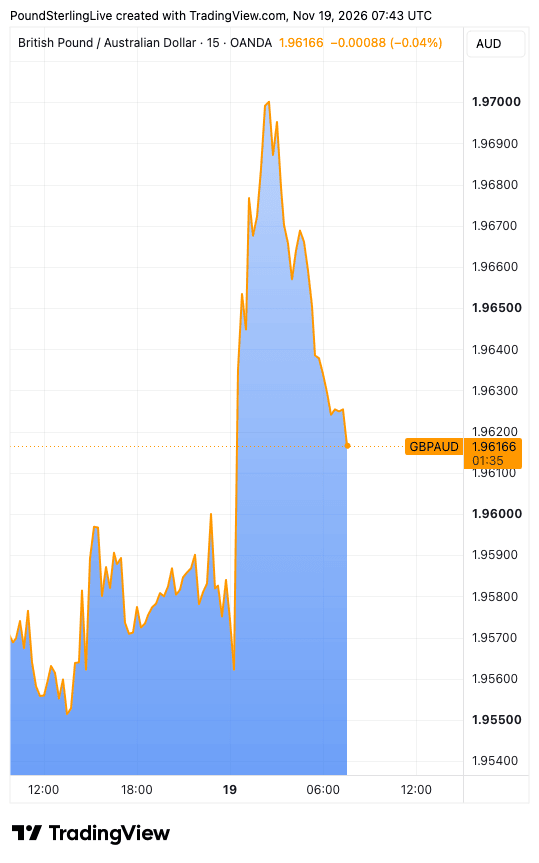
Above: GBP/AUD at 15-minute intervals. The pair peaked near 1.97 in the hours after the release before giving back more than half of the gain.
October's fall in employment followed a 39,300 drop in September as first reported, the second consecutive monthly decline in employment.
Part-time work accounted for most of the losses, falling by 40,600 against a 2,900 fall in full-time employment, and hours worked dropped 0.2%.
The number of unemployed people rose by 17,800 even as the participation rate eased to 66.6% from 66.8%, a sign that job losses drove the rise in the jobless rate.
The Australian Bureau of Statistics flagged that the incoming survey group for South Australia had a higher unemployment rate than other rotation groups, a sampling effect it asks users to be aware of.
The outcome wrong-footed forecasters who had looked for a rebound: Goldman Sachs had expected employment to rise by 30,000 and saw "risks skewed to a lower unemployment rate, given the strength in job ads."
RBA Dissenters Warned of a Sharper Downturn
The figures arrive two days after minutes of the RBA's November meeting showed the three members who voted to hold rates at 4.60% were concerned "the economy might be near the point of entering a materially sharper downturn" and pointed to the costs in terms of unemployment.
Money markets went into the release pricing roughly even odds of an RBA rate cut over the coming twelve months.
Commonwealth Bank of Australia expects the unemployment rate to peak at 5.1% in 2027 as the economy slows.
However, the Board's majority raised the cash rate to 4.85% on concerns about the upside risks to inflation, and Wednesday's data showed wages rose 1.1% in the third quarter, the strongest quarterly gain since late 2023.
"The wages data on the margin reinforces [our] view that the RBA will remain on edge into early 2027 about the upside risks to inflation and spillovers to wages," says Joseph Capurso, FX Strategist at Commonwealth Bank of Australia.
GBP/AUD Pullbacks Can Stay Shallow
As Pound Sterling Live has reported, GBP/AUD was due a pause after a rally that pushed its Relative Strength Index into overbought territory and stretched the exchange rate well above its 21-day moving average.
The jobs data extends that stretch, so a consolidation remains the likeliest near-term path for GBP/AUD, although the weaker labour market makes any pullback shallower.
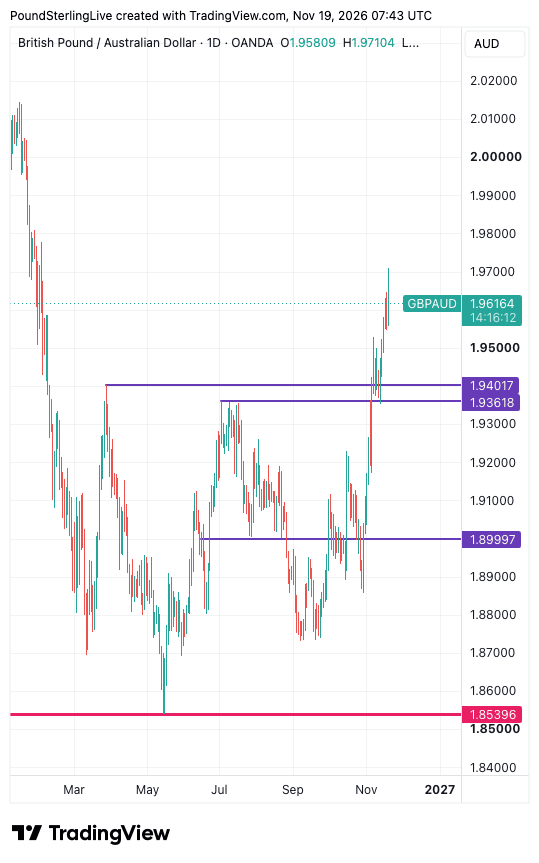
Above: GBP/AUD at daily intervals. Former resistance at 1.9402 and 1.9362 now acts as support.
GBP/AUD would find support at 1.9402 and then 1.9362, both former resistance levels, should the Australian dollar recover some ground.
For the Australian dollar to mount that recovery, October's inflation figures on 25 November must show price pressures strong enough to keep the RBA's majority focused on inflation, with Westpac forecasting annual inflation at 4.8%.