

Image © Adobe Stock
The Canadian dollar stands to gain the most should investors lose faith in the US dollar, as Canada's underhedged asset managers would be forced to sell US dollars to raise their currency hedges.
The Canadian dollar is better placed than most to benefit from a debasement of the US dollar, according to new modelling from CIBC.
"Our Tail Risk Models suggest that selling USD/CAD or USD/JPY are the best candidates in the event of US dollar debasement, similar to what we witnessed over Liberation Day (April 2025), or during January 2026 where the street saw a sudden deleveraging of popular trades," says Sarah Ying at CIBC Capital Markets.
"Our model prefers to short USD/CAD, which offers the cleanest expression of USD debasement. Fundamentally, this may be driven by i) large asset managers in Canada choosing to remain relatively underhedged to peers needing to right-size hedge ratios, or ii) the unwind of the carry trade as risk underperforms," she explains.
Debasement describes a broad loss of investor confidence in the US dollar as a store of value, and CIBC has noted that Canadian investors leave more of their US equity holdings unhedged than investors in other developed markets.
A debasement trade would oblige those investors to raise their hedges by selling US dollars and buying Canadian dollars.
The debasement trade is a longer-dated prospect and for now the US dollar-to-Canadian dollar exchange rate is moving higher, having rallied 2.8% from 1.3930 on 4 November to 1.4316 on 17 November, its highest level since early 2025.
Bets on further Federal Reserve rate hikes built after US inflation figures on 10 November, and the odds of a December Bank of Canada hike fell to 46% from 62% on Canada's softer inflation figures of 16 November.
The tail-risk hedge sits outside CIBC's day-to-day trading view, "we're roughly neutral on USD/CAD at these levels, and expect the pair will chop around in the 1.42-1.43 range in the coming weeks," says Noah Buffam at CIBC Capital Markets.
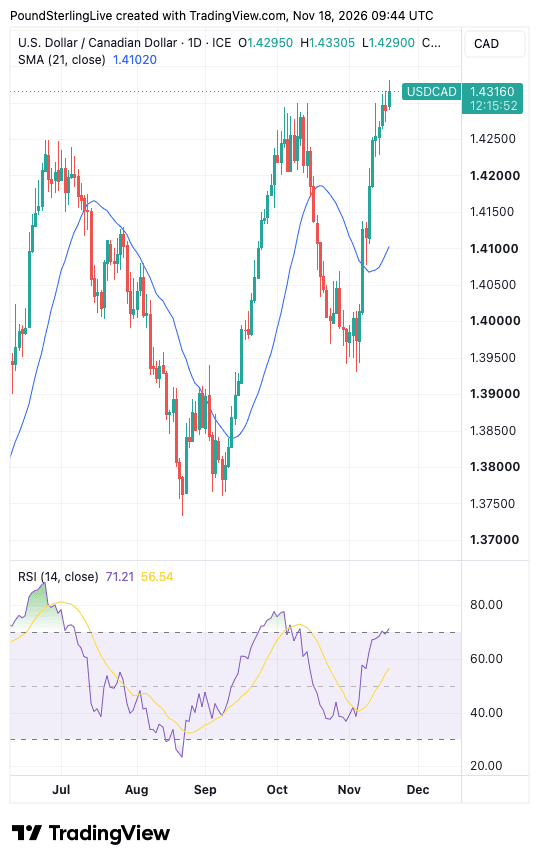
Above: USD/CAD at daily intervals with the 21-day moving average (blue) and the 14-day RSI in the lower panel. The RSI above 70 marks technically overbought conditions. Image © Pound Sterling Live, chart created with TradingView.
USD/CAD trades 1.5% above its 21-day moving average at 1.4102, a stretch that Pound Sterling Live's mean-reversion modelling says must close through a pullback or a consolidation.
Société Générale places the top of USD/CAD's multi-month rising channel at 1.4300 to 1.4330, "Some profit-taking cannot be ruled out around current levels," says Kenneth Broux at Société Générale.
CIBC adds that the protection is cheap, because implied volatility, the price options traders put on future currency swings, has lagged the rise in other markets, "The driving factors of FX have broadened this year, and conflicting cross currents could ironically be a volatility dampener when global hiking cycles are mature," says the Canadian investment bank.
The model also ranks selling USD/CAD as the best hedge against a selloff in private credit, a link CIBC says January 2026's price action confirmed.
Bank of America favours the opposite hedge, buying options that pay out on a higher USD/CAD, on the view that "resilient US growth favors USDCAD upside," says the US investment bank.
A debasement shock in which the Canadian dollar outpaces the pound would pull the pound-to-Canadian dollar exchange rate from near 1.89 to below the 1.8810 support that Pound Sterling Live identified this week.
Commonwealth Bank says a sharp deterioration in sentiment around the AI trade could push USD/CAD toward support at 1.4107, albeit temporarily, a level that sits on top of the 21-day average.