

Image © Adobe Images
The euro looks cheap, but the dollar still has interest rates on its side.
The euro is due a pause in its slide against the dollar, analysts say, although further losses are possible while investors stay risk averse.
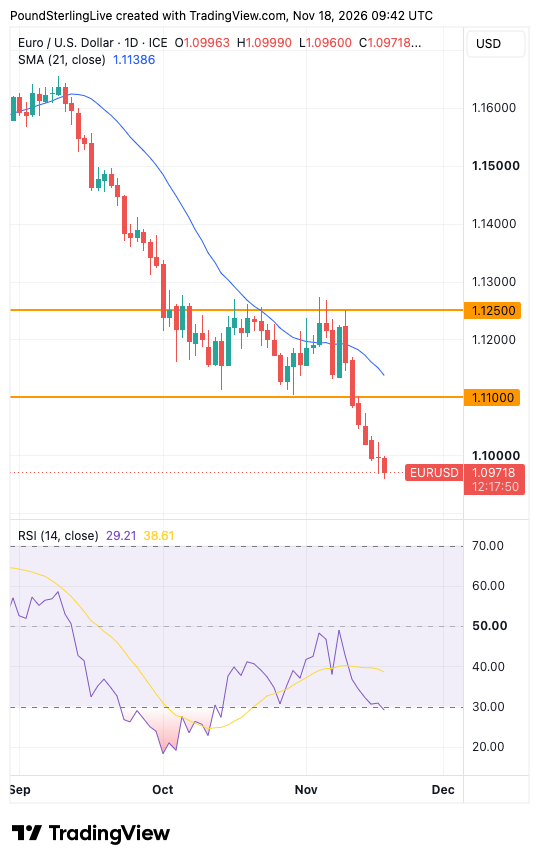
The euro-to-dollar exchange rate broke below 1.10 on 16 November for the first time since April 2025, reaching the level Danske Bank had set as its six-to-12-month target "well ahead of schedule," says the Danish bank.
Expectations for further Federal Reserve rate hikes firmed on hotter-than-expected U.S. inflation figures and hawkish commentary from Fed officials, widening the yield advantage of holding dollars over euros.
Crédit Agricole estimates the pair now trades below its fair value, "EUR/USD has recently plumbed to fresh multi-month lows as the combination of stronger US CPI and hawkish Fedspeak last week has boosted the USD's relative rate appeal vs the EUR. As a result, the 2Y EUR-USD rate spread has hit one of its lowest levels so far in 2026," says a new FX market analysis from the French investment bank.
"EUR/USD is looking undervalued and oversold, and this could help it stabilise in the near term," the bank adds, provided U.S. data disappoints and European Central Bank officials signal they will match the Fed hike for hike.
Tuesday's U.S. data did not disappoint: retail sales rose 0.2% in October against a consensus of 0.1%, and the control group, which feeds into GDP, rose 0.6% against 0.3%.
Hawkish comments from ECB officials have meanwhile given the euro "little support," says Natixis.
EUR/USD has fallen 2.7% from 1.1273 on 4 November to 1.0968, a move Pound Sterling Live's Week Ahead Forecast flagged on Monday when it called a break below 1.10 a real prospect.
The euro is also under pressure against the pound, with the pound-to-euro exchange rate at a new 2026 high of 1.2020.
EUR/USD now sits 1.5% below its 21-day moving average at 1.1139, with the 14-day Relative Strength Index at 29, below the 30 mark that denotes oversold conditions.
Pound Sterling Live's mean-reversion modelling holds that a stretched deviation from the 21-day average closes through a bounce or a period of consolidation, with any bounce aimed at the average itself.
Analysts See Further Euro Losses While Risk Aversion Persists
Despite observations that the move sub-1.10 leaves euro-dollar looking oversold, it could yet be too soon to stand in the way of what is effectively a falling knife.
New U.S. licensing rules on AI chip exports have deepened a sell-off in technology stocks this week, and "uncertainty surrounding Nvidia has also contributed to market jitters and indirectly supported the dollar in its role as a safe-haven currency," says Natixis.
"The dollar's advance could continue for a few more weeks if risk aversion remains elevated, potentially pushing EUR/USD towards 1.0950," Natixis adds.
Turning to the technical picture, "downward momentum is starting to ease, and the likelihood of EUR declining further to 1.0950 is diminishing. That said, only a breach of 1.1050 would indicate that the weakness has stabilised," says Quek Ser Leang, Senior Technical Strategist at UOB.
Goldman Sachs sees the euro's losses extending in the near term, with forecasts published on Monday putting EUR/USD at 1.08 in three months and 1.10 in six months, before a recovery to 1.15 in 12 months as the Fed does less than markets expect: "Both our baseline and probability-weighted Fed forecasts are less hawkish than market pricing," says Goldman Sachs.
The euro must clear graphical resistance at 1.1100, old support from the October range that broke on 11 November, before any bounce can reach the falling 21-day average.