

Image © Adobe Stock
The euro's recovery against the dollar is likely to stall while French borrowing costs stay elevated and the dollar sheds the political risk discount it has carried since the 2025 tariff shock.
The euro's recovery against the dollar from its October lows is set to run into a ceiling, as France's unresolved public finances weigh on the single currency and the dollar sheds a political discount, investment bank analysts say.
The euro-to-dollar exchange rate trades at 1.1231 on Tuesday, testing resistance at 1.1250 after rising from Friday's low of 1.1131 and the 2026 low of 1.1105 set on 29 October.
Brent crude has fallen around 20% since its 30 October peak and markets expect the European Central Bank to raise interest rates in December, yet the euro has barely moved.
"The EUR continues to trade on a softer footing. It has so far failed to benefit from lower energy prices or the more hawkish-than-expected ECB policy update," says MUFG, the Japanese bank, in a recent update.
"French fiscal risks also remain elevated, acting as a headwind for EUR performance," it adds.
Commerzbank points to another reason why EUR/USD gains are set to be capped: the dollar side of the pair, after inflation swaps cut euro area inflation expectations for the coming year to just below 3% from 3.9% at the end of October, and U.S. expectations to 1.93% from 2.63%.
"All of this should, if anything, point to a modest appreciation of the euro against the US dollar. Yet this has not really materialized over the past few days," says Volkmar Baur, FX and Commodity Analyst at Commerzbank.
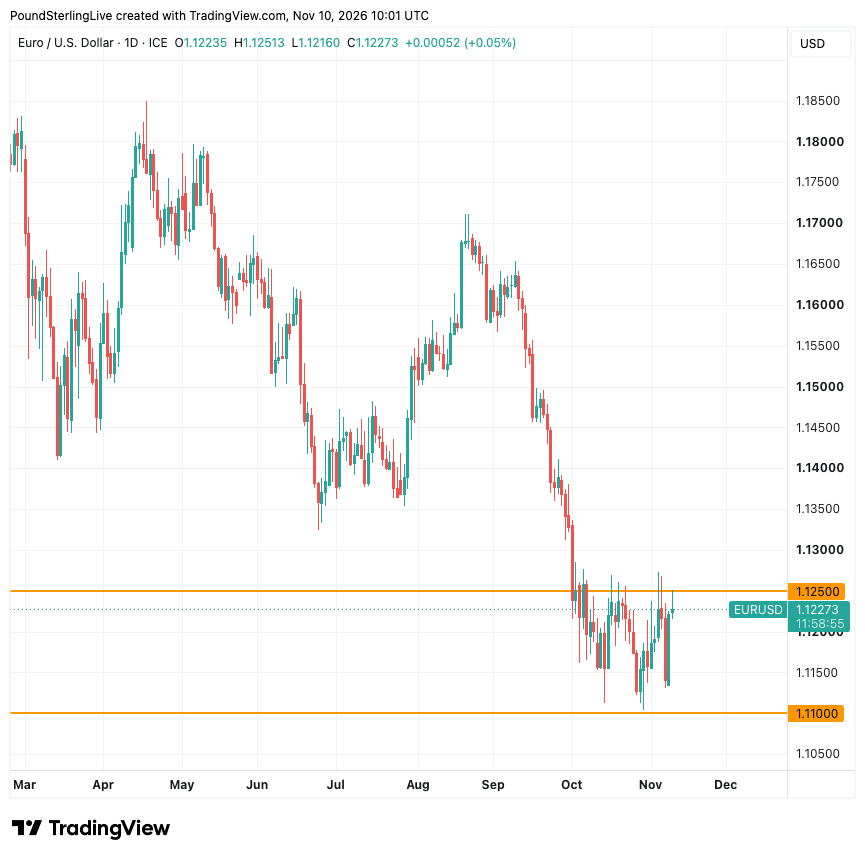
Above: The euro-dollar's recent rebound put into context.
The dollar has instead recovered ground it lost to a political risk premium, the discount investors applied to the currency after President Trump's 'Liberation Day' tariffs in April 2025, according to Commerzbank.
EUR/USD has converged again with the gap between U.S. and German two-year yields, as the midterm elections and softer rhetoric from the administration ease the political risk, and "over the past few days, this premium appears to have declined significantly again," Baur adds.
French Spreads Cap the Euro's Upside
The euro weakens when French borrowing costs rise because investors fear the tensions could spill over to the rest of the eurozone, according to UniCredit.
The gap between French and German ten-year borrowing costs, the favoured measure of French stress, stands around 150 basis points, more than 100 basis points above its ten-year average, according to UniCredit.
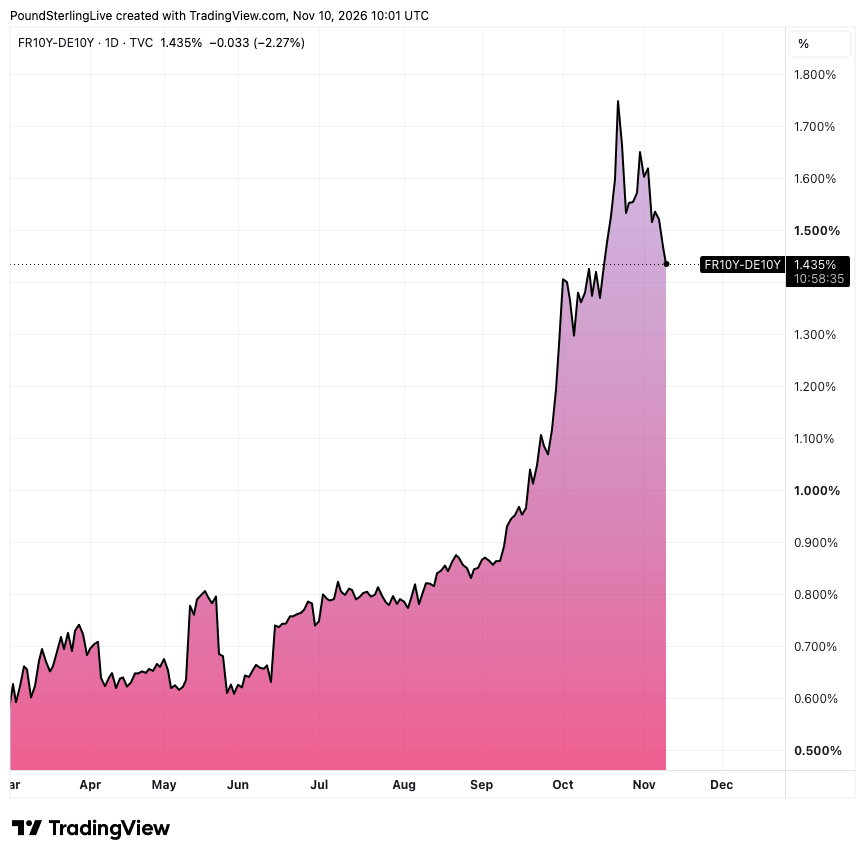
Bank of America estimates that every 10 basis point widening in that spread is associated with a 0.4% weaker EUR/USD, on large moves.
UniCredit finds the euro reacts to the spread in one direction only, "the pair weakened when the spread widened but failed to appreciate when yield differentials tightened from a high of nearly 180bp to around 154bp," says the Italian bank.
UniCredit puts the French discount at "around two to three big figures" on EUR/USD, and says French politics "may function as a cap to any EUR-USD rebound well above 1.15."
Goldman Sachs sees euro weakness as the best expression of the energy shock, one it judges "underpriced" due to the euro's "exposure to energy prices, and possible knock-on effects on sovereign spreads."
French lawmakers vote on the 2027 budget on 17 November, after France's worsening public finances prompted Fitch Ratings to cut its outlook on the country's A+ rating to negative last month, as Pound Sterling Live reported.
UniCredit expects the government to force the budget through using Article 49.3 of the constitution, which allows a bill to pass without a vote, leaving spreads in a 120-160 basis point range.
UniCredit maps EUR/USD against four French fiscal paths, with only a credible debt plan taking the pair meaningfully above spot:
1) Debt reduction: 1.15-1.16, around 3% above spot
2) Debt stabilisation: 1.13-1.14, around 1% above spot
3) Muddling through: below the 2026 low and towards or below 1.10
4) Confrontation with the EU: 1.05-1.10
Euro Recovery Forecast for Q2 2027
"As long as the market continues to expect both the Fed and the ECB to raise rates in December, EUR-USD may well continue to trade broadly sideways for the time being," says Commerzbank's Baur.
ING estimates EUR/USD trades 2.1-2.3% below its short-term fair value, a gap it says exceeds what the French risk premium justifies.
ING expects the dollar to stay supported until next spring, "French budgetary politics look set to keep a risk premium in the euro ahead of April's elections," says Chris Turner, Global Head of Markets at ING.
Turner sees EUR/USD trading in a 1.10-1.15 range over the next four to five months.
"From the second quarter, however, softer US rates, moderating energy prices and clarity on French politics could trigger a gentle recovery in EUR/USD towards 1.18 by year-end 2027," he adds, a target around 5% above spot.
ING's bold call for 2027 is a rotation into European assets, should a decisive Marine Le Pen victory in April come with greater budget clarity, echoing the EUR/USD rally of 2017 when euro-sceptic parties failed to advance.
Goldman Sachs prefers EUR/GBP downside as a cleaner trade on euro weakness, a view that favours further gains in the pound-to-euro exchange rate from 1.1960.
For the euro to extend its rebound beyond 1.1250, French lawmakers must pass a budget that convinces bond investors to narrow the spread over Germany.