

Image © Adobe Images
The euro is set to chop sideways against the dollar into Tuesday's U.S. inflation figures, and only a solid beat in those figures would bring forward the resumption of its medium-term downtrend.
The dollar's rally on Friday's U.S. jobs report has all but evaporated, leaving the euro-to-dollar exchange rate to chop around current levels into Tuesday's U.S. inflation data.
EUR/USD starts the week at 1.1194, having recovered most of Friday's fall to 1.1131 after the U.S. economy added 165,000 jobs in October, more than double the 70,000 economists expected.
From a technical perspective, the pair is consolidating, and the 21-day moving average, drawn in blue, has flattened out:
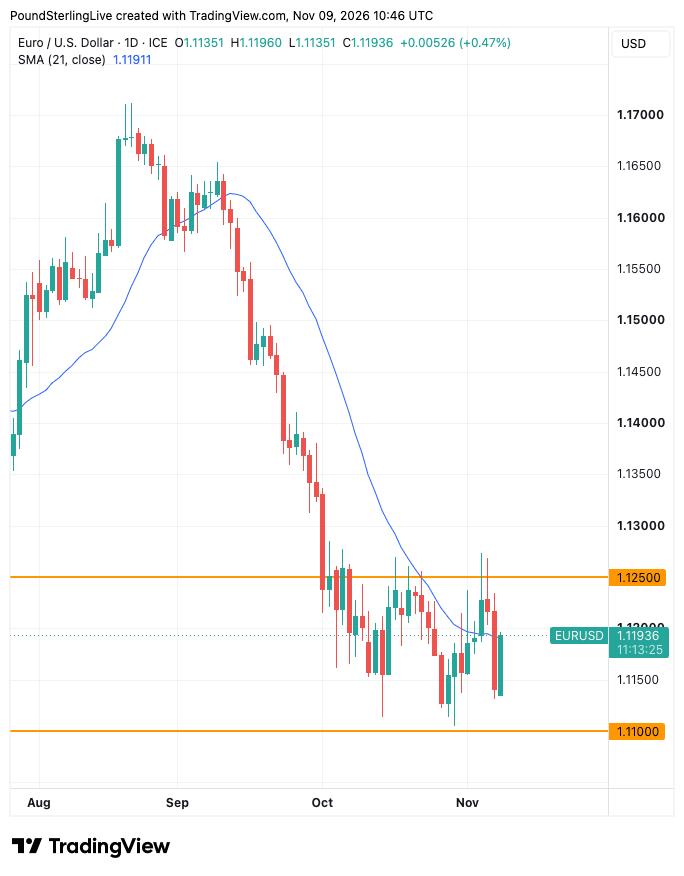
Above: EUR/USD daily chart. Image © Pound Sterling Live, chart created with TradingView.
The flattening is the moving average catching up with a consolidation under way since early October, and the chart gives no clear short-term direction.
Graphical horizontal resistance at 1.1250, the upper orange line, has capped rallies since early October, and the pair could not hold above it after rising to 1.1273 on 4 November.
Support at 1.1100, the lower orange line, sits just beneath the 2026 low of 1.1105 set on 29 October.
Pound Sterling Live looks for EUR/USD to chop between 1.1100 and 1.1250 this week.
A daily close above 1.1250 would change Pound Sterling Live's near-term forecast.
On a medium-term view, the 100-day moving average has been falling since September and sits well above the market, which points to ongoing weakness in the euro.
November is traditionally a good month for the euro on seasonality, so the month could bring further chop around current levels before the downtrend resumes.
Bank of America's analysis shows year-end seasonals favour selling the dollar, although the U.S. bank says "we caution against relying on USD seasonality this year."
Last week's Week Ahead Forecast looked for a recovery towards 1.1269 with 1.1113 underpinning the pair: EUR/USD rose to 1.1273 on Wednesday, and Friday's post-payrolls low of 1.1131 held above that line.
Dollar Bulls Need a Solid Beat From U.S. Inflation
The dollar's next move depends on Tuesday's October inflation figures from the Bureau of Labor Statistics, due at 13:30 UK time.
Economists expect headline prices to have risen 0.3% in the month, down from 0.6% in September, with core prices, which strip out food and energy, forecast to rise 0.2% after 0.3%.
Only monthly changes will be published, as the 2025 government shutdown left no October index from which to calculate an annual rate.
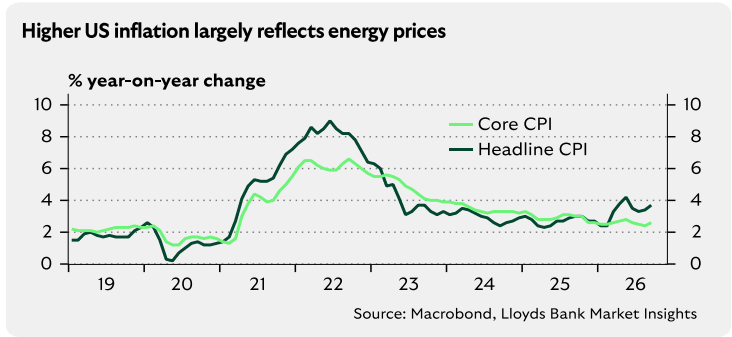
Under the playbook, an above-consensus reading would strengthen the dollar and push EUR/USD lower. A miss to the downside would support the euro.
Pound Sterling Live's view is that the dollar bulls need a solid beat, as an in-line print is too small a surprise to boost the dollar given positioning and expectations.
Money markets price a December Fed hike at just below 80% after the jobs report, so an in-line inflation print would only confirm what is already in the price.
Speculators also hold their largest net short position in the euro since 2016, according to Commodity Futures Trading Commission data published at the end of October.
A crowded short position needs fresh bad news to extend, and without it speculators tend to buy back euros to lock in profits, which lifts the pair.
Commonwealth Bank of Australia expects core prices to rise 0.3%, above consensus, and says "EUR/USD will re-test its year-to-date low of 1.1105 this week."
Friday's producer price figures are a second-tier release, as are the week's speeches from Fed officials.
On the euro side, ECB President Christine Lagarde speaks on Wednesday and Thursday, and eurozone third-quarter GDP is a second-tier release.
The Dollar Loses Its Haven Support if Tech Stocks Rebound
Beyond the inflation data, the dollar will take direction from U.S. technology stocks, whose selloff last week drove investors into the currency.
The Nasdaq 100 fell 6.4% on 5 November, its worst session since March 2020, on fears that a Democrat-controlled Congress will tighten regulation of AI data centres.
What does safe-haven demand mean for the dollar? When stocks fall sharply, investors sell riskier assets and move cash into U.S. Treasuries and dollars, lifting the currency regardless of the economic data, and that support fades once stocks recover.
"We think the dollar rally requires the risk-off mood to persist this week," says ING, the Dutch bank, which estimates EUR/USD trades 2.1-2.3% below its short-term fair value.
Commonwealth Bank of Australia judges the selloff in AI stocks an overreaction and expects concerns over the data-centre buildout to fade.
Bank of America's technical strategists say a sustained break above 1.1277 would complete a small double bottom, with 1.143 the target.
Euro Downtrend Set to Resume Beyond November
Any euro recovery is likely to prove temporary, as the medium-term drivers still favour the dollar.
Bank of America reiterates a "bearish trend bias and preference to sell rallies," with downside risks towards 1.10 and 1.0882 while the pair holds below a downtrend line near 1.15.
"We are cautious on EUR/USD but do not expect it to sell off aggressively because we think that additional ECB tightening could limit the downside risks to a degree in the coming months," says Valentin Marinov, Head of G10 FX Strategy at Crédit Agricole.
The pound-to-euro exchange rate trades at 1.1991, just beneath the 1.20 barrier it has yet to close above, and a dollar rally that hits the euro harder than the pound would help GBP/EUR through it.
Pound Sterling Live's Euro to Dollar forecast looks for chop between 1.1100 and 1.1250 this week, with the downtrend set to resume once November's seasonal support for the euro passes.