
Image © Adobe Images
The pound's gains against the Australian dollar depend on the sell-off in AI-linked stocks, and investors buying back into equities at discounted levels would lift the Australian dollar and risk a setback for the pair.
The pound-to-Australian dollar exchange rate starts the week at 1.9450, close to its highest level since February, after a slump in global stocks broke the deadlock between two high-yielding currencies.
The risk-sensitive Australian dollar bore the brunt of the sell-off, which was driven by fears that a Democrat-controlled Congress will restrict spending on AI infrastructure.
GBP/AUD risks a setback in the coming days should buyers return to stocks at discounted levels and lift the Australian dollar.
U.S. inflation data on Tuesday and UK GDP figures on Thursday are the week's main tests for the pair, which has broken out of its summer range with the 21-day moving average, drawn in blue, now above the 100-day average, in red:
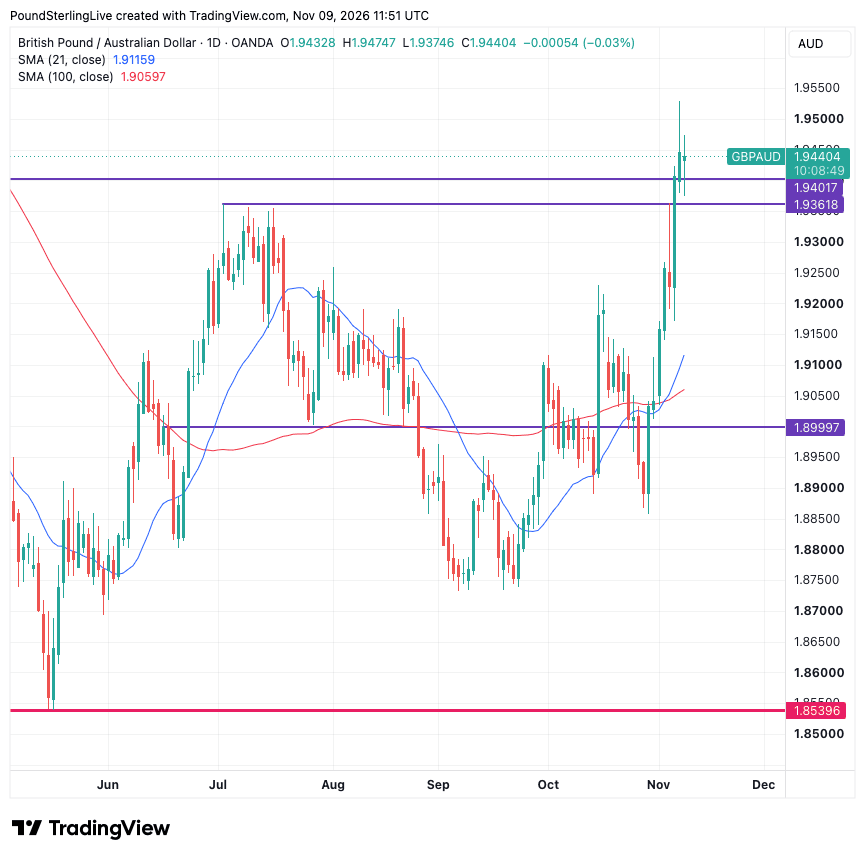
The 21-day is rising steeply, and the 100-day, flat through the summer, now edges higher.
What does it mean when the 21-day average crosses above the 100-day? It tells us the average price of the past month has overtaken that of the past five months, a sign that buyers have taken control of the trend.
The relative strength index has reached 70, the overbought threshold, for the first time since 2025.
Friday's high at 1.9528 is the first resistance and the February high at 1.9587 the next, with the March high at 1.9402, which capped the pair until Thursday, now acting as support.
The July high at 1.9362 sits just beneath it, and the two levels form one support band.
Pound Sterling Live's mean-reversion modelling holds that a pair stretched this far above its 21-day average tends to close the gap through a pullback or a consolidation. Any setback should be soft and held by the 1.9362-1.9402 band.
Pound Sterling Live looks for GBP/AUD to slip back towards that band this week should stocks extend their recovery. A daily close above 1.9528 would change the near-term Pound to Australian Dollar forecast.
The medium-term trend favours the pound, with the 1.90 pivot the level that would have to give way to reverse it.
Last week Pound Sterling Live looked for a test of 1.9140, with a break opening 1.9228 and 1.9362; the pair cleared all three and reached 1.9528 on Friday. Pound Sterling Live's warning of a pullback after the pair was turned back at 1.9362 on Wednesday was wrong: the Bank of England's hike the following day took the pair through the level.
Risk Appetite Must Recover Before the Australian Dollar Can Rebound
The Australian dollar's slide followed a 4.0% fall in the S&P 500 on Thursday, the index's largest one-day drop since April 2025, and, more broadly, its losses against the pound have tracked the slide in U.S. stocks closely:
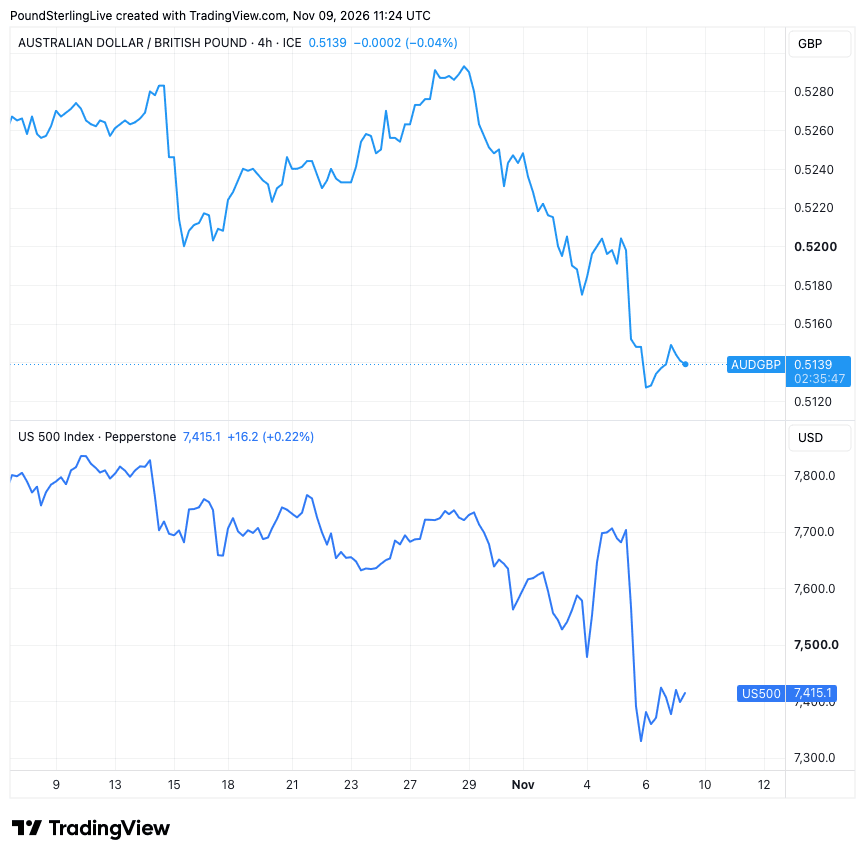
Above: AUD/GBP (top) plotted against the S&P 500 (bottom), four-hour chart. Image © Pound Sterling Live, chart created with TradingView.
Commonwealth Bank of Australia, the country's largest lender, says the Australian dollar reacts more to swings in risk sentiment than its peers because "speculative positioning in AUD is more than double that in NZD." Larger speculative holdings mean heavier selling when investors cut risk.
Australia is exposed to the AI theme through its own investment boom, with "another exceptionally strong result for data-processing equipment imports, taking the Q3 total to $11.1bn," says Westpac, the Australian bank.
Asian stocks rebounded on Monday, and the Australian dollar recovered around 0.3% against the U.S. dollar.
Commonwealth Bank of Australia says "we consider oil and AI prices overreacted," although "any recovery can pull AUD/USD up only modestly," the bank adds.
However, Bank of America, which tracks the positioning of trend-following funds, says "our projections point to AUD selling and CAD buying next week."
Strong U.S. Inflation Would Add to the Pressure on the Australian Dollar
Beyond stock markets, the Australian dollar will take direction from Tuesday's U.S. inflation figures, which will shape expectations for a Federal Reserve hike in December.
Markets price around an 80% chance of a December hike after U.S. payrolls rose by 165,000 in October.
Consumer prices are forecast to rise 0.3% month-on-month in October, after 0.6% in September, with core inflation seen at 0.2% after 0.3%. Lloyds forecasts headline inflation of 0.2% and Westpac 0.4%, with the figures due at 13:30 London time.
Under the playbook, a print above consensus would lift the U.S. dollar and add to the Australian dollar's losses. A softer print would ease the pressure and give the Australian dollar room to recover.
GBP/AUD tends to rise when the U.S. dollar strengthens, as Pound Sterling Live reported in October.
The Pound Needs Solid UK GDP Data to Hold Its Gains
Turning to the pound, Thursday's GDP figures will show whether the UK economy has the momentum to support the Bank of England's hawkish turn.
The Bank raised Bank Rate to 4.00% on 5 November, with all nine policymakers voting for a hike and Catherine Mann backing a larger 50 basis point increase.
The economy is forecast to have grown 0.7% in the third quarter, up from 0.4% in the second, with the figures due at 07:00.
Lloyds forecasts 0.8%, "its strongest quarterly expansion since early 2022 and slightly above the BoE's 0.7% estimate," and Commonwealth Bank of Australia 0.4%.
Under the playbook, a print above consensus would support expectations for further Bank of England hikes and lift the pound. A miss would weigh on it.
The Bank's November decision "could burnish the GBP appeal, making it one of the highest yielding G10 currencies," says Crédit Agricole, the French investment bank.
The Reserve Bank of Australia signalled on 3 November that its own hiking cycle is close to an end, as Pound Sterling Live reported.
Westpac reads the decision by the RBA's Monetary Policy Board "as confirming our current view that the MPB will keep rates on hold in December."
However, "it remains a tough ask to be structurally short AUD with rates at 4.85%," says J.P. Morgan.
Australian consumer sentiment and the NAB business survey on Tuesday, housing finance on Wednesday and inflation expectations on Thursday are second-tier releases, as are speeches from the Bank of England's Huw Pill and Clare Lombardelli on Tuesday.
Pound Sterling Live's Pound to Australian Dollar forecast looks for a setback towards 1.9402 and 1.9362 as stocks recover, with the medium-term uptrend intact for as long as the pair holds above 1.90.