
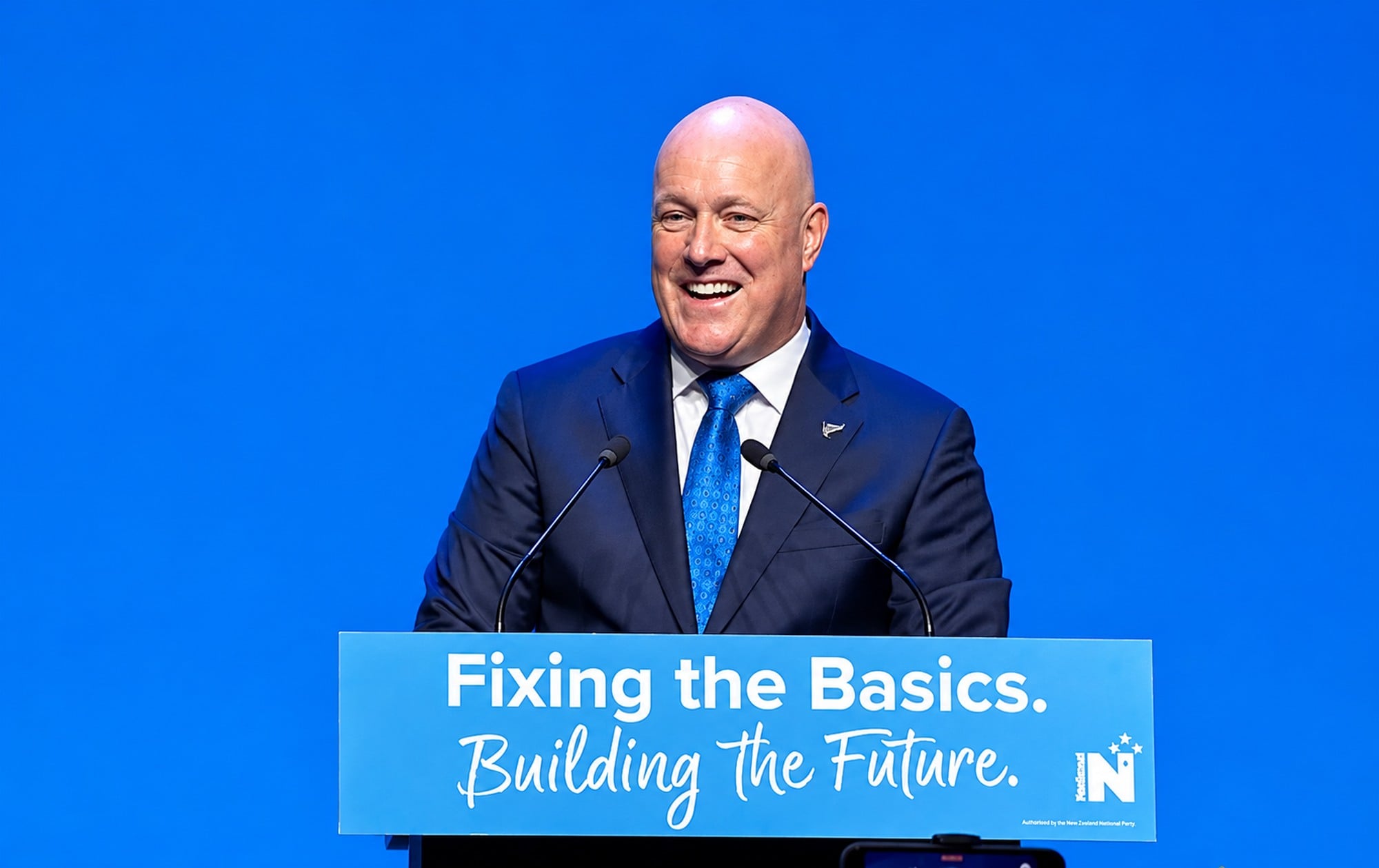
Image © Pound Sterling Live. File image of Christopher Luxon.
The New Zealand dollar has room to recover against the pound as global stocks rebound, although New Zealand's unresolved election result adds a layer of uncertainty to the kiwi's path.
The pound-to-New Zealand dollar exchange rate starts the week at 2.3902, having fallen back on Monday from Friday's high at 2.4179, the pair's highest level since 2015.
New Zealanders are digesting a close general election, although the kiwi's Monday gains owe more to a recovery in global stock markets.
The New Zealand dollar is a high-beta currency, and a further recovery in beaten-down technology stocks would extend its gains against the pound.
U.S. inflation figures on Tuesday and UK GDP data on Thursday are the week's main tests, with GBP/NZD trading above its 21-day moving average, drawn in blue, and its 100-day average, in red:
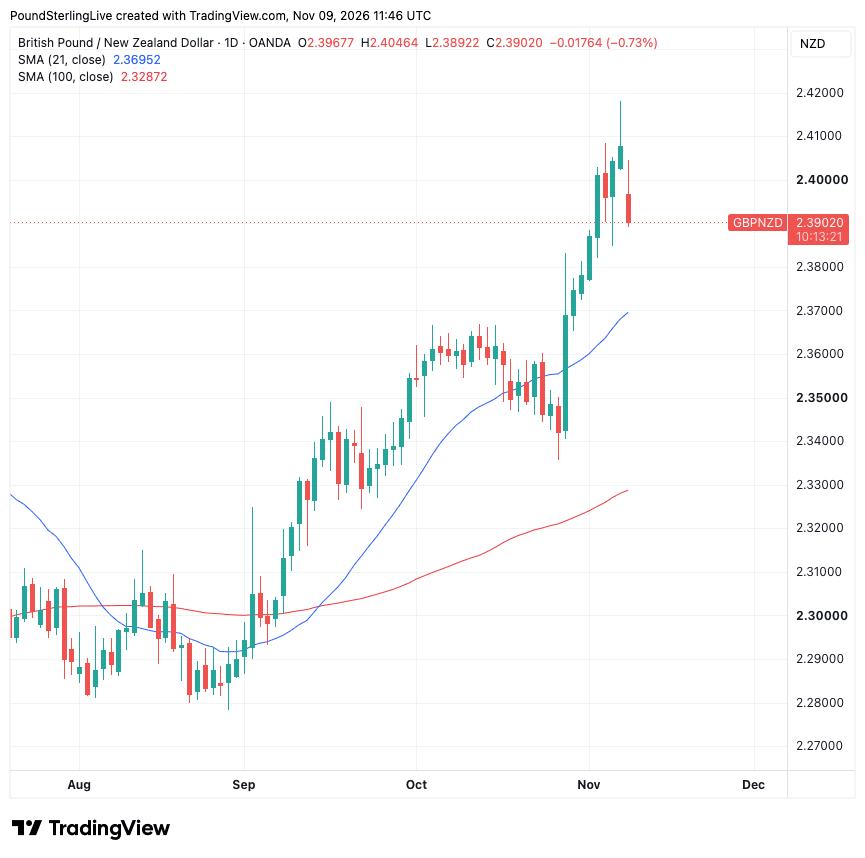
Above: GBP/NZD daily chart with the 21-day (blue) and 100-day (red) moving averages. Image © Pound Sterling Live, chart created with TradingView.
Both averages are rising, the 21-day steeply since late October and the 100-day at a steady pace since September.
Friday's high at 2.4179 is resistance, and the 2.40 level, first cleared on 3 November, is the pivot that Monday's drop has taken the pair back beneath.
The October ceiling at 2.3668 sits alongside the 21-day average, and the two form the first support band.
Pound Sterling Live's mean-reversion modelling holds that a pair trading above its 21-day average tends to close the gap through a pullback or a consolidation.
Pound Sterling Live therefore looks for GBP/NZD to ease towards the 2.3668 band this week should stocks extend their recovery. A daily close above 2.4179 would change the near-term Pound to New Zealand Dollar forecast.
Standing back, the multi-year uptrend remains intact, and a setback should be seen as a pause within it.
Last week Pound Sterling Live looked for the rally to extend towards 2.40, and the pair reached 2.4026 on 3 November before peaking at 2.4179 on Friday.
Stocks Must Keep Recovering for the Kiwi to Extend Its Bounce
The New Zealand dollar rose around 1% against the U.S. dollar on Monday as Asian stock markets recovered from last week's sell-off in AI-linked shares.
The kiwi reacts strongly to such swings in sentiment because of its high-beta status.
What is a high-beta currency? It is one that moves further than its peers when investors change their appetite for risk, falling hardest in a sell-off and recovering fastest when buyers return.
"Global risk sentiment, USD moves and RBNZ expectations" are likely to matter more for the kiwi than the vote, says Commonwealth Bank of Australia.
The kiwi also carries heavy bearish positioning, with the New Zealand dollar the "largest short in G10 after fresh IMM-driven selling," says Crédit Agricole in a recent update.
A recovery in risk appetite would force those sellers to buy back the currency, adding to its gains.
Strong U.S. Inflation Would Cut the Kiwi's Recovery Short
However, the New Zealand dollar's recovery faces a test from Tuesday's U.S. inflation figures, which will shape expectations for a Federal Reserve hike in December.
Consumer prices are forecast to rise 0.3% month-on-month in October, with core inflation seen at 0.2%. CIBC forecasts core inflation of 0.3% and Citi 0.19%, with the figures due at 13:30 London time.
Under the playbook, a print above consensus would lift the U.S. dollar and push U.S. bond yields higher, weighing on stocks and the kiwi. A softer print would support the recovery in risk appetite.
Commonwealth Bank of Australia says NZD/USD "will test its April 2025 low of 0.5486 if US core CPI for October surprises to the upside as we expect."
The Election Adds Uncertainty Without Changing the Kiwi's Path
Turning to the vote, the centre-right bloc holds a 10-seat lead in the preliminary count, with the Opportunity Party holding the balance of power.
Around 400,000 special votes remain to be counted, and the final result is due on 27 November.
"Based on these results, we see a higher probability of a centre-right government ultimately emerging that likely will require the support of the Opportunity Party in some form," says Westpac.
The outcome matters for the Reserve Bank of New Zealand's remit, as "a centre-right government won't change the RBNZ mandate while a centre-left government likely still will," Westpac adds.
Crédit Agricole says a return to a dual mandate under Labour would "only marginally add to the RBNZ's current dovishness as perceived by the market."
Goldman Sachs expects no new government to form before the RBNZ's 9 December meeting, and says "NZ's political backdrop is neutral for the RBNZ."
Markets price around 16 basis points of tightening for December after unemployment rose to 5.7% in the third quarter, an 11-year high.
A speech by RBNZ Chief Economist Paul Conway on Tuesday, retail card spending and migration data on Thursday and the manufacturing PMI on Friday are second-tier releases for the kiwi.
UK GDP Gives the Pound Its Own Test
Thursday's UK GDP figures are expected to show growth of 0.7% in the third quarter, with the data due at 07:00. Investec forecasts 0.8% and ASB 0.4%.
Under the playbook, a print above consensus would support the pound and limit the kiwi's recovery. A miss would add to GBP/NZD's setback.
Oxford Economics says "a December hike is now a 50-50 call, but either way it looks very likely Bank Rate will reach 4.25% by its February meeting."
Pound Sterling Live's Pound to New Zealand Dollar forecast looks for a setback towards 2.3668 should stocks extend their recovery, with the multi-year uptrend intact for as long as the pair holds above its rising 100-day average.