

Image © Adobe Images
British companies are turning AI into productivity gains faster than their European peers, although firms are banking much of the gain by hiring fewer people.
British companies lead Europe in putting numbers on what artificial intelligence has delivered for their businesses, a Morgan Stanley study of more than 6,200 European company transcripts finds.
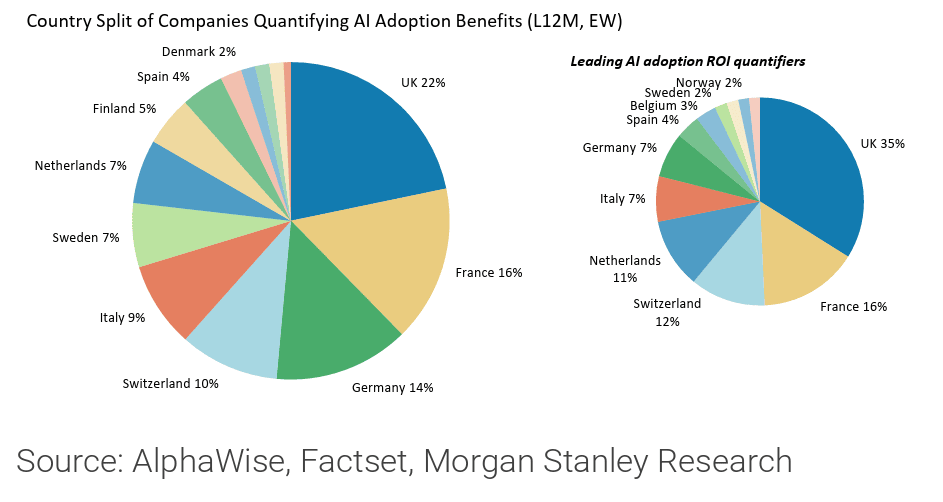
"The UK has the most companies quantifying AI adoption benefits & the greatest number of stocks in our 'leading European AI adoption ROI quantifiers' list," says Morgan Stanley, the US investment bank, in research published on 8 November.
UK companies make up 35% of Morgan Stanley's list of 59 leading quantifiers, which includes Lloyds, NatWest, Barclays and the London Stock Exchange Group.
Lloyds Banking Group expects AI and other measures to "drive around £2 billion of gross cost savings from 2027 to 2030," the bank told investors in July.
Faster productivity growth raises the rate at which the economy can expand without generating inflation, known as potential growth.
UK private-sector productivity growth stands at around 2.5% year-on-year as of the third quarter, with "a particularly notable inflection over 2026," says Bruna Skarica, Chief UK Economist at Morgan Stanley.
Skarica attributes the rise to stronger output in high value-added services, particularly technology, while employment growth has lagged output.
Deutsche Bank expects third-quarter GDP growth of 0.7%, the strongest since late 2024, "capex growth has also lifted output, with AI spending, defence spending, and industrial policy all boosting GDP," says Sanjay Raja, Chief UK Economist at Deutsche Bank.
"AI-related investment remains strong, supporting demand for software, cloud infrastructure, data-centre capacity and energy," say the Bank of England's Agents in their latest survey of company contacts.
The findings support Pound Sterling Live's House View, which holds that the AI trade is spreading from US equities into the UK economy, with business investment one of the channels.
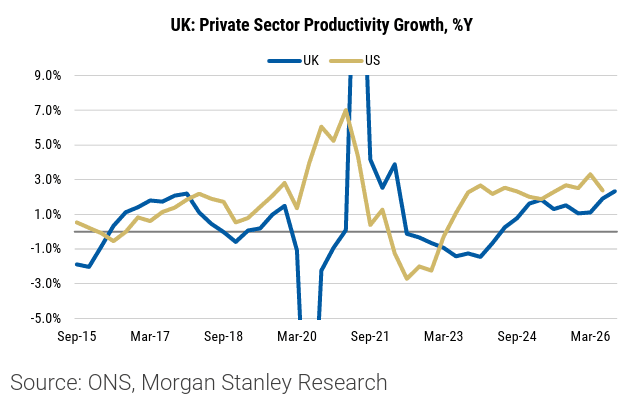
Above: UK productivity growth can return to pre-crisis levels.
The OECD's medium-adoption scenario adds about one percentage point a year to productivity growth over the next decade.
"This would be consistent with the 2.5% rate attained in the UK in 2026 persisting from here. This would, in turn, result in the UK's potential GDP growth reverting to its pre-GFC levels. To us, this looks the most plausible upside scenario," says Morgan Stanley's Skarica.
The IMF finds 70% of UK employment sits in AI-exposed occupations, against 60% in the US, split almost equally between jobs where AI complements workers and jobs where it can replace them.
Britain's gains come from using AI, with its data-centre build-out far smaller than those of the US and China, "UK looks uniquely placed to serve as a test-case for the European 'application opportunity' hypothesis," adds Skarica.
But, UK Output Is Rising Faster Than Hiring
The productivity gain has come with weaker hiring, the pattern Pound Sterling Live has described as jobless growth.
UK payrolls have not responded to the sharp rise in output over 2026, Morgan Stanley's analysis of ONS data shows.
Employment in the information and communications sector is the weakest of any sector, which Skarica attributes to its faster adoption of AI.
Across Europe, revenue growing faster than headcount is the most common theme when companies discuss AI and jobs, accounting for 40% of such comments in Morgan Stanley's study.
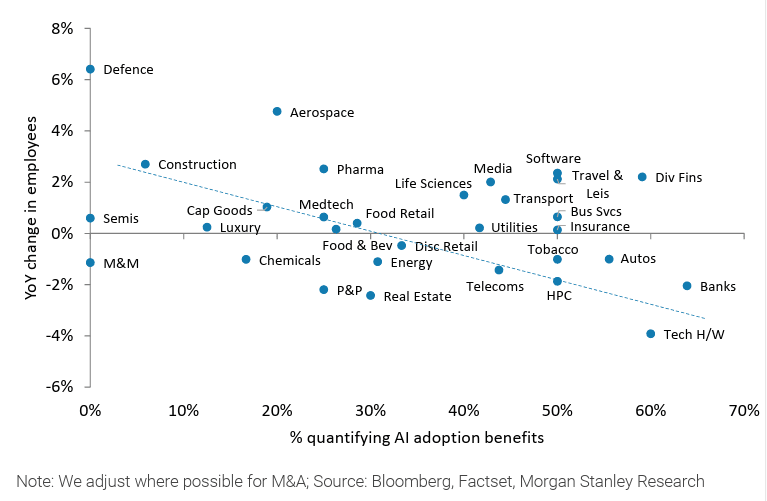
Morgan Stanley's research shows a linear pattern between employee change and exposure to AI adoption benefits.
Some 63% of the leading quantifiers have cut headcount over the past year, against 46% of companies in the MSCI Europe index.
UK firms are hiring fewer people rather than laying staff off, as Pound Sterling Live reported last week.
Labour-market effects "continue to be seen primarily through lower replacement hiring, slower recruitment and reduced trainee intakes rather than widespread job losses," say the Bank's Agents.
Pound Sterling Live holds that the resulting unemployment sits outside the reach of Bank of England rate cuts, because businesses hold ample cash and are not waiting on cheaper credit to hire.
However, professional services and administrative support have been employment growth outperformers in recent months, "AI does not displace, but makes workers more productive, which ultimately results in an equilibrium where employment growth is positive, albeit slower than the pace of output expansion," says Skarica.
The 2.5% figure is a cyclical measure, which "can only be translated to structural, long-run trend if it is sustained," she adds.
UK productivity growth must hold near 2.5% in the ONS's new quarterly productivity estimates, due on 17 November, for Morgan Stanley's upside scenario to stay in play.