
Image © Adobe Images
The New Zealand dollar has room to recover as a cheaper currency lifts New Zealand's economy and keeps the RBNZ raising interest rates.
The New Zealand dollar's slide to a 17-year low on a trade-weighted basis risks overshooting, analysts say, because New Zealand's economy is improving.
Stronger growth and inflation running above target keep the Reserve Bank of New Zealand (RBNZ) on course to raise interest rates, which would lift the kiwi against the U.S. dollar, the Australian dollar and the pound once investors' appetite for risk returns.
"For now it looks like the combination of a low exchange rate, stronger global demand and tight supply conditions in soft commodity markets will do the heavy lifting for the economy. And there the outlook continues to look very bright," says a new economic overview from Westpac, the Australian bank.
"Inflation remains high and will be tough to bring down. This will keep the RBNZ raising the OCR gradually into the end of 2026 and through 2027," Westpac adds.
The kiwi's weakness is broad-based: its trade-weighted index, a measure of its value against a basket of currencies, stands at 63.2, a 17-year low, and NZD/AUD is near 13-year lows at 0.8166.
The pound-to-New Zealand dollar exchange rate is at 2.3979, close to the 2.4179 high it set on 6 November, its highest since 2015. NZD/USD is at 0.5497, having touched 0.5482 on 16 November, its weakest since 2020.
USD/NZD, the inverse of NZD/USD in which a rising line means a weaker kiwi, trades well above its 21-day moving average, the blue line on the chart:
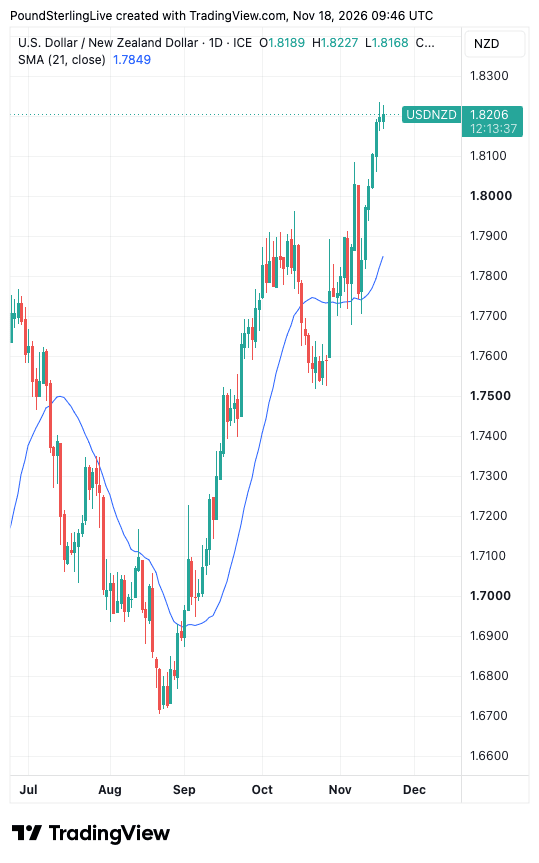
Above: USD/NZD at daily intervals with the 21-day moving average (blue). A rising line means a weaker New Zealand dollar. Image © Pound Sterling Live, chart created with TradingView.
USD/NZD sits 2.0% above its 21-day average, and Pound Sterling Live's mean-reversion modelling holds that a gap of this size closes through a pullback or a consolidation. A pullback in USD/NZD would also mean a firmer kiwi against other currencies.
According to analysis by Commonwealth Bank of Australia, foreign investors cut their share of New Zealand government bonds by 2.3 percentage points to 57% in October, a five-year low, ahead of the general election.
Strategists at CBA say the selling reflected investors cutting risk ahead of the vote, "overall, we do not expect the weakness in foreign ownership to persist," says the Australian bank.
Should foreign buyers return, the currency would find itself better supported.
The RBNZ Might Be Another Source of Support
A key driver of recent NZD underperformance has been the view that the RBNZ has been too slow on the rate hike agenda, meaning local bond yields haven't offered international buyers the premium they demand.
But, firm inflation readings could mean the RBNZ has to move again: New Zealand's selected price indexes rose 1.4% in October and 6.4% over the year, Stats NZ figures show, with petrol up 11.9% on the month.
ASB, the New Zealand bank, forecasts annual inflation of around 4.4% in the fourth quarter, "persistent cost-push pressures and a weak NZD appear to be impacting pricing," says the local lender.
Looking ahead, analysts see some strength returning.
Bank of America targets 1.21 in AUD/NZD, which implies a stronger kiwi against the Australian dollar, "in the near term, we also see rising headwinds from rate differentials for AUD/NZD," says the U.S. bank in a recent update.
Investment bank analysts' 12-month forecasts for NZD/USD sit above spot: Westpac and OCBC see 0.62, UBS 0.60, MUFG 0.59 and Morgan Stanley 0.58.
A Cautious RBNZ Would Keep the Kiwi Under Pressure
Nevertheless, should the RBNZ raise interest rates more slowly than markets expect, the kiwi would lose part of its rate support.
Goldman Sachs expects hikes in February and June 2027 to take the Official Cash Rate to 3.25%, "further hikes look unnecessary to us and over-priced by markets," says the U.S. investment bank.
"Our RBNZ forecast is materially more dovish than pricing in financial markets," it adds.
Goldman Sachs' economists expect the New Zealand dollar to weaken over the medium term, although its currency strategists forecast NZD/USD at 0.60 in 12 months, above spot.
Five- and ten-year inflation expectations slipped to just above 2% in the RBNZ's December quarter survey, data released on 17 November show.
"The risk given the October decision is that the RBNZ prefer a more gradual approach," says ASB.