

Image © Adobe Images
The pound risks a pause against the Australian dollar as stronger Australian wage growth meets hawkish RBA minutes and a possible turn in stock market sentiment.
The pound is due a breather against the Australian dollar after a rally that has stretched the exchange rate well above its recent average.
The pound-to-Australian dollar exchange rate rallied 4.2% from a low of 1.8859 on 29 October to a peak of 1.9647 on 18 November, its highest level since early February, and has since eased to 1.9613.
GBP/AUD now trades 1.9% above its 21-day moving average, the level the exchange rate tends to return to after a strong run, with the Relative Strength Index at 72.7, above the 70 threshold that marks overbought conditions.
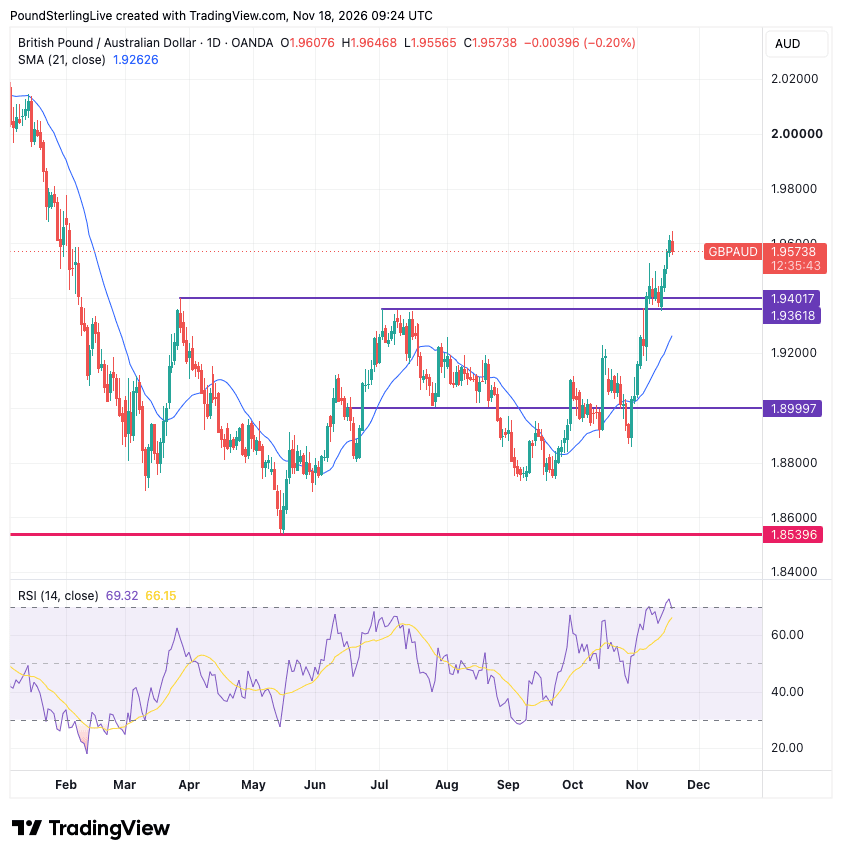
Pound Sterling Live's modelling holds that a deviation of this size - between the spot rate and the 21-day MA - will mean revert and the two will move to close the gap, either through a pullback towards the average or a period of consolidation that allows the average to catch up.
Signs that the Reserve Bank of Australia remains concerned about inflation will limit bets on Australian rate cuts, in turn giving the Australian dollar the support it needs to recover some of its losses against sterling.
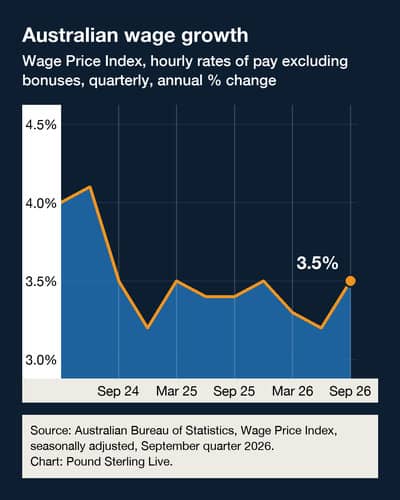
The latest sign came on Wednesday, when data showed Australian wages rose 1.1% in the third quarter, the strongest quarterly gain since late 2023 and ahead of the 1.0% expected.
"The wages data on the margin reinforces [our] view that the RBA will remain on edge into early 2027 about the upside risks to inflation and spillovers to wages," says Joseph Capurso, FX Strategist at Commonwealth Bank of Australia.
Analysts Doubt the Market's Bets on RBA Rate Cuts
Minutes of the RBA's November meeting, released on Tuesday, show the majority of the Board raised the cash rate to 4.85% on concerns about the upside risks to inflation, although the three members who voted to hold warned the economy "might be near the point of entering a materially sharper downturn."
Money markets price roughly even odds of an RBA rate cut over the coming twelve months.
Elias Haddad, Global Head of Markets Strategy at Brown Brothers Harriman, says markets betting on a cut "may be getting ahead of themselves" because the minutes point to "stronger domestic inflation pressures, particularly in market services and ULC [unit labour costs]."
"Persistent upside inflation risks could warrant further hikes," he adds.
RBA Governor Michele Bullock reinforced the message on Tuesday, saying "the risks on inflation are still skewed to the upside."
The Australian Dollar Needs Stock Markets to Steady
The Australian dollar has so far struggled to benefit from that domestic support, as a sell-off in technology stocks took AUD/USD to 0.6720 on Tuesday, within a cent of its 2026 low.
The Australian dollar is a risk-on currency: it tends to rise when global stock markets advance and fall when they retreat, as investors sell commodity-linked currencies in favour of havens such as the US dollar and Japanese yen.
US stocks fell for a fourth consecutive session on Tuesday, leaving the S&P 500 roughly 12% below its record, after tighter US curbs on China's access to advanced AI chips added to doubts over the returns on AI spending.
Weakness in China, Australia's largest export market, adds a further headwind, "The Chinese economy is struggling to gain traction with little policy support from the authorities," says Commonwealth Bank of Australia's Capurso.
Iron ore prices, a key source of Australian export income, have fallen below $90 a tonne for the first time since November 2022.
However, CIBC says positive news from Nvidia's earnings and Anthropic's stock market listing this week "could see a reversal in recent risk off."
The Australian dollar would recover ground against the pound should stock markets steady, taking GBP/AUD back towards support at 1.9402 and then 1.9362, both former resistance levels.