

Image © Adobe Images
Pound sterling retains support against the euro despite a sharp drop in payrolls.
The Bank of England will likely raise rates again in December despite Tuesday's labour market figures showing a fall in payrolled employees.
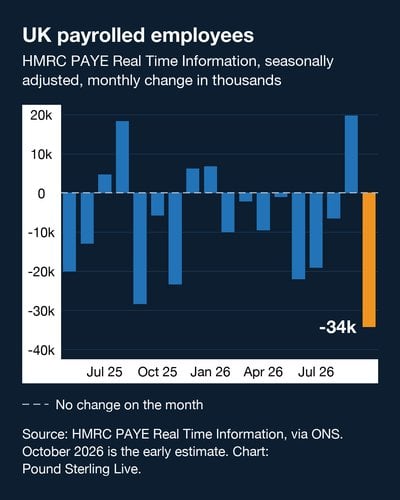
HMRC payroll data, considered the more accurate measure of the employment measures released today, showed 34K fewer employees in October against expectations for a 10K gain, while job vacancies fell to 690K, the lowest since 2014 outside the pandemic.
These headlines read as soft, and would typically be associated with a fall in sterling. Yet, the currency is supported on the day: the pound-to-euro exchange rate rises to 1.1985, the pound-to-dollar pairing rises to 1.3196.
The reason for the resilience is that other elements of the report were constructive, and the Bank of England might be more concerned about Wednesday's inflation report, meaning the all-important pricing of a December rate hike survives Tuesday's labour figures.
It was truly a mixed bag from the ONS which also said unemployment fell to 4.6% in the three months to September, below the 4.7% economists had expected and the lowest since April 2025.
Unemployment's fall points to limited 'spare capacity' in the labour market, which keeps the Bank of England on course for a December rate rise and, in turn, allows sterling to keep its yield advantage over the euro and limit its losses against a dollar lifted by Federal Reserve hike bets.
"There's likely less slack in the labour market than previously thought," says Sanjay Raja, Chief UK Economist at Deutsche Bank.
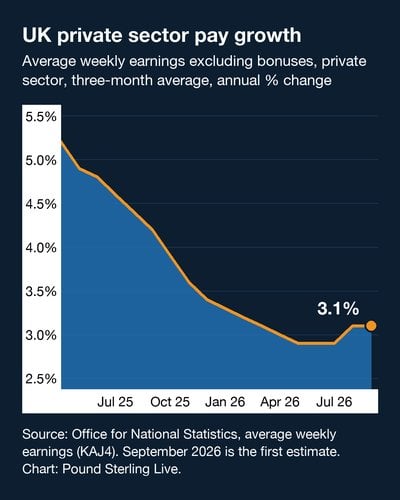
Private sector regular pay growth, the Bank's preferred wage gauge, held at 3.1% in September, matching the Bank's own forecast. Cooling wages might, however, not be enough to prevent another hike, as traditional monetary policy theory would suggest. Pound Sterling Live reported recently that Deputy Governor Clare Lombardelli has shown that weak hiring in the current cycle has done less to cool wages than a conventional downturn
Wages, Economic Growth Are Robust Enough for the Bank of England to Act
Pantheon Macroeconomics now forecasts a December hike, provided Wednesday's inflation figures carry no large downside surprise, "MPC members have changed the burden of proof; the evidence has to show a hike is unnecessary. At the margin, today's data fail to show that," says Rob Wood, Chief UK Economist at Pantheon Macroeconomics.
"Private pay is showing strong momentum by rising 4.2% three-months-on-three-months annualised," he adds.
The jobless rate is meanwhile now "within a whisker of 4.5%, which the Bank of England believes to be the economy's 'equilibrium' or 'steady state' condition," says Philip Shaw, an economist at Investec.
Third-quarter growth beat expectations, and "if the pace of GDP growth continues to surprise to the upside, without an accompanying increase in productivity, the Bank of England may begin to fear that it needs to lean against tighter labour market conditions, threatening a more aggressive series of Bank rate increases," he adds.
"There is enough here to keep the Committee's hawks banging the drum for a higher terminal rate," says Lloyds Bank.
However, Barclays expects the Bank to hold in December, "The noise in the LFS data, combined with the weakness in the other labour market indicators we think will enable the MPC to look through the fall in the unemployment rate," says Jack Meaning, Chief UK Economist at Barclays.
"We continue to judge that the modal group on the MPC will prefer to hold Bank Rate at 4.0% in December if data comes in line with its expectation," he adds.
Martin Beck, Chief Economist at WPI Strategy, expects November's hike to prove "a one-and-done", with private pay growth already running at a pace consistent with inflation returning to 2%.