

Image © Adobe Images
The pound should stay on an upward path against the euro and keep outperforming against a strong dollar while solid UK growth supports further Bank of England rate hikes.
The pound's uptrend against the euro is intact after official figures showed the UK economy kept up a strong pace of growth in the third quarter, keeping further Bank of England rate hikes in play.
GDP grew 0.7% in the three months to September, matching the consensus forecast, the Office for National Statistics said on Thursday. Output rose 0.2% in September alone against expectations for no growth, although August was revised down to show no growth.
This steady growth gives the Bank of England little reason to hold back on rate hikes while inflation runs well above target, in turn allowing sterling to keep its yield advantage over the euro and keep in touch with the high-yielding dollar.
"Something is stirring: monthly GDP beat consensus for the fifth straight month and the seventh in eight," says Rob Wood, Chief UK Economist at Pantheon Macroeconomics. "Today's figures, at the margin, make a December hike more likely," he adds.
Household consumption rose 0.6% in the third quarter and government investment jumped 13.6%, adding 0.4 percentage points to growth, according to the quarterly breakdown.
KBC, the Belgian bank, says personal consumption is nearing its fastest pace of the last four years.
"Households are spending and businesses are investing more than we expected," says Sanjay Raja, Chief UK Economist at Deutsche Bank. "Underneath the hood, AI investment has been strong with our estimate of AI related spending growth adding 0.3-0.4pp to GDP growth this year," he adds.
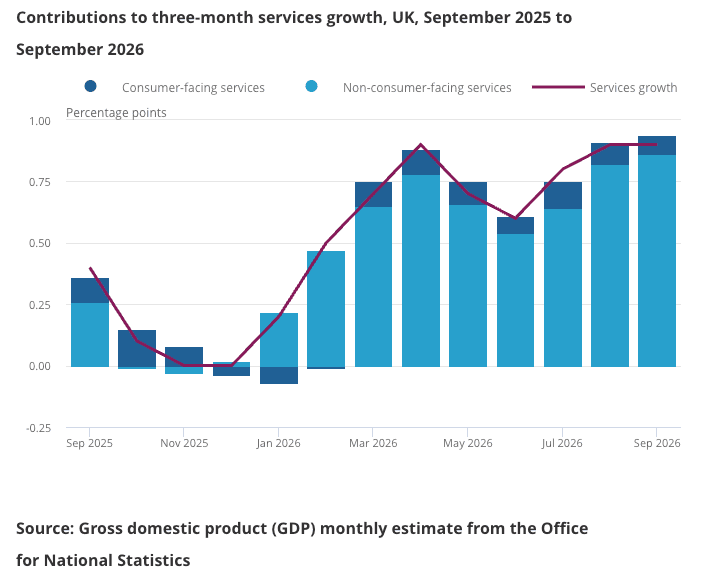
Computer programming and consultancy, the industry that made the largest contribution to three-month growth in each of the previous seven months, fell 1.9% in September.
"That challenges the 'AI-tailwind' story, given these sectors' exposure to AI, but some payback after rip-roaring summer growth is par for the course in volatile sectors," says Pantheon's Wood.
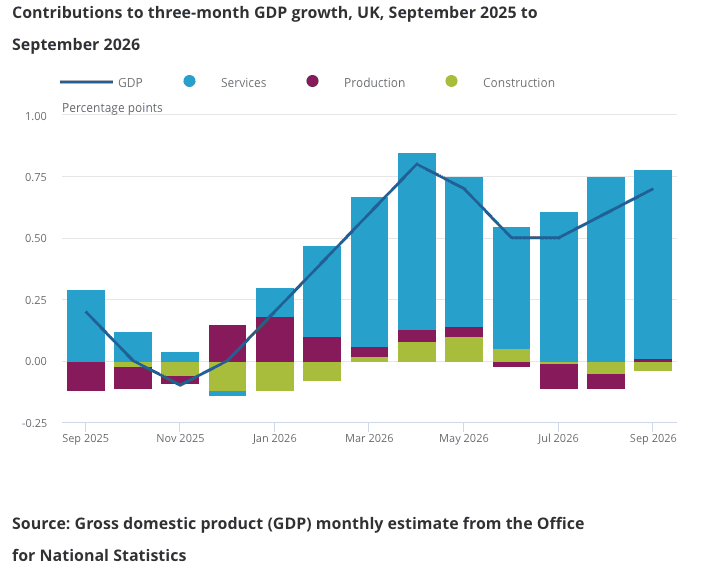
"There is a danger the headline number flatters an economy that is beginning to lose momentum underneath," says Kit Rees, Investment Strategist at Quilter.
Markets price around 17 basis points of tightening at the Bank of England's December meeting, close to a two-in-three chance of a hike.
Commonwealth Bank of Australia expects the Bank to hold in December before raising rates in February and April 2027.
GBP/EUR Holds Its 21-Day Average to Keep the Uptrend
Sterling's reaction to the figures was limited, but the data does enough to underpin Pound Sterling Live's constructive thematic stance on GBP/EUR, noting that growth and enduring inflationary pressures will keep domestic interest rates higher for longer, particularly compared to other key economies, which in turn bestows strength upon the currency.
The sterling-euro rallied 3.5% from late September to a peak of 1.2016 on 30 October and has since made a shallow 0.35% pullback to 1.1974, holding above its 21-day moving average at 1.1953.
Pound Sterling Live's short-termmodelling treats the pullback as the consolidation needed to close the gap that had opened between spot and the 21-day average, leaving the uptrend intact:
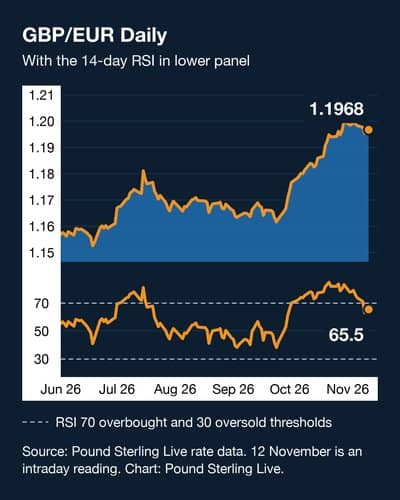
Above: GBP/EUR at daily intervals. The pair holds above its rising 21-day moving average, with the 100-day average near 1.1750 marking deeper support.
As the chart above shows, the 21-day has been re-engaged, and the market now looks better balanced.
Nevertheless, Spectra Markets has warned that falling gas prices could invigorate the euro, as Pound Sterling Live reported on Thursday, opening the door to a deeper GBP/EUR pullback.
J.P. Morgan has held its trade betting on a lower EUR/GBP since the Bank's November hike, as Pound Sterling Live reported.
UK and EU leaders meet in Brussels on 20 November to discuss closer relations, which KBC says helps lower UK risk premia.
Pound Stares Down the Strong Dollar
Against the dollar, the pound, like most others, has struggled this week, but it's holding up better than the euro as hot U.S. inflation data lift bets on further Federal Reserve rate hikes.
U.S. consumer prices rose 0.4% in October and core prices 0.3%, both above forecasts, lifting the dollar index to 103, its highest since April 2025.
The pound-to-dollar exchange rate has fallen 1.4% in a week to 1.3267, although it is down just 0.15% over a month in which EUR/USD has fallen 1.3%.
Sterling's smaller losses against the dollar are what keep GBP/EUR close to its highs.
Commonwealth Bank of Australia warned before the release that a soft reading "can modestly unwind pricing for a December BoE hike and pull GBP/USD even lower."
The beat in September output removes that risk for now.
However, "the AI investment boom is therefore a key pillar of the US exceptionalism narrative underpinning our expectation of further USD appreciation," says the Australian bank.
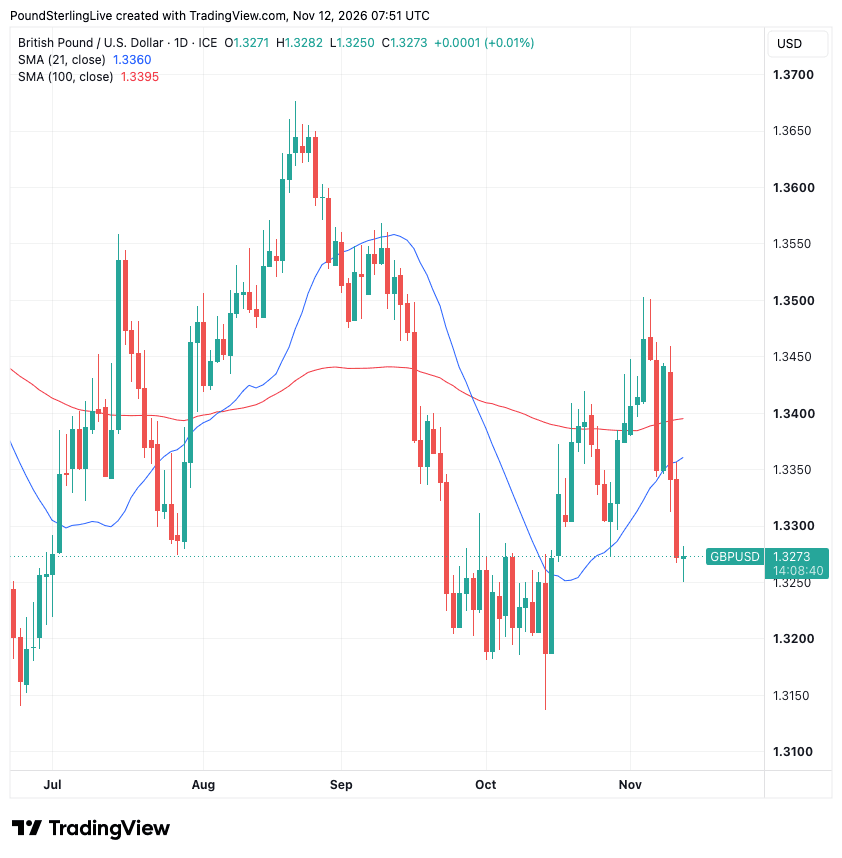
Above: GBP/USD at daily intervals. The pair has fallen below its 21-day and 100-day moving averages after hot US inflation data.
Pound Sterling Live continues to hold a constructive medium-term view on the pound's prospects; the economy is outperforming expectations, the Bank of England is still raising rates as UK inflation proves sticky and slow to fall back to the 2.0% target, and the euro is undermined by French fiscal stress.
GBP/USD needs to hold above 1.3234, the support level Commonwealth Bank of Australia is watching, to keep the pound's decline against the dollar orderly.