
Image © Adobe Images
Pound sterling's pullback against the euro could deepen if falling energy prices keep lifting the single currency, although the Bank of England's rate support should keep any setback shallow.
The pound-to-euro pullback could have further to run as falling energy prices ease the pressure on the single currency, says Brent Donnelly, strategist at Spectra Markets.
"The big EURGBP [GBP/EUR uptrend] downtrend looks tired. The improving energy situation may take the edge off the 'Europe is going to have an energy crisis' view. Dutch NG is high, but falling," he says.
Dutch NG is the Dutch TTF gas contract, Europe's benchmark gas price, which has fallen 15% from its recent high as hopes grow that the US-Iran conflict is nearing a resolution.
Donnelly tests the energy signal against the Norwegian krone, "I include an overlay of EURNOK in red because that is another energy indicator. EURNOK has been tracking energy prices very closely since the war against Iran started," he adds.
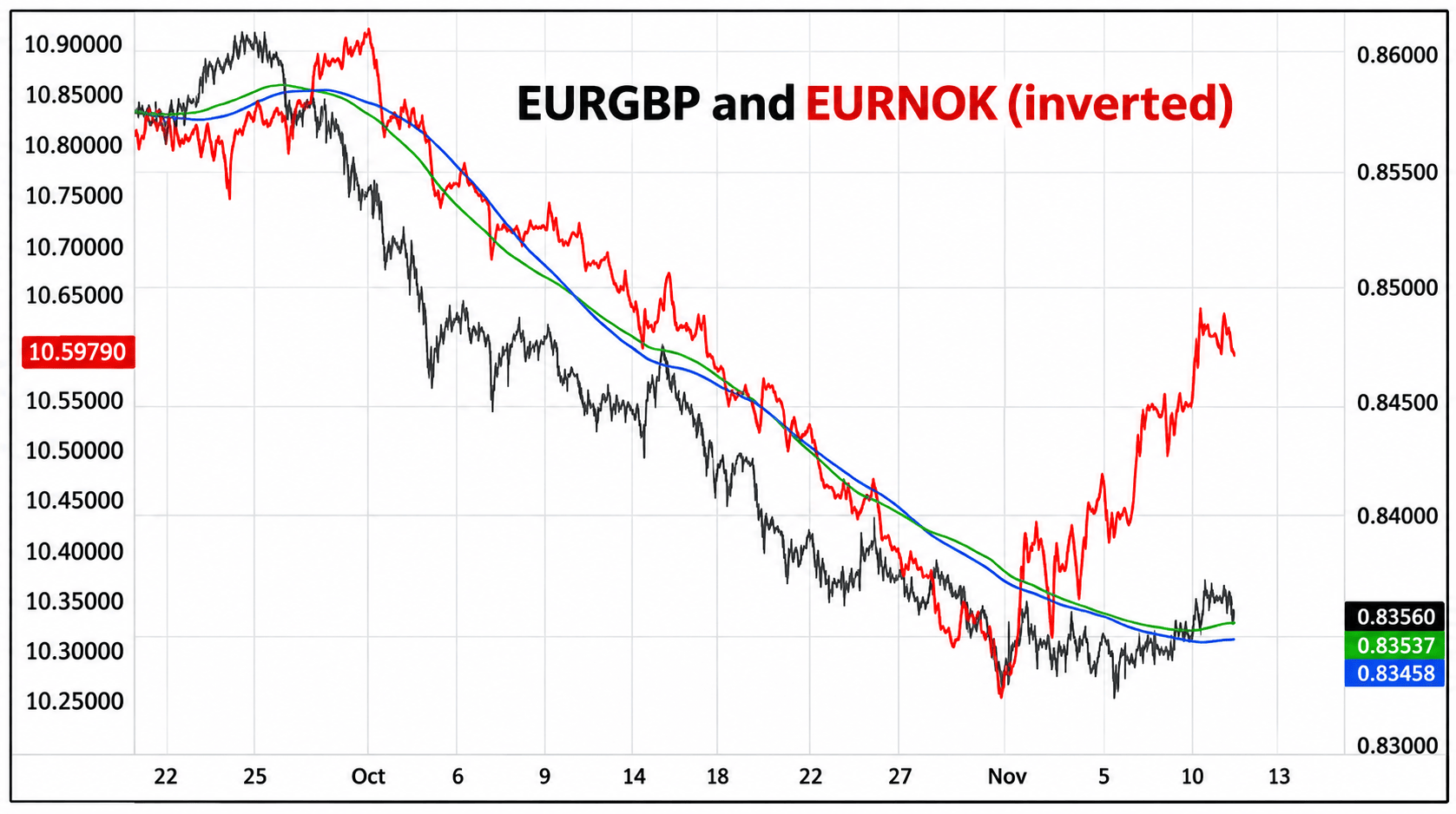
EUR/NOK has risen 3.3% since the end of October as lower oil and gas prices weigh on the krone, the currency of a large net energy exporter.
"With Brent already off its highs and a diplomatic solution on the table, the mechanism that lifted the krone is now working in the other direction," says Handelsbanken, the Nordic lender.
EUR/GBP is following on a smaller scale, and Donnelly notes the pair has risen above its moving averages, which sit between 0.8346 and 0.8354 (GBP/EUR 1.1970 to 1.1982) on his chart, for the first time since it traded at 0.8600 (GBP/EUR 1.1628).
The pound-to-euro exchange rate rallied 3.5% from late September to a peak of 1.2016 on 30 October and has since slipped 0.4% to 1.1967.
What would it mean for the pound if EUR/GBP followed EUR/NOK higher? A 3.3% rise from the 30 October low would take GBP/EUR back to around 1.1630, close to where the pound's autumn rally began.
Crédit Agricole is positioned for a more modest setback, with its short-term valuation model, FAST FX, holding a long EUR/GBP trade (a bet on a lower GBP/EUR) that targets 0.8496 (GBP/EUR 1.1770), as Pound Sterling Live has reported.
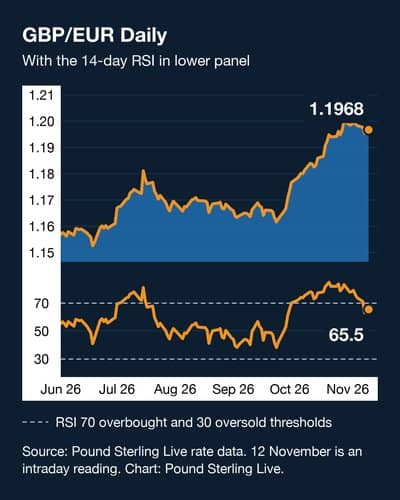
Pound Sterling Live Expects UK Rate Support to Keep Any Setback Shallow
Pound Sterling Live's view remains that any pound weakness against the euro will be shallow, because the Bank of England is set to keep UK interest rates higher than the ECB's for longer.
The Bank of England projects UK inflation peaking at 4.9% in the second quarter of 2027 and returning to the 2.0% target only in the third quarter of 2028, its November Monetary Policy Report shows.
Eurozone inflation is on a much steeper path lower, with ECB staff projecting a fall to 2.5% in the second quarter of 2027 and readings close to 2.0% thereafter, their September projections show.
Lower energy prices would pull eurozone inflation down faster still, which opens the door to an easier ECB stance in 2027 and limits the lift the euro gets from the energy story.
ING forecasts eurozone inflation at 1.8% by the end of 2027, and "the ECB can keep its powder dry in 2027 and might even consider a rate cut towards the end of the year," says ING.
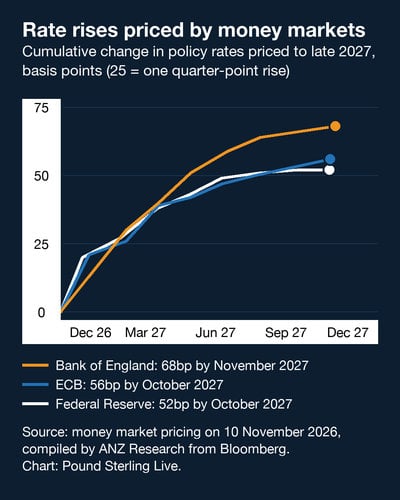
Money markets price Bank Rate rising to 4.67% by November 2027 and the ECB's deposit rate to 3.00% by October 2027, which would widen the pound's yield advantage to around 1.7 percentage points from 1.5 points today, as Pound Sterling Live has reported.
BNP Paribas is less sure about the inflation gap, forecasting eurozone inflation at 3.2% in 2027, close to its 3.5% forecast for the UK.
NatWest expects the ECB to raise rates in December and says a further increase is possible in March 2027, which would narrow the pound's yield advantage.
Pound sterling is exposed to a deeper setback only if eurozone inflation proves as sticky as BNP Paribas expects and keeps the ECB raising rates alongside the Bank of England.