Image © Adobe Images
The Norwegian krone is set to weaken should oil prices stay off their highs and investor nerves rise, with a Norges Bank that has stopped raising rates offering less carry support.
The Norwegian krone's rally is over now that oil prices have retreated from their highs and Norges Bank has finished raising interest rates, says a new FX market analysis from Handelsbanken.
"Oil will still drive NOK, and any renewed escalation would support the krone again. But with energy prices past their peak, the balance of risks for NOK has turned from tailwind to headwind," says Handelsbanken.
Brent crude has fallen from near $120 a barrel to around $90 on hopes of a US-Iran diplomatic deal, cutting the value of Norway's energy exports and easing the inflation pressure that kept Norges Bank hawkish, in turn removing the two supports behind the krone's rally this year.
Norges Bank held its policy rate at 4.50% on 5 November and said it is "prepared to raise the policy rate if needed to bring inflation down to target within a reasonable time horizon."
Statistics Norway's October figures, released on Tuesday, weakened the case for a further hike: underlying prices rose 0.3% on the month, below the 0.4% consensus, and headline inflation slowed to 2.7% from 3.0%.
Money markets now price little chance of a December hike, "in our view, Norges Bank has peaked, and we expect the first cut to 4.25 percent by the third quarter of next year," says Handelsbanken.
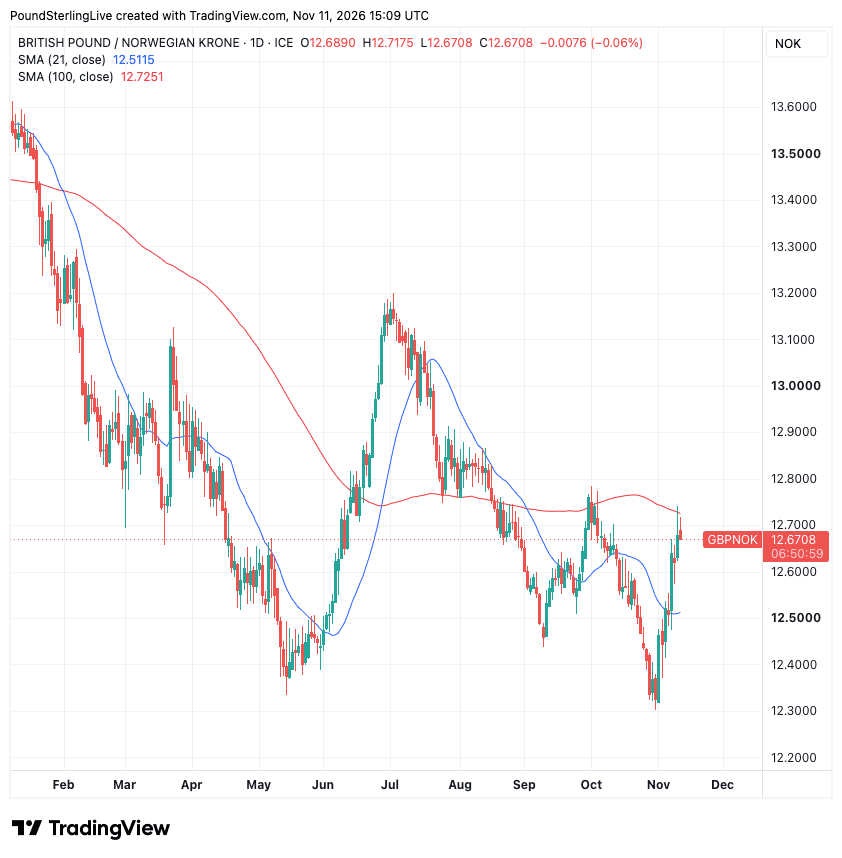
The krone is already in retreat: the euro-to-krone exchange rate has risen 3.3% from 10.2733 on 30 October to 10.6090, and the pound-to-krone rate is up 2.9% over the same period at 12.6831, a pullback Crédit Agricole's positioning models flagged as due last week, as Pound Sterling Live reported.
Handelsbanken concedes the correction it anticipated is already under way, "for positioning, we would use rebounds in NOK to add exposure to a weaker krone rather than chase the move after a sharp correction," it adds.
Handelsbanken's framework sorts markets into four regimes by the direction of oil prices and the VIX, the gauge of equity-market fear, and shows the krone fares worst when oil falls and fear rises.
"Since 1993, we identify 16 episodes of falling oil and rising VIX. In these, EURNOK rose by an average of 3.1 percent, with the krone weakening in the majority of cases, and the outcomes have fat tails," says Handelsbanken.
A renewed Middle East escalation would lift oil and support the krone temporarily, although Handelsbanken says the equity sell-off that would come with it keeps the krone in one of the less favourable regimes.
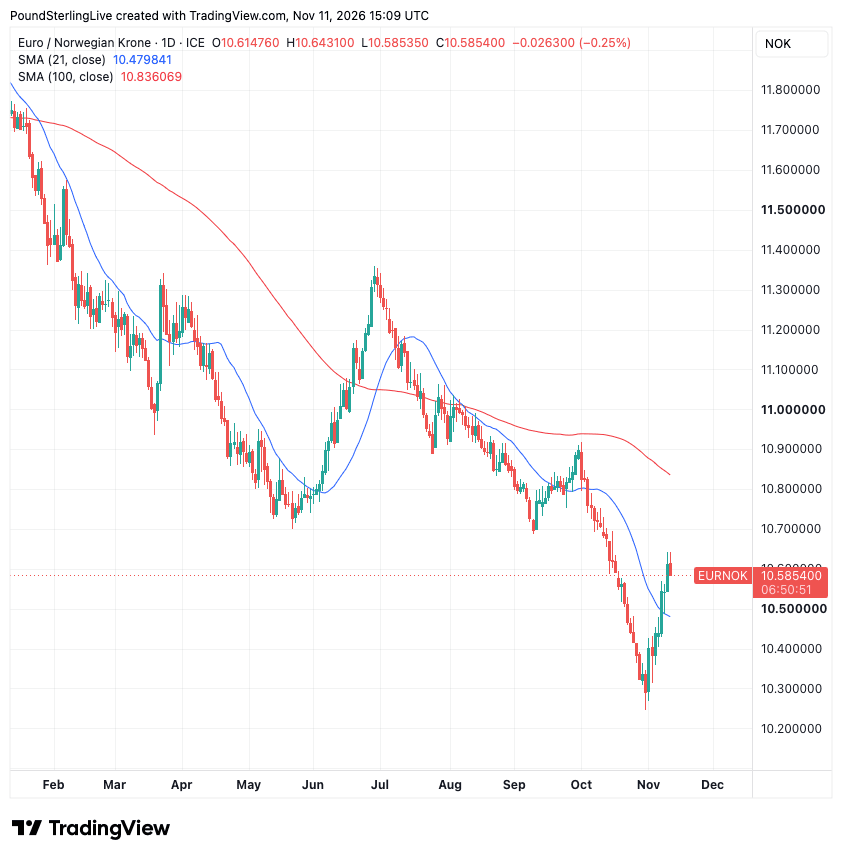
Rabobank is more constructive and targets EUR/NOK at 10.00 on a 12-month view, saying it would treat a move back to 10.80, the 100-day moving average, as one of the "opportunities to re-establish long positions."
Handelsbanken sees no fundamental case for 10.00 at current oil prices, "we see the risks tilted towards a higher EURNOK from current spot," it adds.
The pound is well placed to extend gains against the krone, with the Bank of England's 5 November hike to 4.00% narrowing the yield advantage the krone holds through Norges Bank's 4.50% policy rate.
Handelsbanken's preferred longer-term expression of krone weakness is against the Swedish krona.
The krone is likely to stay on the back foot until oil prices rise again and equity volatility subsides, the combination that powered this year's rally.