

Image © Adobe Images
The pound can extend its gains against the Australian dollar this week as UK inflation data meets Australian jobs figures and a widening policy gap between a Bank of England still minded to hike and an RBA that has finished.
The pound-to-Australian dollar exchange rate rallied 3.5% from 1.8859 on 29 October to 1.9528 on 6 November, consolidated above 1.9352 last week and starts this week at 1.9526, close to its highest level since February.
Gains followed the Reserve Bank of Australia's 3 November hike to 4.85%, which markets read as the last of its cycle, which contrasts with the Bank of England's move to 4.00% two days later, which is expected to be followed by more.
UBS sees that gap between the two central banks widening further and has opened a trade backing GBP/AUD gains (read more below). UK inflation figures on Wednesday and Australian employment data on Thursday are the week's main tests of the divergence.
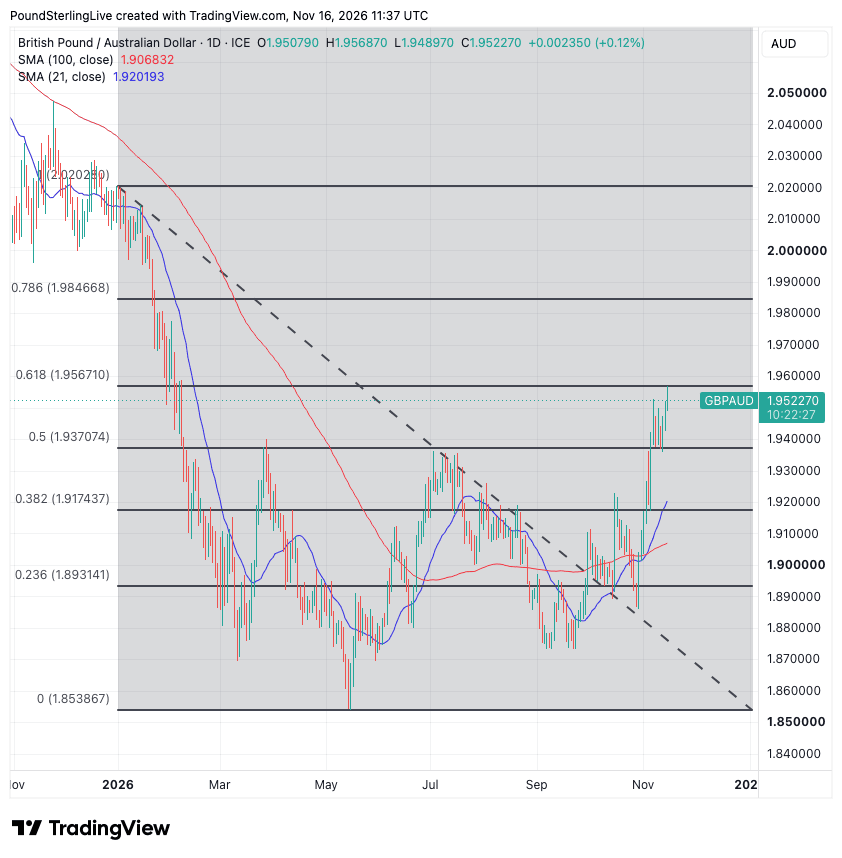
The Fibonacci levels on the chart, drawn across the fall from January's high near 2.02 to May's low at 1.8539, have marked the pair's turning points since the summer:
What is a Fibonacci retracement? It measures how much of a large move a market has reversed, using ratios of 23.6%, 38.2%, 50%, 61.8% and 78.6% taken from the Fibonacci number sequence. Traders across the market watch the same levels, so buy and sell orders cluster around them, which is why prices often pause or turn there.
The 61.8% level carries the most weight, as a recovery that clears it is widely read as a reversal of the earlier decline.
GBP/AUD has respected the levels: last week's dip to 1.9352 was bought within pips of the 50% retracement at 1.9371, and the pair turned at 1.9569 on Monday, a pip above the 61.8% level at 1.9567.
The 21-day moving average, in blue, has climbed steeply since late October and the 100-day, in red, is rising steadily, with both confirming the uptrend.
Last week's sideways trade let the 21-day average close part of its gap with spot, the consolidation Pound Sterling Live's mean-reversion modelling looks for after a sharp rally.
Resistance sits at the 61.8% level at 1.9567, with the 78.6% retracement at 1.9847 the next target above it, while the 50% level at 1.9371 is first support and the 38.2% level at 1.9174 sits beneath it.
The rising averages favour a push through 1.9567, and a daily close above it would open the way to 1.9847. A daily close back beneath 1.9371 would change the near-term Pound to Australian Dollar forecast.
Further out, the October break of the downtrend line from January, the dashed line on the chart, signalled the end of the 2026 decline, and the rising averages keep the medium-term trend in sterling's favour.
Last week Pound Sterling Live looked for a setback towards the 1.9402-1.9362 band, with a daily close above 1.9528 changing the call. The pair dipped to 1.9352 on Thursday and recovered without a daily close above 1.9528.
UK Inflation Must Stay Sticky for Sterling to Break Higher
Beyond the chart, sterling's next push depends on Wednesday's UK inflation figures, which will shape expectations for a further Bank of England rate hike.
Consumer price inflation is forecast to hold at 3.5% in October, with the figures due at 07:00 London time. Deutsche Bank forecasts 3.8%, and Barclays, Goldman Sachs and Lloyds 3.7%.
"Looking ahead, more inflation is coming. We continue to see headline CPI pushing closer to 4.25% y-o-y at the start of next year," says Sanjay Raja, Chief UK Economist at Deutsche Bank.
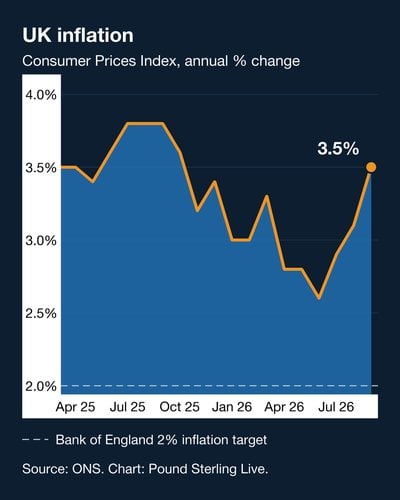
Under the playbook, a print above consensus would lift expectations for another Bank of England hike and support the pound. A miss would weigh on it.
Tuesday's labour market figures come first, with unemployment at 4.7% previously; Goldman Sachs forecasts 4.6% and Commonwealth Bank of Australia 4.8%.
However, "a lift in the UK unemployment rate, alongside stronger Australian employment, should push AUD/GBP higher towards the end of the week," says Commonwealth Bank of Australia.
Australian Jobs Data Can Give the Aussie Only a Brief Lift
Turning to Australia, Thursday's labour force survey at 00:30 London time is the Australian dollar's main test after employment fell by 39,300 in September.
Employment is forecast to rise by 20,000 in October, with the unemployment rate seen steady at 4.7%. Commonwealth Bank of Australia and Goldman Sachs both forecast a 30,000 gain.
Under the playbook, a print above consensus would support the Australian dollar and pull GBP/AUD back from the 61.8% level. A miss would help sterling through it.
"But the risk is a stronger increase that pushes up AUD/USD, albeit briefly," says Commonwealth Bank of Australia, which expects AUD/USD to stay weak around 0.68.
The minutes of the RBA's November meeting on Tuesday and UK retail sales on Friday are second-tier releases, and Nvidia's earnings on Tuesday carry risk for the Australian dollar through global stock markets.
UBS Sees Policy Divergence Taking Sterling Higher
Behind this week's data sits the policy gap that UBS expects to carry GBP/AUD higher. "We favor going long GBPAUD, where growing monetary policy divergence between the Bank of England (BoE) and the Reserve Bank of Australia (RBA) is not yet fully priced, in our view," says the Swiss bank, which targets 1.995.
UBS says "the BoE still has work to do to contain inflation," while "a deteriorating Australian housing and macro backdrop could lead markets to price additional RBA easing in 2027."
Westpac's conviction that the RBA has finished hiking has strengthened, "the housing market has undershot our forecasts over the past couple of months. We are also seeing early signs of a turn in the consumer," says the Australian bank.
Pound Sterling Live's Pound to Australian Dollar forecast looks for GBP/AUD to test 1.9567 this week, with a daily close above it opening the way to 1.9847 and UBS's target at 1.995 beyond.