
Image © Adobe Images
Pound sterling can extend its gains against the euro this week if a busy run of UK labour market and inflation data keeps Bank of England rate hike bets and UK bond yields elevated.
The pound-to-euro exchange rate starts the week at 1.1986, just beneath the 1.20 level it has yet to close above since late October.
Sterling found support last week after hot U.S. inflation figures pushed UK rate hike expectations higher, sending the UK two-year bond yield to its highest level in three years on Friday.
That is the backdrop for a busy UK calendar, with labour market figures on Tuesday and inflation figures on Wednesday, followed by retail sales, public borrowing and a UK-EU summit on Friday.
Those relatively high yields underpin GBP/EUR, which has held above its rising 21-day moving average, the blue line on the chart below, through last week's dip.
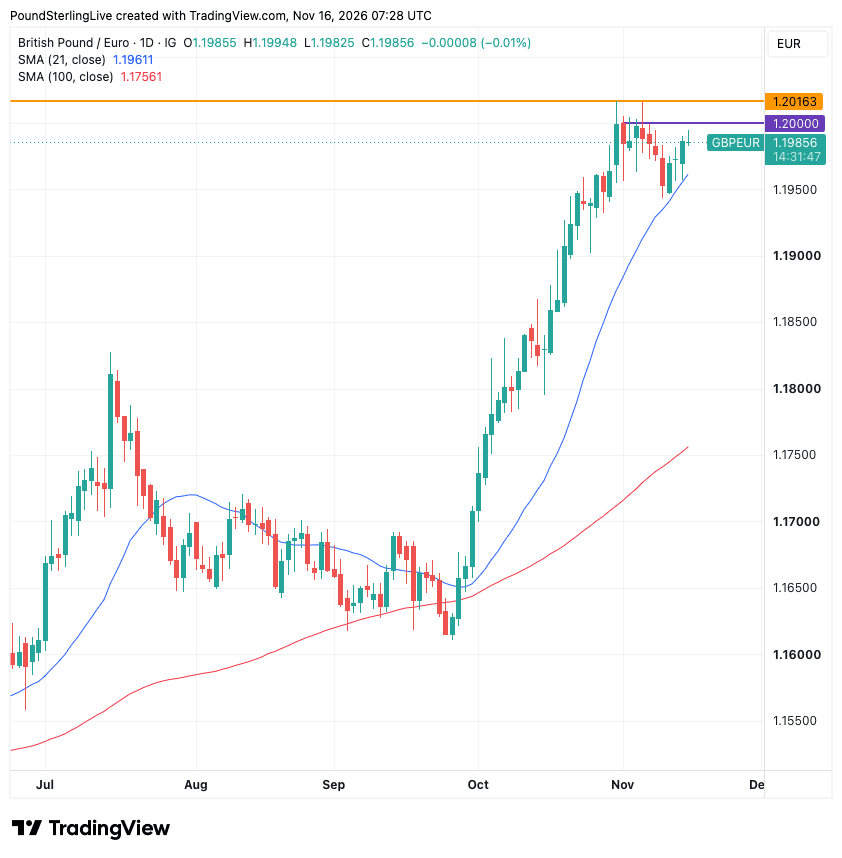
Above: GBP/EUR at daily intervals with the 21-day (blue) and 100-day (red) moving averages, resistance at 1.20 (purple) and 1.2016 (orange).
GBP/EUR fell to 1.1942 on 10 November and recovered from there, a soft pullback that tested the 21-day average without breaking it.
The 21-day average has risen steadily since late September and the 100-day, the red line, is also climbing, which confirms the uptrend over both the short and the medium term.
Pound Sterling Live's mean-reversion modelling holds that the gap between spot and the 21-day, around 0.5% a week ago, has largely closed through last week's consolidation, leaving the pair free to resume its advance.
The 1.20 level, the purple line, remains the barrier that matters, because GBP/EUR has yet to record a daily close above it.
Graphical horizontal resistance at 1.2016, the orange line, marks the 30 October high.
Pound Sterling Live sees a first daily close above 1.20 as possible this week, and a break of 1.2016 would open the way to fresh highs.
A daily close beneath 1.1942, last week's low, would change the near-term Pound to Euro forecast.
Further out, Pound Sterling Live expects GBP/EUR to settle into a new, higher range that incorporates 1.20, with its upper reaches in the mid-1.20s.
Last week's Week Ahead Forecast looked for GBP/EUR to consolidate between 1.1930 and 1.20, and the pair traded between 1.1942 and 1.1995, closing every session beneath 1.20.
UK Data Must Keep Rate Hike Bets Alive for the Pound to Clear 1.20
The pound needs this week's UK data to keep Bank of England rate hike expectations elevated if it is to clear 1.20.
Those expectations rose after U.S. core consumer prices increased 0.3% in October for a third consecutive month, the Bureau of Labor Statistics reported on 10 November.
"The 10-year Treasury yield rose back above 5%, dragging gilt yields higher," says Lloyds Bank Market Insights.
The UK two-year gilt yield rose to 4.968% on Friday, its highest level in three years.
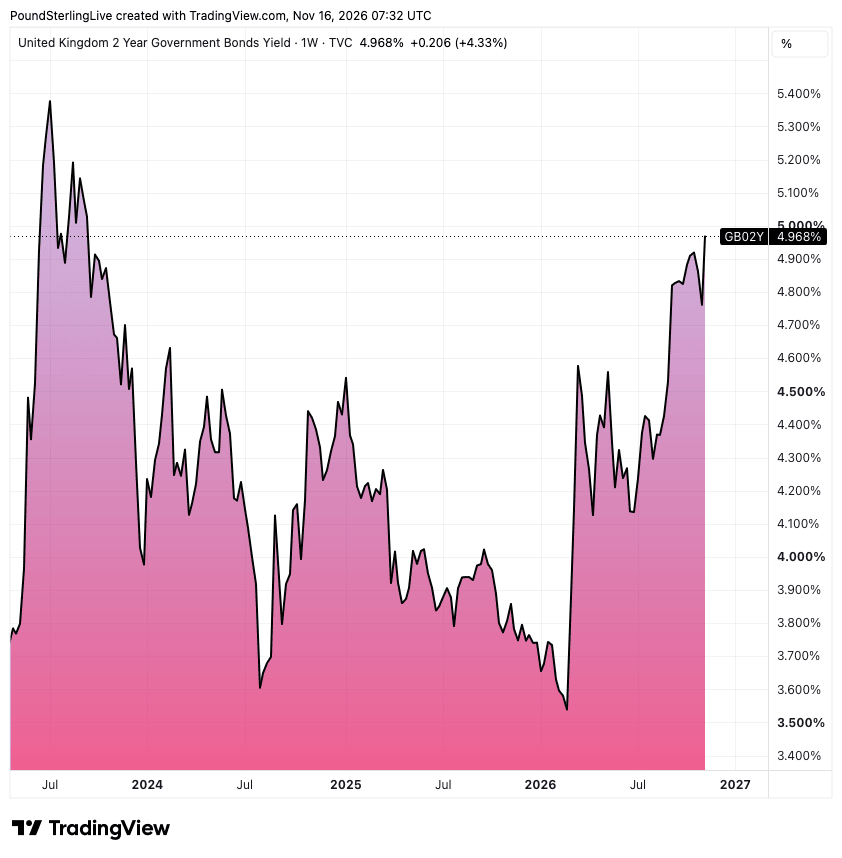
Above: The UK two-year government bond yield at weekly intervals.
What does the two-year yield tell us? It is the return investors demand to lend to the UK government for two years, and it moves with the level markets expect Bank Rate to average over that time, so a higher yield signals more expected Bank of England hikes and makes the pound more rewarding to hold than the euro.
Money markets price a better than 70% chance of a Bank of England hike on 17 December.
Pantheon Macroeconomics has brought forward its calls for the next two Bank of England hikes to December and February, from February and April, "Bailey and Lombardelli have put the burden on incoming evidence to justify waiting," says Rob Wood, Chief UK Economist at Pantheon.
The ONS publishes labour market figures at 07:00 on Tuesday, where unemployment stood at 4.7% and payrolled employees rose by 13,000 in the previous release.
Deutsche Bank sees "more upside risk than downside risk" to the jobless rate, says Sanjay Raja, Chief UK Economist at Deutsche Bank.
"MPC members appear to be more nervous that the labour market might not be as loose as first thought and could pose a greater risk of medium-term inflationary pressures," says Investec.
Under the playbook, lower unemployment or firmer pay growth than expected would lift the pound.
Inflation figures follow at 07:00 on Wednesday, with consensus looking for headline CPI to hold at 3.5% in October, below the Bank of England's own staff forecast of 3.7%.
"Upside news versus the BoE staff forecast of 3.7% y/y for October CPI could meaningfully boost market expectations for a December rate hike," says Lloyds Bank Market Insights.
MUFG notes that Bank of England officials have signalled at least one more hike, "the upcoming reports are expected to remain consistent with further BoE tightening," says the Japanese bank.
Under the playbook, a print above consensus would lift the pound by adding to December hike bets, and a miss would weigh on it.
Governor Andrew Bailey speaks on Wednesday after the inflation figures, and hawkish signals would add support for the pound.
Crédit Agricole says the pound "could even grow vulnerable to more position squaring on market GBP longs" if the UK data disappoint.
Investors who have bought the pound would sell to lock in profits, and that selling deepens a fall when many hold the same trade.
Options traders "are actively bidding for EUR upside to position for mean-reversion," says MUFG, with EUR/GBP risk reversals, a gauge of demand for protection against a rise versus a fall, at their most euro-bullish since early October.
Retail sales and public borrowing figures on Friday are second-tier releases.
The Euro Faces France's Budget Vote and a UK-EU Summit

Image © Adobe Images
The euro has its own tests this week, with French lawmakers voting on the 2027 budget on Tuesday.
A defeat for the budget would add to pressure on French borrowing costs, which weigh on the single currency.
Eurozone inflation figures for October on Wednesday, expected to confirm 4.0%, and a speech by ECB President Christine Lagarde on Friday are second-tier events.
The UK and EU meet for a summit on Friday, where Deutsche Bank says what matters for markets is "dates, caps, carve-outs and a clear path to implementation."
Deutsche Bank expects any near-term GDP gains from a deal to be marginal.
Pound Sterling Live's House View modelling holds that closer ties with the EU ease the risk premium on UK assets, which gives the pound's rally against the euro more room to run.
Pound Sterling Live's Pound to Euro forecast looks for a first daily close above 1.20 this week, provided UK labour market and inflation figures keep Bank of England hike bets elevated.