Image © Adobe Images
The pound's selloff against the dollar has reached the floor of its 2026 range, where Pound Sterling Live sees better value in fading the move as UK data takes over from U.S. inflation.
UK labour market and inflation figures are the main events for the pound against the dollar this week, after hot U.S. inflation data drove the pair towards the lows of its 2026 range.
The Pound to Dollar exchange rate starts the week at 1.3205, having fallen 1.9% from 1.3459 last Tuesday as the dollar rallied on bets the Federal Reserve will keep raising rates.
From a technical perspective, GBP/USD now sits just above the orange lines on the chart, which mark the floor of its 2026 range:
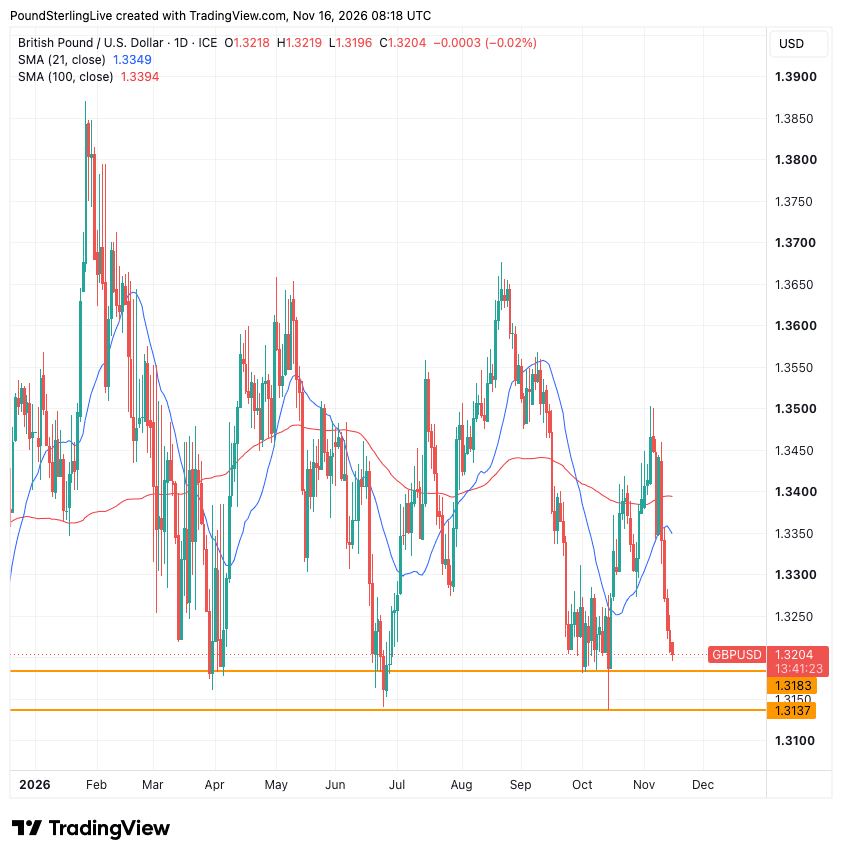
Above: GBP/USD at daily intervals with the 21-day (blue) and 100-day (red) moving averages and the floor of the 2026 range (orange).
The 21-day moving average, the blue line, has turned lower over the past week, confirming the short-term downtrend.
The 100-day moving average, the red line, has run flat since late September and sits at the approximate location of the middle of the 2026 range. It is therefore where GBP/USD is biased to return to once the current run of weakness fades.
Graphical horizontal support at 1.3183, the upper orange line, marks the floor that held in early October. Beneath it, 1.3137, the lower orange line, marks the 2026 low set on 14 October.
The bar to a break of those lows is high, because GBP/USD has rebounded from this zone in April, June and October.
Some follow-through towards 1.3183 is possible this week, but Pound Sterling Live looks to fade the selloff and sees better risk-reward in positioning for a return to the 100-day, near 1.3390.
What does fading a selloff mean? It means taking a position against the latest move on the view that it has run its course, which here means buying the pound near the floor of its range.
A daily close beneath 1.3137 would change the near-term Pound to Dollar forecast.
On a medium-term view, GBP/USD remains in the range that has contained it since April, with the 100-day at its centre.
Last week's Week Ahead Forecast looked for gains towards 1.3502, and GBP/USD reached 1.3459 on Tuesday before hot U.S. inflation data took it beneath the 21-day, the level that forecast named as its invalidation, and on to 1.3205 by Friday.
UK Data Must Revive Bank of England Hike Bets for the Pound to Recover
For the pound to recover, this week's UK data must keep Bank of England hike bets alive, starting with labour market figures from the Office for National Statistics at 07:00 on Tuesday.
Unemployment stood at 4.7% in the previous release.
"Weaker data, particularly an increase in the unemployment rate, would weigh on GBP/USD and reinforce expectations the Bank of England waits until February before raising the Bank rate again," says Commonwealth Bank of Australia.
Under the playbook, a lower jobless rate or stronger wage growth would support sterling.
October's consumer price inflation figures arrive at 07:00 on Wednesday, where economists expect the rate to stay at 3.5%, against 3.7% in the Bank of England's November projections.
A Bank of England hike on 17 December carries odds of more than 70% in money markets.
BBH expects a resilient labour market and sticky prices to keep Bank of England hikes in play over the coming year, "GBP has limited downside against USD, with support around 1.3150," says the U.S. bank.
Under the playbook, an inflation reading above consensus would lift the pound.
A softer reading would weigh on it.
Retail sales on Friday are a second-tier release.
Dollar Bolstered by Rising Yields, Stock Rally Could Limit Advance
Beyond the UK data, GBP/USD will take its lead from the dollar, which rose last week as U.S. inflation data lifted bets on further Fed hikes and sent the two-year Treasury yield, the part of the market most sensitive to those bets, back to 4.86%:
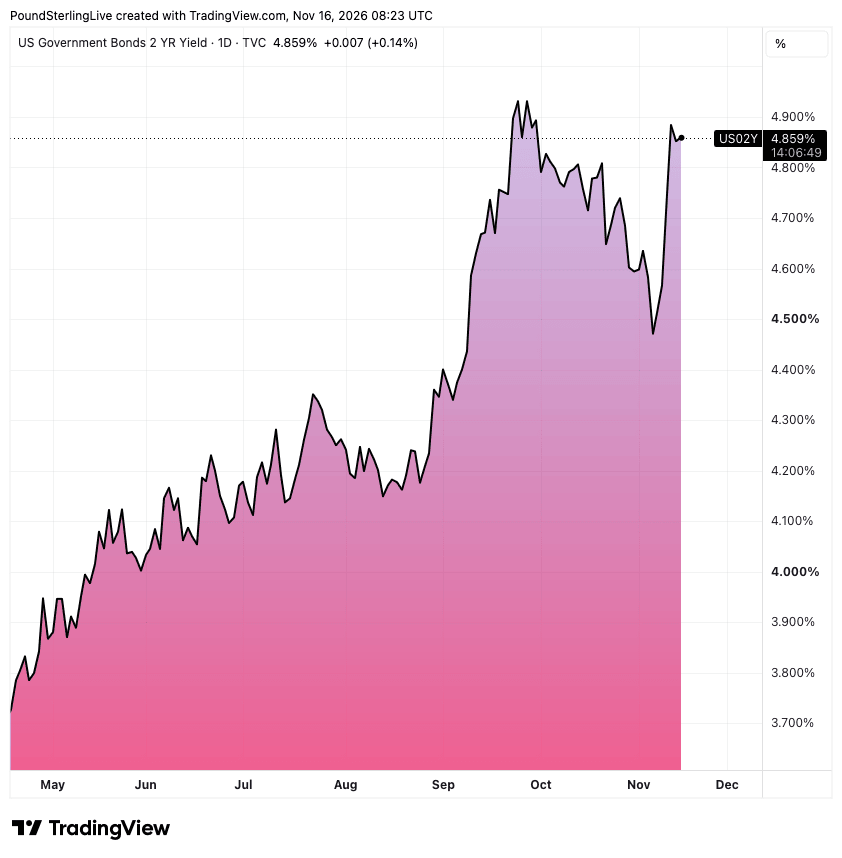
Above: The U.S. two-year Treasury yield at daily intervals.
Crédit Agricole CIB says the dollar is now overvalued and overbought, "we note that US markets have once again started pricing in three Fed rate hikes in the coming months or significantly more than our own expectations," says the French bank.
"With many positives already in the price of the USD, it could be vulnerable to any potential data disappointments and/or less hawkish Fed guidance as well as softer earnings and/or weaker tech stock performance after the Anthropic IPO," it adds.
Nvidia reports earnings on Tuesday and Anthropic lists its shares on Wednesday, the week's two tests of sentiment towards AI stocks.
Neil Wilson of Saxo Bank argues the derating of chip stocks may be overdone, with valuations at 14 to 15 times forward earnings after a drawdown of around 40%.
Pound Sterling Live's House View modelling holds that the AI stock selloff moves the dollar only through its effect on Fed expectations, so a solid year-end rally in stocks that cools those bets would send GBP/USD back towards the 100-day.
Seasonal patterns also favour selling the dollar into the end of the year, "USD longs must contend with negative December seasonals," says Bank of America in a recent update.
The U.S. bank cautions against leaning too hard on the pattern this year, with macro forces, geopolitics and moves in equity markets able to disrupt it.
However, Commonwealth Bank of Australia expects GBP/USD to extend its losses this week, with support next at the November 2025 low of 1.3038.
Pound Sterling Live's Pound to Dollar forecast looks to fade the selloff near the 2026 lows this week, with a year-end rally in stocks the likely trigger for a return to the 100-day.