

Image © Adobe Images
The euro will recover against the pound if a Marine Le Pen victory comes with a working majority that eases France's borrowing costs, analysts say.
A clear winner with a working majority, Le Pen or otherwise, would narrow the gap between French and German ten-year borrowing costs, the favoured measure of French stress, and remove part of the discount the euro carries against the pound.
This is the view of analysts considering the implications for the euro ahead of next year's critical vote.
"Having toned down her views on France leaving the euro, a decisive victory by Marine Le Pen in April and greater budget clarity could reassure markets. If eurozone growth continues to defy energy and political headwinds, a rotation to European assets could be the surprise package for EUR/USD," says Chris Turner at ING.
Goldman Sachs was out with its 2027 currency outlook on Friday and named "the emergence of European credit stress as the single largest driver of this year's EUR/GBP sell-off."
The pound-to-euro exchange rate rallied 3.5% from late September to a peak of 1.2016 on 30 October and trades at 1.1987, tracking the surging premium investors have demanded to hold French debt, as measured by rising French bond yields.
"French risks have been a major headwind for the EUR since the end of September. The c. 3% sell-off versus major currencies during this time frame is in line with our estimates of the FX impact of the 3 standard deviation (c. 50bp) widening in OAT spreads," says Barclays in a study of French risk published on 12 November. (OAT = French bond).
The gap between French and German ten-year borrowing costs stands at around 150 basis points, up from around 60 in the summer, a move that reflects the jump in anxieties over France's fiscal and political outlook.
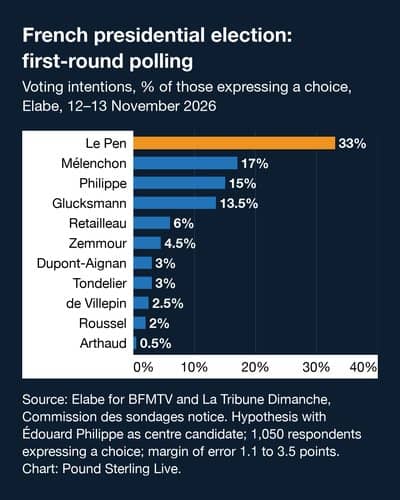
Marine Le Pen leads polling for the first round of the presidential election on 18 April with voting intentions in the mid-30s, and Jean-Luc Mélenchon is emerging as a contender for the run-off on 2 May.
"The ability of any newly elected president to deliver on his or her programme will therefore depend critically on the ability to secure a workable majority in the National Assembly," says Barclays.
A centrist victory "would likely be perceived initially as the more market-friendly outcome," although without a strong mandate it "could ultimately prove a slow-burn scenario," the bank adds.
"Polls pointing to a high probability of a Le Pen / Mélenchon second round would likely keep this premium elevated, reflecting both uncertainty over the fiscal path and a more adversarial stance toward European institutions," says Natixis in a recent study of the election.
That outcome would keep the pound supported against the euro.
Pound Sterling Is Exposed to a Decisive Le Pen Win
In the meantime, "French budgetary politics look set to keep a risk premium in the euro ahead of April's elections," he adds.
Goldman Sachs forecasts EUR/GBP at 0.86 in 12 months (GBP/EUR 1.1628), "largely on a relaxation in European sovereign credit stress," which would take the pound back to where its autumn rally began.
"The compression in premia has already run a long way, and the bar to pricing more positivity in Sterling appears high for 2027," says the bank.
Elsewhere, Crédit Agricole forecasts EUR/GBP at 0.84 in 12 months (GBP/EUR 1.1905), MUFG at 0.87 (GBP/EUR 1.1494) and Nomura at 0.91 (GBP/EUR 1.0989).
J.P. Morgan's strategists and Rabobank look for further pound gains over the next three months, with targets on an 0.82 handle in EUR/GBP (GBP/EUR 1.2195).
Pound Sterling Live continues to hold a constructive view on the pound against the euro into the elections, with French fiscal stress the dominant driver of the single currency as France's budget vote comes into focus.
Pound sterling should hold its gains against the euro for as long as French borrowing costs stay elevated ahead of April's first round.