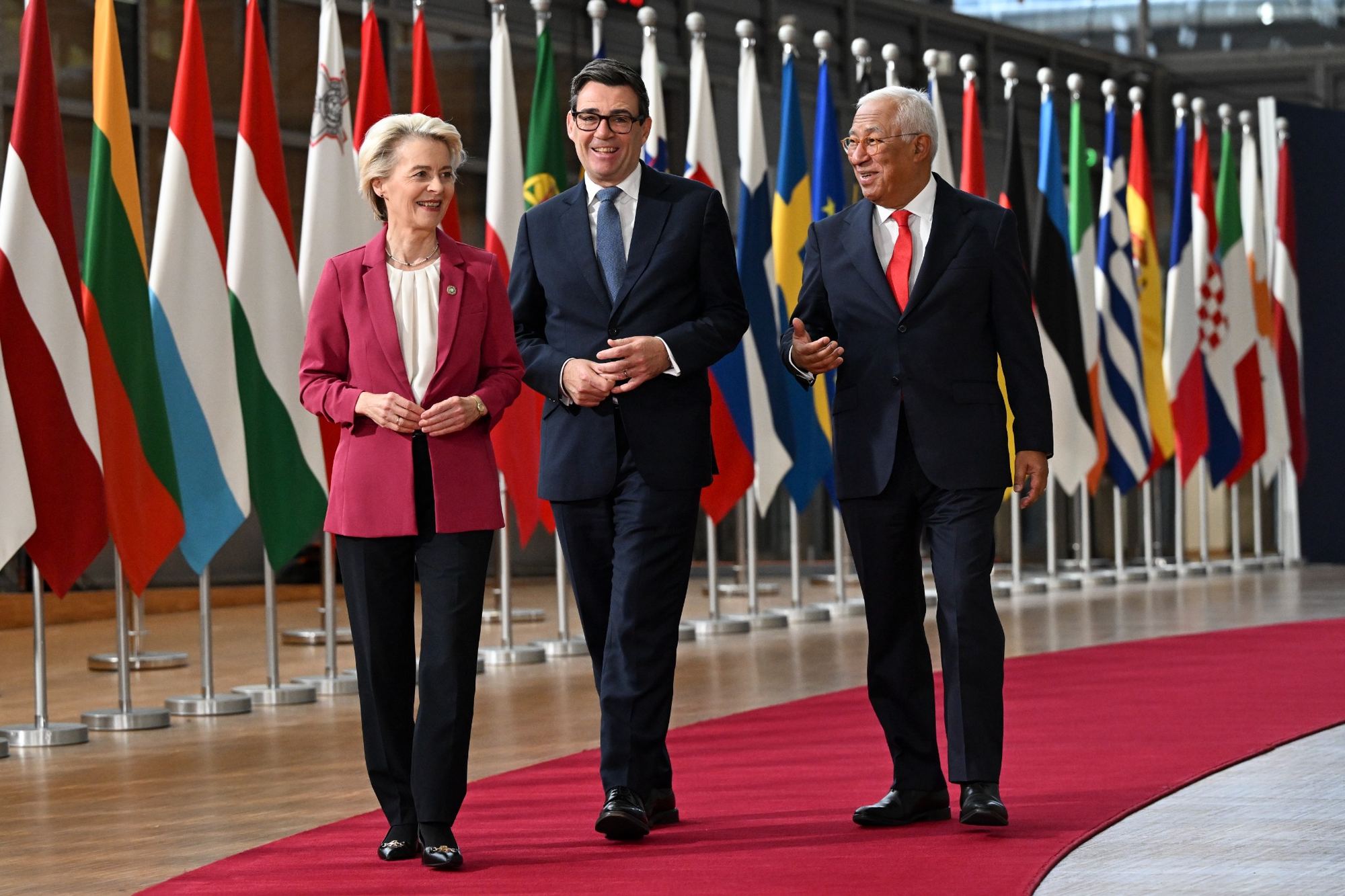
António COSTA, President of the European Council, and Ursula VON DER LEYEN, President of the European Commission, meet with Andy BURNHAM, Prime Minister of the United Kingdom, on 20 November 2026 in Brussels. Copyright: European Union.
Pound sterling stands to gain against the euro over time as Britain aligns with EU rules to win market access, although the euro has room to recover first as pessimism over France fades.
Pound sterling stands to gain against the euro as Prime Minister Andy Burnham pays for closer access to European markets, analysts say.
Investors should demand a smaller risk premium on UK assets as Britain's trade with its largest market runs more smoothly; the premium is the extra return investors require when they worry about a country's prospects. A smaller premium draws foreign money into UK assets, and those purchases require pounds.
"EU reconvergence prospects should support the GBP, while French risks weigh on the EUR," says Barclays in its year-ahead currency outlook, published on Tuesday.
Burnham is in Brussels on Friday for the EU-UK summit, where he and European Commission President Ursula von der Leyen and European Council President António Costa are set to finalise agreements on food and agriculture exports, emissions trading and a youth mobility scheme.
Burnham told business leaders in Brussels that Treasury analysis shows the deal adds up to 0.5% to UK GDP, calling it "the single biggest growth intervention in this parliament."
Britain Pays a Price for Closer Access to EU Markets
Pre-summit reporting shows the access comes with concessions on rules, students and trade policy:
Food rules: Britain would align more closely with EU rules on food safety and animal and plant health, in return for fewer certificates and border checks on exports such as cheese and bacon.
University fees: The EU wants its students to pay the same fees as domestic undergraduates at UK universities, a demand that puts "a potentially big price tag on the scheme," says Jill Rutter of the Institute for Government, the independent think tank. The Times reports Friday that this is proving a major stumbling block for the negotiations.
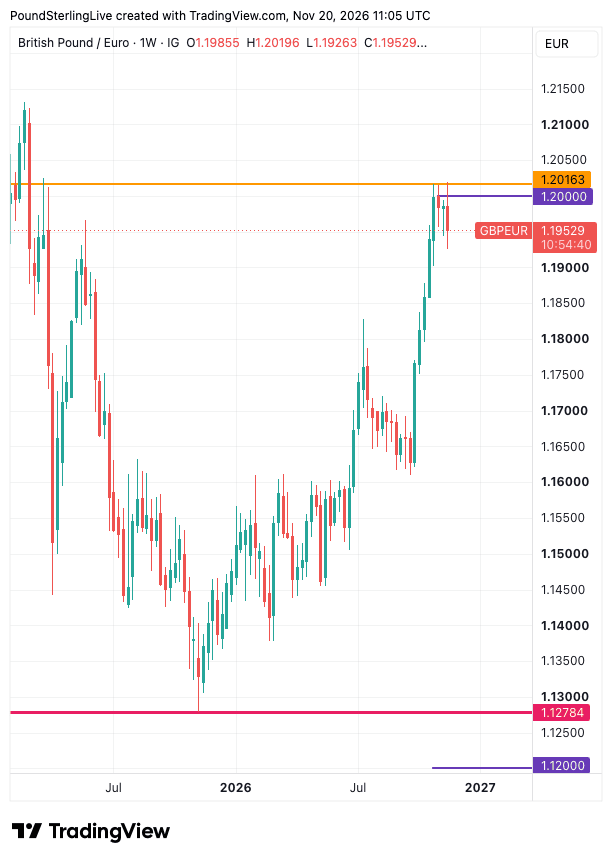
Above: GBP/EUR at weekly intervals.
Youth mobility: The two sides settled on capping the "youth experience scheme" at 100,000 people, who can live and work in each other's territory for up to three years.
Chinese cars: A French and German proposal would exempt UK-built cars from the EU's "Made in Europe" rules, which reserve subsidies and public contracts for products with enough European-made parts, provided Britain aligns its external tariffs with the bloc's. That could mean UK tariffs on Chinese electric vehicles, and nearly 57% of the 717,000 cars built in Britain in 2025 went to the EU, SMMT data show.
The fees row threatens to hold up the whole package: talks on fees have a six-month deadline, and the other agreements may not be implemented until a solution is found, with an EU official saying the deals would have to "come into force in a balanced way."
What matters for markets "is simple: dates, caps, carve-outs and a clear path to implementation," says Sanjay Raja, Chief UK Economist at Deutsche Bank.
None of the three deals requires payments into the EU budget, although both sides will fund shared running costs such as IT systems, a House of Commons Library briefing says.
Analysts See Support for the Pound Over Time
Deutsche Bank expects the near-term GDP gains from the deals to be marginal, and analysts frame the reset as support for the pound over a longer horizon.
"Closer UK-EU economic ties should be modestly supportive of GBP over time by reducing trade frictions and improving the investment outlook," says Commonwealth Bank of Australia, which adds that any path to EU membership would be long.
Analysts at KBC say plans to improve relations with the EU help lower the risk premium on UK assets.
"If the UK were to agree a materially closer relationship with the EU down the line, the annual cost of closer market access would likely be more than offset from a sterling perspective by fresh investment flows and the overall long-term boost to growth. Nevertheless, it may require an initial downpayment, in the form of a rewidening of the UK's current account," says Deutsche Bank's Shreyas Gopal.
The current account measures the money flowing in and out of the UK through trade, investment income and transfers. A wider deficit leaves Britain more reliant on foreign capital, which tends to weigh on the pound.
CIBC Looks for the Euro to Recover First
Over a shorter horizon the pound has lost ground against the euro: the pound-to-euro exchange rate rallied 3.5% from late September to a 2026 high of 1.2020 on 18 November and has since pulled back 0.6% to 1.1949, putting it on course for its first weekly loss in eight weeks, as Pound Sterling Live has reported.
Turning to the euro, "Since the OAT/Bund spread widened on French fiscal concerns, EUR/GBP has fallen some 2.7%, and we are seeing a rebound in recent days. There could be some weak technical resistance around the 0.8375 [GBP/EUR 1.1940] area, though we expect the pair to rise on an unwind of EU pessimism, and on positive news on the US/Russia/China trilateral talks," says CIBC.
The OAT/Bund spread is the gap between French and German ten-year borrowing costs, and a wider gap signals stress over France's public finances that weighs on the euro. A narrowing gap lets the euro recover.
Resistance is a level where sellers have previously halted a rise, and CIBC's EUR/GBP level equates to support at 1.1940 in GBP/EUR, which the pair dipped beneath on Friday before recovering.
The reading we are getting from these calls is that a short-term euro rebound followed by renewed support for the pound from closer EU ties is on the cards.
Pound Sterling Live continues to hold a constructive medium-term view on the pound, with resilient UK growth, elevated inflation and France's fiscal and political troubles meaning the current dip against the euro should prove shallow.
A daily close beneath 1.1940 would signal that the euro rebound CIBC expects is under way.