
Image © Adobe Images
Pound sterling walks into the weekend a little bruised but a stronger-than-expected retail spending report reminds us that the fundemantals behind the currency are solid.
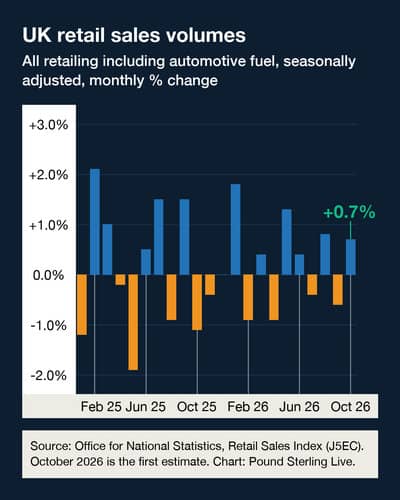
UK retail sales volumes rose 0.7% in October, beating economists' expectations for no change and recovering a 0.6% fall in September, and annual growth of 2.3% ran ahead of the 1.7% consensus, official data show.
Stronger spending keeps alive the case for the Bank of England to raise interest rates again on 17 December, in turn helping the pound hold on to the yield support that carried it to a 2026 high against the euro and has limited its losses against a dollar lifted by Federal Reserve hike bets.
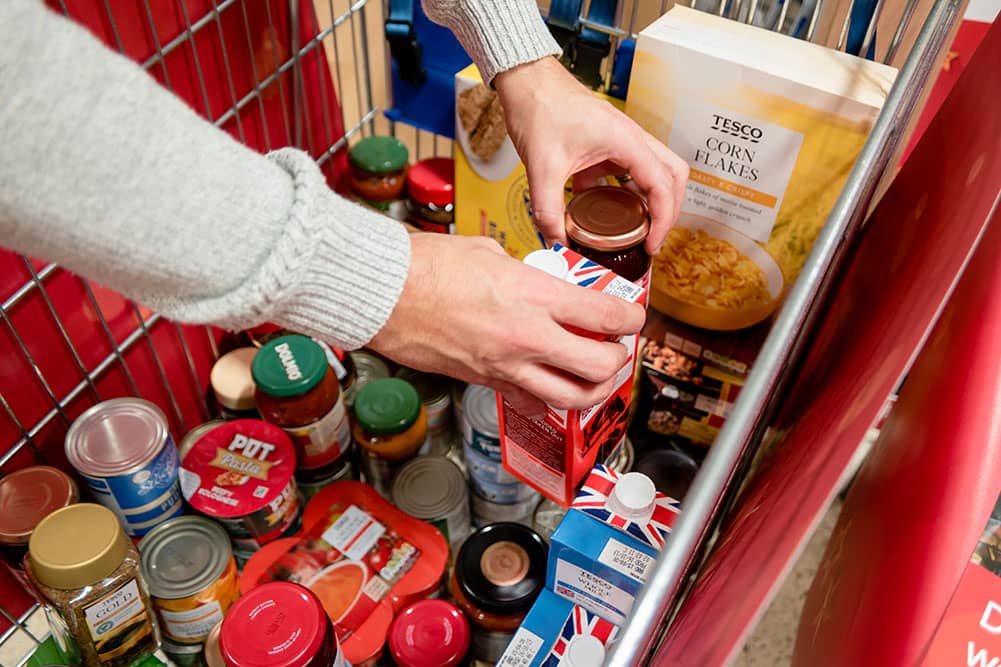
"Food stores rose as supermarkets reported an October uplift on emergency items such as UHT milk and tinned goods following the launch of the UK government's Be Ready campaign on 22 October 2026," says the Office for National Statistics.
Non-food stores also recorded a 1.1% rise in volumes, which clothing retailers put down to people buying more per visit and new launches.
The pound was under pressure ahead of the release and looks ready to record its first down week against the euro in eight. However, these solid numbers remind us that the fundamental underpinnings behind the recent rally are intact and suggest weakness should be shallow. Following the release the pound-to-euro exchange rate rose from 1.1933 to 1.1939, and the pound-to-dollar exchange rate rose from 1.3114 to 1.3121.
Crédit Agricole had named Friday's retail sales as the first test of whether domestic demand can withstand the more than three further Bank of England hikes markets price for the year ahead.
"We stick to our caveat that too much optimism remains embedded in the price of the GBP, as our FAST FX model remains long EUR/GBP this week," says Alexandre Dolci, FX Strategist at Crédit Agricole, a position that gains if GBP/EUR falls.
Consumers to Come Under Pressure
October's 0.7% rise beat the gloomier house forecasts, with Barclays' card-spending model pointing to a 0.4% fall and Oxford Economics expecting a 0.1% decline.
Oxford Economics expects consumer-facing sectors to come under growing pressure in the first half of 2027 as the energy price cap rises again in January, "households face the biggest squeeze on their spending power since the 2022-2023 surge in energy prices that followed Russia's invasion of Ukraine," says the consultancy in a recent update.
"Our base case is that the BoE stops at 4.25% once it has seen evidence that pay growth isn't accelerating. This peak would be 75bps lower than current market pricing," the consultancy adds.
Interest rate expectations help determine how UK bonds trade, which in turn are an important driver of foreign investor demand. It is that demand that helps the pound derive value. Should Bank of England rate expectations fall faster than in the Eurozone, the U.S. and elsewhere, the pound would be expected to come under pressure as foreign investor demand for British bonds diminish, which is why we spend so much time watching the central bank and anticipating what it might do in the future.
Rabobank sees a risk of the pound exposed to a further unwind of Bank of England hike expectations, although it expects political risk ahead of the spring French presidential election to keep the euro on the back foot.
Pound Sterling Live Expects GBP/EUR Dips to Stay Shallow
Against the euro, the pound's medium-term uptrend is intact: GBP/EUR rallied 3.5% from 1.1611 on 25 September to a 2026 high of 1.2020 on Wednesday, but it has since slipped 0.7% to 1.1939.
Against the dollar, the pound fell 3.1% from 1.3503 on 4 November to a 2026 low of 1.3081 on Thursday as Federal Reserve hike bets lifted the greenback, taking it below the 1.3140 to 1.3160 area that Citi analysts identified in a recent update as the year's triple bottom.
Pound Sterling Live continues to hold a constructive medium-term view on the pound, with the Bank of England still raising rates as UK inflation proves sticky and slow to fall back to the 2.0% target.