
Image © Adobe Images
Britain's debt interest bill risks climbing further as inflation lifts payments on index-linked gilts and the Bank of England raises interest rates.
UK government borrowing came in below expectations in October, but debt has climbed to levels last seen in the early 1960s and the interest bill on it hit a record for the month, Friday's public sector finances figures show.
This debt pile is becoming more expensive to service as inflation lifts payments on index-linked government bonds and the Bank of England raises interest rates, leaving the government less money for public services and a thinner buffer against future shocks.
"Higher debt servicing costs absorb a greater share of government revenues, reducing fiscal room and leaving the public finances more exposed to future economic shocks," says Nabil Taleb, economist at PwC UK.
Public sector net borrowing, the gap between what the government spends and what it raises, was £17.0bn in October, below the £18.0bn economists had expected, although it was £0.8bn more than a year earlier and the third-highest October since records began in 1993.
Public sector net debt reached £3,058.3bn at the end of October, equal to 95.8% of GDP, the total value of the economy's annual output, and 1.9 percentage points higher than a year earlier, the Office for National Statistics reports.
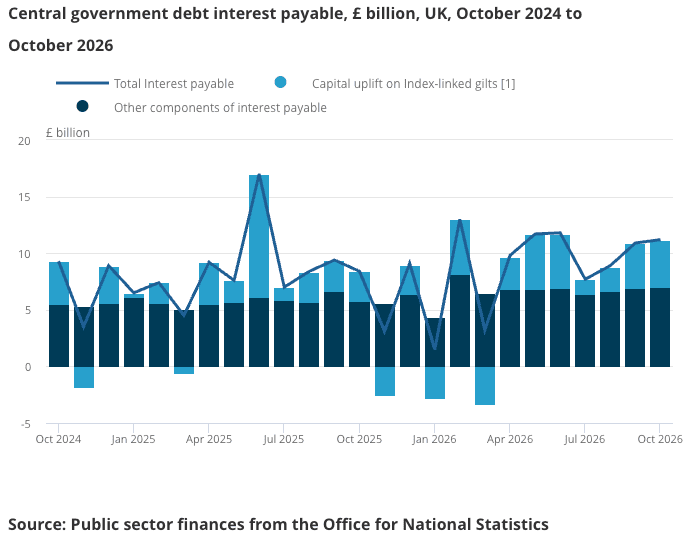
Central government debt interest came to £11.2bn in October, £2.8bn more than a year earlier and the highest October figure since monthly records began in 1997.
Of that, £4.2bn was the inflation uplift on index-linked gilts, government bonds whose payments rise with the Retail Prices Index measure of inflation, which climbed 0.6% between July and August.
"That part falls due when the gilts mature. It still has to be funded, and putting it off doesn't make it any cheaper," says Tony Sanchez, Founder at Bridging Loan Directory.
The Chancellor Gets Some Respite on Borrowing
Stronger tax receipts kept October's borrowing below forecast, with central government receipts up £6.7bn on the year at £93.6bn, led by income-related taxes.
Day-to-day spending rose £7.0bn to £99.3bn, partly because of the higher interest bill.
Borrowing in the financial year to date was £111.3bn, £7.3bn less than a year earlier but £3.3bn above the March forecast of the Office for Budget Responsibility (OBR), the government's official forecaster.
As Pound Sterling Live reported last month, borrowing was running £6.0bn above the OBR's March forecast at the halfway point of the year, and the ONS has since revised its estimate for April to September down by £3.6bn.
"The Chancellor will certainly be hoping that this continues – as ever, money found behind the back of the proverbial sofa that can help fund some of the government's spending priorities would be most welcome," says Sandra Horsfield at Investec.
However, "the October Budget did little to address the more serious challenges facing the public finances, so we continue to have doubts about the Government's ability to follow through on its fiscal plans, suggesting upside risks to borrowing in the coming years," says Pantheon Macroeconomics.
Some Advisers See Little to Show for Britain's Debt
Turning to the comparison with the early 1960s, "Debt was high in the 1960s, but so was national pride. The country was paying off debts accrued during WW2. There was a sense of accomplishment and the public could accept that there was a debt to pay, but we'd saved the world. Today, the debt is high, but national pride is through the floor. There haven't been any heroics, just shocking decisions and missmanagement. So whilst there are similarities between the debt now and in the 60s, the differences are gargantuan," says Ben Perks, Managing Director at Stourbridge-based Orchard Financial Advisers.
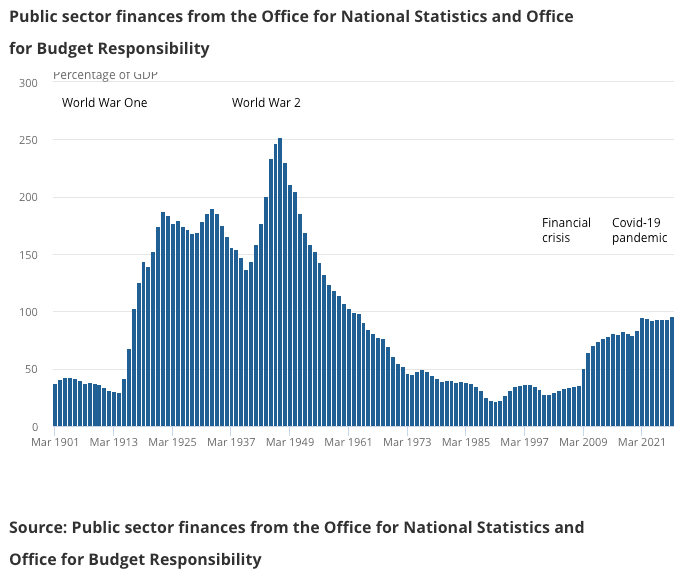
"The 1960's was a time of high growth. Houses were being built, jobs created and all with no currency debasement. It feels like within a blink of an eye, the national debt has risen from 2 trillion to 3 and the country has very little to show for it," says Chris Barry, Director at London-based Thomas Legal.
The debt will cost more to carry if the Bank of England keeps raising interest rates, and the OBR says "a one per cent change in interest rates could raise or reduce government debt interest costs by £16 billion."
"Borrowing costs remain elevated and with further hiking from the Bank of England to come, the government is going to find itself increasingly hemmed in by the cost of its debt," says Kit Rees, investment strategist at Quilter.
Chancellor John Healey has a £15bn margin against his main fiscal rule, which requires day-to-day spending to be covered by tax receipts by 2029-30, the OBR's October forecast shows.
"Public sector net debt peaks around 97 per cent of GDP in 2028-29, before falling slightly to 96 per cent in 2031-32," says the OBR.