

Image © Adobe Images
The pound can claw back some ground against the dollar this week as stock markets steady, U.S. inflation data tests Fed hike bets and the Thanksgiving holiday thins out trading.
The pound-to-dollar exchange rate's direction this week depends on whether global stock markets steady after last week's sell-off and whether Wednesday's U.S. inflation figures cool bets on further Federal Reserve rate hikes, with the Thanksgiving holiday on Thursday set to thin out trading.
Last week the pair fell from 1.3218 at Monday's open to a low of 1.3076 on Friday, its lowest level since November 2025, before starting this week at 1.3135. The pound fell as a sell-off in AI stocks sent investors into the dollar, which they treat as a safe haven when stock markets fall, and as minutes of the Fed's October meeting showed almost all officials expect to raise interest rates further.
The recent selling has taken GBP/USD well beneath its 21-day moving average, which has turned lower since early November. The 21-day average is the pair's average closing price over roughly the past month, and Pound Sterling Live's modelling treats it as the level the pair tends to return to after a large move away from it.
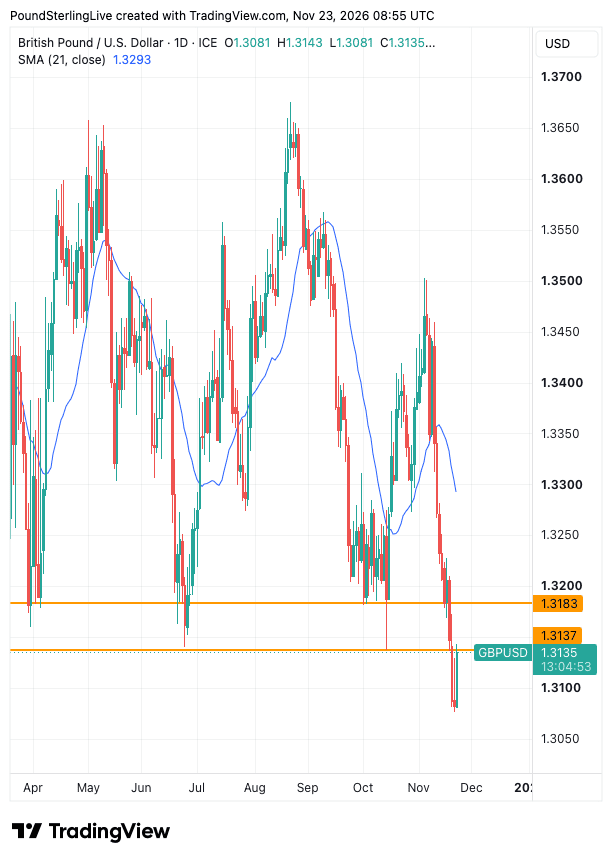
Above: GBP/USD at daily intervals with the 21-day moving average (blue) and resistance at 1.3137 and 1.3183 (orange).
GBP/USD now sits about 1.2% beneath the blue line, a stretch Pound Sterling Live's mean-reversion modelling expects to close through a bounce or a period of consolidation.
The lower orange line at 1.3137, the 2026 low the pair broke on Thursday, now acts as resistance, a level where sellers are likely to step in on a rise.
The upper orange line at 1.3183, the floor that held in early October, is the next resistance above it.
Last Friday's low of 1.3076 is the first support.
Pound Sterling Live forecasts a relief bounce through 1.3137 and 1.3183 as mean reversion unfolds in line with the dollar's safe-haven services not being in demand into the U.S. holiday.
A daily close beneath 1.3076 would change the near-term Pound to Dollar forecast: my reasoning is that 1.3076, last Friday’s low, is the low the bounce starts from. A daily close beneath it would mean sellers had pushed through it, and the “relief bounce” call would be wrong for this week.
On a medium-term view the trend has softened and it's hard to argue for strength to be anything other than short-term, a reflection of the broader pro-USD backdrop that we find the market in ahead of the new year.
U.S. Inflation Data Must Cool Fed Hike Bets for the Dollar to Soften
GBP/USD's ability to bounce depends on the dollar, and Wednesday's U.S. inflation figures are the week's main test of the Fed hike bets that have lifted it.
The Bureau of Economic Analysis publishes October's personal consumption expenditures (PCE) price figures, the Fed's preferred inflation measure, at 13:30 UK time on Wednesday.
Economists expect core PCE, which strips out food and energy, to rise 0.3% on the month and 3.2% on the year, up from 3.1% in September.
Commonwealth Bank of Australia forecasts a softer 0.2% monthly rise in PCE inflation, "weaker US inflation will weigh on US interest rates and the USD," says the Australian bank. CIBC sits on the other side of consensus, with core PCE at 3.3% on the year.
Lower expected U.S. interest rates cut the return on dollar deposits and U.S. government bonds, which reduces demand for the dollars needed to buy them.
Under the playbook, a reading below consensus would cool Fed hike bets and lift GBP/USD. A reading above consensus would add to the dollar's support.
Money markets price no chance of a half-point Fed hike in December and an 11% chance the Fed holds, CME FedWatch data show.
The second estimate of third-quarter GDP and October durable goods orders, also due on Wednesday, are second-tier releases.
Calmer Stock Markets Would Ease the Dollar's Safe-Haven Bid
Beyond the data, the pound needs stock markets to steady, after last week's slide in AI shares took the S&P 500 into a correction, a fall of more than 10% from its peak.
"Last week's stock market sell off was rapid, brutal and detached from fundamentals," says Kathleen Brooks, Research Director at XTB.
Commonwealth Bank of Australia expects the dollar to stabilise this week and GBP/USD to find support near 1.31 as safe-haven demand ebbs.
Corpay's Peter Dragicevich says the dollar trades above fair value with several Fed hikes already priced, "we might be nearing the point where risk sentiment begins to stabilise and the USD starts to gradually weaken." He expects the Thanksgiving holiday to quieten trading on Thursday and Friday.
However, MUFG expects the dollar's strength to persist while the sell-off stays in stocks, and warns that a credit event, such as a large borrower failing to repay its debts, would bring a rush into the dollar.
Pound Sterling Live's Pound to Dollar forecast looks for a relief bounce towards the 21-day average this week, provided stock markets steady and Wednesday's inflation figures cool Fed hike bets.