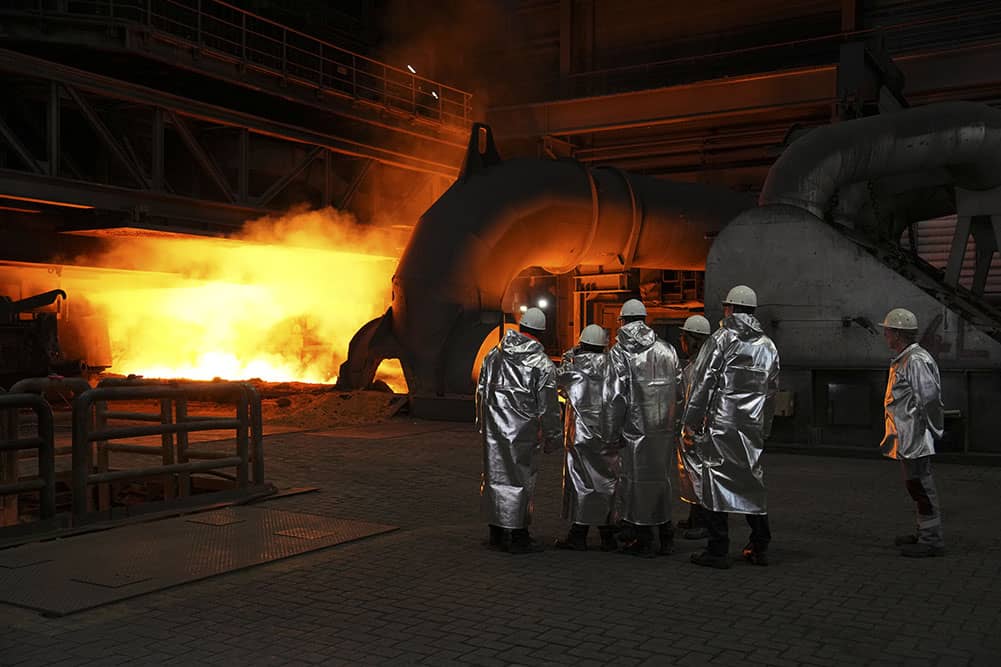
Image © Thyssenkrupp Steel Europe facilities. Image European Union, 2025. Photographer: Pau Barrena.
The eurozone economy risks a deeper split as German factories ramp up output and French firms hold back ahead of next year's election.
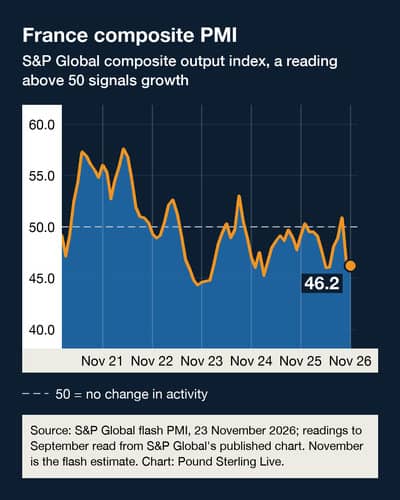
France is edging towards recession while Germany grows at its fastest pace since March 2022, Monday's flash PMI figures from S&P Global show.
The purchasing managers' index (PMI) asks companies each month whether their activity is rising or falling, and a reading above 50 signals growth. The eurozone composite PMI held at 51.7 in November, just below the 51.9 economists had expected, as Germany's strength offset France's weakness.
The headline figure "masks worrying divergences in performance within the euro area," says Chris Williamson, Chief Business Economist at S&P Global Market Intelligence.
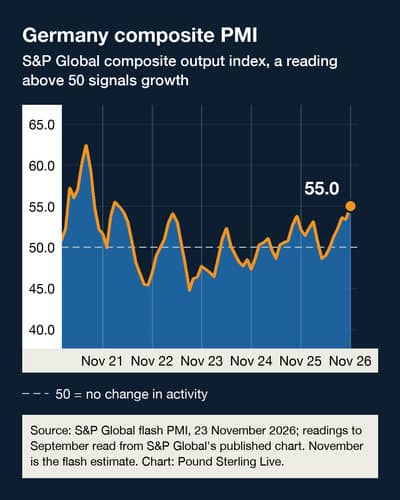
"While growth in Germany has accelerated to the fastest for four and a half years, as its manufacturing sector enjoys a growth spurt of the likes not seen for over five years, France is suffering a deepening downturn," he adds.
Germany's lead over France was the widest for six years, although the eurozone readings remain consistent with the economy growing at a near 0.3% pace in the fourth quarter, says Williamson.
Eurozone services activity slowed to a five-month low of 51.2, below the 51.9 economists had expected, but the manufacturing PMI rose to a two-month high of 52.9.
Germany's Factories Lead Its Fastest Growth Since 2022
Germany's composite PMI rose to 55.0 from 53.4, its highest since March 2022 and well above the 53.3 economists had expected, the flash figures for Germany show.
German manufacturing output rose to a 63-month high of 57.4 and services activity climbed to a 13-month high of 54.0.
Williamson ties the upturn to manufacturers of business equipment and machinery, which are benefiting from "surging investment spending on defence and AI-related technologies, boosting Germany's economy in particular."
"Encouragingly, alongside the sustained upturn in manufacturing, which continues to see support from rising export orders, demand also revived in the more domestic-oriented service sector and showed the strongest improvement in more than a year, hinting at a broadening recovery," says Phil Smith, Economics Associate Director at S&P Global Market Intelligence.
France Moves Closer to a Technical Recession
France's composite PMI fell to 46.2 from 46.6, a six-month low and below the 47.8 economists had expected, the flash figures for France show.
French manufacturing output fell to a 21-month low of 44.5, although services activity edged up to 46.6 from 46.2.
"The November 'flash' PMI data have raised the odds of France entering a technical recession in the fourth quarter. The eurozone's second-largest economy is struggling with weak domestic demand, in part due to hesitancy from clients to commit to projects ahead of a highly uncertain election period next year," says Joe Hayes, Senior Principal Economist at S&P Global Market Intelligence.
A technical recession is two consecutive quarters of falling economic output.
Goldman Sachs had forecast France's composite PMI would recover to 47.9 in November as the drag from October's social protests faded.
France's presidential election in April and May 2027 adds to that uncertainty, and Pound Sterling Live has reported on what a Marine Le Pen victory would mean for the euro.
The ECB Has Support for a December Rate Rise
Turning to the European Central Bank, the PMI's price signals and the steady growth across the eurozone "will support calls for a further rate hike from the ECB in December," says S&P Global's Williamson.
Input costs rose sharply again in November, although cost inflation eased to a three-month low and companies raised their selling prices at the slowest rate since August.
However, "lower oil prices have helped tame inflationary pressures somewhat in November," says Williamson, who adds that "higher interest rates are also starting to show up as an increasing drag."
A hawkish central bank leans towards higher interest rates, which make borrowing more expensive and slow spending to bring inflation back towards its target.
"For now the surveys send a clear hawkish signal of inflation still running well ahead of the ECB's 2% target in the coming months," he adds.