
Image © Adobe Images
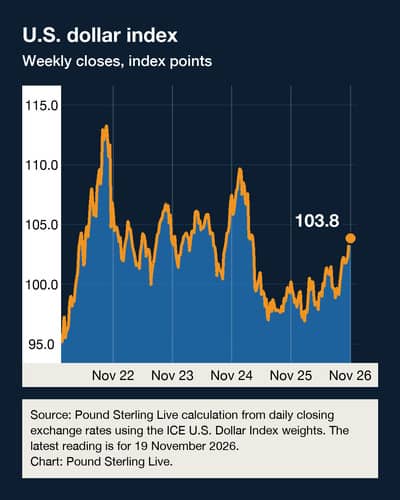
The dollar is set to stay elevated against the pound and euro through 2027 as the AI boom keeps U.S. yields and growth on top, although a downgrade to AI investment plans would undercut that support.
Deutsche Bank has raised its dollar forecasts for 2027 after the AI boom kept the U.S. currency strong against the pound and the euro through a year in which the bank had expected it to weaken.
The AI boom has lifted U.S. real interest rates and drawn heavy inflows into U.S. stocks, putting the dollar back at the top of the rankings for yield and growth and keeping the pound and euro under pressure, the bank says.
"Our expectations for a weaker dollar this year did not play out. The AI boom has been the big factor - it has pushed US real rates higher, attracted massive equity inflows, prompted renewed inflation pressure and a hawkish Fed," says George Saravelos, Global Head of FX Research at Deutsche Bank.
"On balance, though, the 'AI dollar' is alive and well," he adds.
The pound-to-dollar exchange rate fell to 1.3121 on Thursday, a six-month low, after minutes of the Federal Reserve's October meeting showed almost all officials expect to raise interest rates further. The euro-to-dollar exchange rate fell to a 52-week low of 1.0953 on Wednesday.
The bank's new forecasts show some dollar strength into the first half of 2027 and modest weakness in the second half, which "would still leave the dollar very elevated," says Deutsche Bank's Saravelos.
"Our forecasts exhibit a 'higher for longer' dollar scenario that is very unusual by historical standards of mean-reversion," he adds.
Deutsche Bank's U.S. economists expect the Fed to raise interest rates by 25 basis points in December, January and March, taking the fed funds rate to 4.625%.
The pound will meanwhile depend on Bank of England rate expectations for support against a higher-yielding dollar: sterling "has broadly continued to take its cue from front-end rates," says Shreyas Gopal at Deutsche Bank.
The odds of a December rate rise at the Bank of England softened after Wednesday's release of October inflation numbers undershot the Bank's own forecast, as Pound Sterling Live reported.
Turning to the euro, "the euro is likely to be weighed down by French political uncertainty, and fairly aggressive ECB pricing doesn't help either," says Deutsche Bank's Saravelos.
"Yet we think the balance of risks will improve as 2027 progresses. French risk premium is already substantial, the election is more likely to reduce than exacerbate political fragmentation, and Europe's underlying macro backdrop remains surprisingly resilient," he adds.
A recovery in the euro through 2027 would test the pound's gains against the single currency, which took the pound-to-euro exchange rate to a 2026 high of 1.2020 on Wednesday.
A Downgrade to AI Investment Would Weaken the Dollar
Deutsche Bank's forecasts stop short of a much larger dollar rally because of the currency's growing reliance on AI investment, "we have high conviction that a more pronounced downgrade to capex expectations would push down US real rates and weaken equity inflows, undermining the two key pillars of USD support," says Saravelos.
"Recent equity market weakness in the tech sector has, for now, failed to translate into a lower USD as Fed pricing remains elevated," he adds.
Pound Sterling Live's House View modelling also holds that a pullback in AI stocks moves the dollar only through its effect on Fed rate expectations, as Pound Sterling Live reported after Nvidia's results.
Deutsche Bank said on Wednesday that the dollar appears to be overshooting the move in interest rate differentials, and it doubts foreign investors' heavy buying of U.S. stocks can last if market turmoil persists.
Saravelos also sees downside risks for the dollar in a rotation from U.S. Treasuries into foreign bond markets, rising hedge ratios on dollar assets, lower energy prices and the U.S. twin deficit.
The dollar will stay elevated against the pound until a downgrade to AI investment plans pulls U.S. real interest rates lower.