
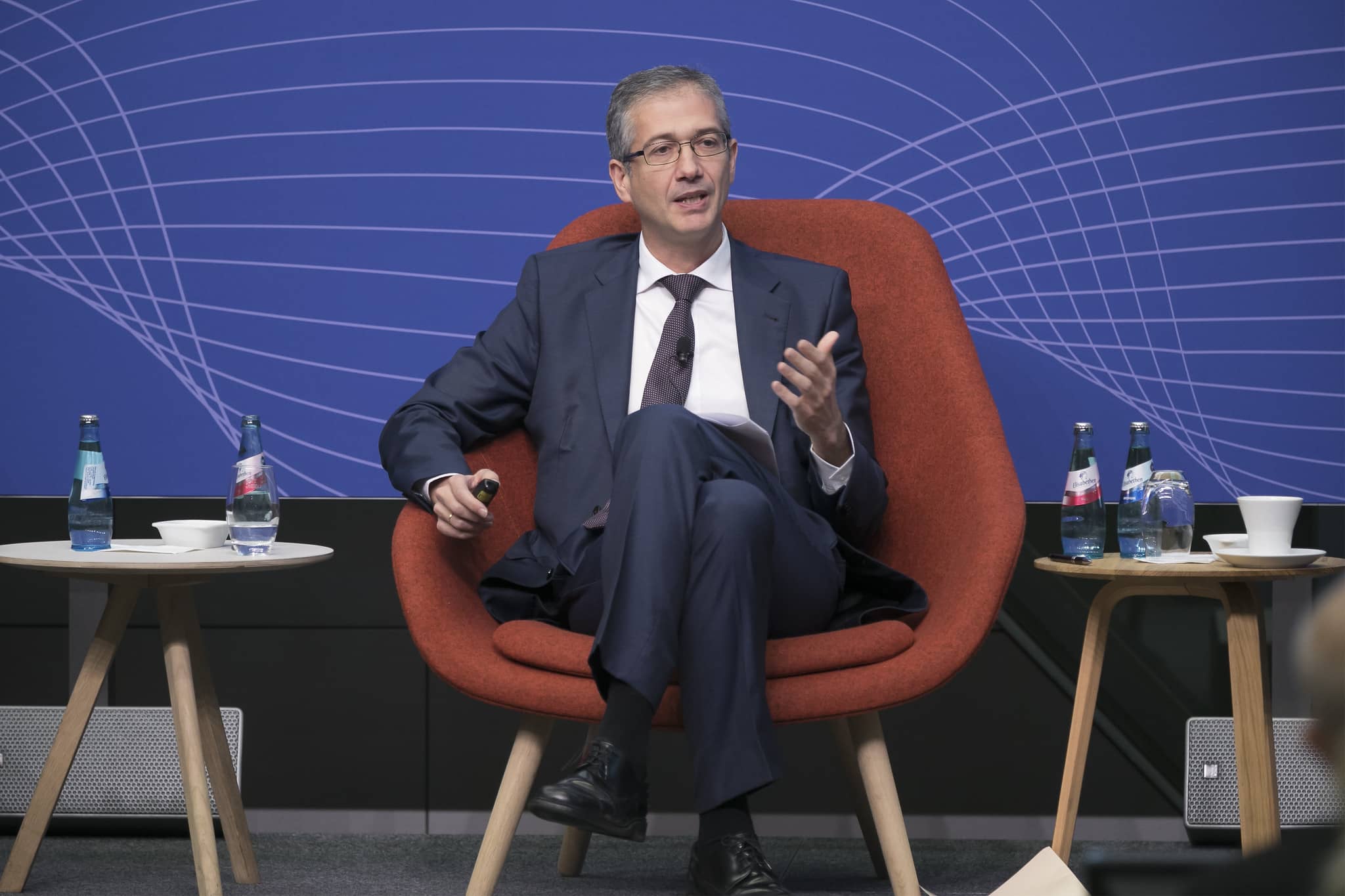
Image © ECB.
The euro could lose rate support if a dovish-leaning De Cos stops the ECB's hiking cycle early.
The euro risks coming under pressure if Pablo Hernández de Cos caps the European Central Bank's hiking cycle after he takes over as President in February, analysts say.
Hernández de Cos, the former Bank of Spain governor who now heads the Bank for International Settlements, is set to replace Christine Lagarde after Germany and France backed him over the Netherlands' Klaas Knot, with EU leaders expected to formalise the choice at their 26-27 November summit.
The ECB is expected to raise its deposit rate to 2.75% in December, and money markets price at least one further hike by April 2027 and probably another in the second half of the year.
However, should de Cos steer the Governing Council consensus to maintain the deposit rate at 2.75% markets would react by selling euros as the classical FX playbook says the euro would lose ground against the dollar and the pound if the ECB stops raising rates while the Federal Reserve and the Bank of England are still tipped to hike.
"Widely regarded as a centrist with dovish leanings, the appointment of the former Bank of Spain governor … probably raises the bar for the ECB to tighten beyond 2.75%," says a new FX market analysis from the French investment bank Société Générale.
The de Cos announcement didn't trigger a material response in foreign exchange markets, suggesting the markets want to hear more from the future President. The euro-to-dollar exchange rate fell to a 2026 low of 1.0953 on 18 November and trades just below 1.10, with the dollar supported by expectations for back-to-back Fed hikes in December and January.
The pound-to-euro exchange rate set a 2026 high of 1.2020 on the same day, with money markets pricing a 71% chance of a Bank of England hike in December after Wednesday's release of October inflation numbers.
Pound Sterling Live holds that added ECB caution centred on indebted members such as France acts as a headwind for the euro, and it is on record that de Cos favours reducing the ECB's government bond holdings slowly so as not to unsettle markets.
Some Analysts Doubt De Cos Will Reset the Game
However, the market is taking a sanguine approach to the matter.
Citi analysts explain that the next President's view on how prices are set matters more than the change of personnel, because it is the key to the ECB's reaction function.
Earlier this year de Cos said central banks "should pay particular attention to inflation expectations," a remark Citi reads as a shift to a more neutral stance since his time on the ECB's Governing Council.
"Relative to Lagarde, de Cos appears marginally more dovish and Knot marginally more hawkish, but both have demonstrated pragmatism, while the other appointments could matter just as much," says Christopher Graham at Standard Chartered in a recent update.
Princeton economist Markus Brunnermeier, Germany's pick for chief economist, is one of those appointments, and Citi expects that "he'll show sensitivity to financial conditions".
The need for further rate hikes at the central bank rests with inflation sitting well above the ECB's target: Euro area core inflation for October was revised up to 2.6% on 18 November, the highest reading since May 2025, according to the final data.
ECB Vice President Boris Vujčić recently said market pricing for another hike next year "does not seem unreasonable."