

Image © Adobe Images
The UK economy is set to keep growing strongly without adding jobs as AI investment lifts factory output and firms cut staff to contain costs.
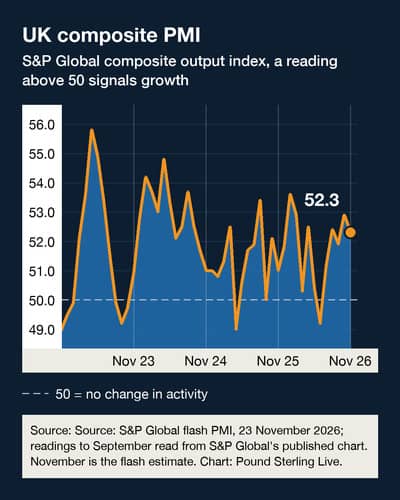
The UK is experiencing a jobless economic boom, with Monday's flash PMI figures from S&P Global pointing to strong growth even as companies cut staff.
This jobless boom backs Pound Sterling Live's view that AI investment is lifting UK output but isn't helping the labour market, leaving the Bank of England unable to bolster employment through the traditional method of cutting interest rates.
The flash surveys point "to a robust 0.6% increase in GDP during the fourth quarter," says Chris Williamson, Chief Business Economist at S&P Global Market Intelligence, although employment "showed a renewed fall as companies continue to worry over rising costs and seek to boost productivity."
S&P Global's purchasing managers' index (PMI) surveys companies each month on whether their activity is rising or falling. A reading above 50 signals growth.
The UK composite PMI, which combines manufacturing and services, held in growth territory at 52.3 in November, although it slipped from 52.9 and missed the 52.9 economists had expected.
Manufacturing output rose to a 27-month high of 54.2 from 53.6, the fastest increase since August 2024.
Manufacturers credited the rise in sales to AI data centre build-outs, higher defence spending and stronger demand for food and drink, S&P Global reports.
Manufacturing is now "the main driver of the economic upturn," with factories "enjoying an AI-related investment led growth spurt," says Williamson.
Bank of England estimates show AI-related activity has added around 0.5 percentage points to UK output growth since the start of 2026, as Pound Sterling Live has reported.
Employment is lagging output across the UK private sector, where productivity growth stands at around 2.5%, Morgan Stanley finds, as Pound Sterling Live reported earlier this month.
UK Companies Grow Without Hiring
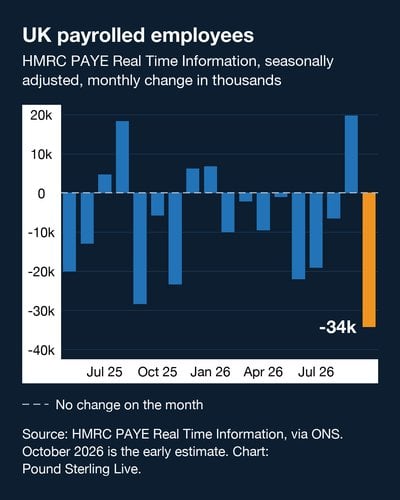
Employment fell again in November after a marginal rise in October.
Job cuts were concentrated in services, where firms pointed to high payroll costs, efforts to boost productivity and the decision not to replace staff who leave.
"The impact of high energy prices was again exacerbated by high staffing costs, the latter partly blamed by business on government policy," says Williamson.
Business optimism about the year ahead nonetheless rose to its highest since February, S&P Global reports.
Pound Sterling Live holds that Bank of England rate cuts would not fix this kind of unemployment, because businesses hold ample cash and are not waiting on cheaper credit to hire.
S&P Global Sees a December Bank of England Rate Rise as Near Certain
Turning to the Bank of England, "the combination of resilient output growth and stubbornly elevated inflation meanwhile makes another rate hike by the Bank of England at its December meeting a near certainty, and raises the likelihood of another hike in February," says Williamson.
Higher interest rates make borrowing more expensive and slow spending, helping to bring inflation back towards the Bank's 2% target.
Services activity slowed to a five-month low of 52.0 from 52.8, below the 53.0 economists had expected.
Williamson says services growth weakened "in part due to the impact of rising interest rates."
Input cost inflation eased for the first time since July, although it stayed well above its long-run average.
A data-dependent central bank decides each move on the latest economic figures.
"However, policymakers will likely remain data dependent," says Williamson.