File image of ECB President Christine Lagarde. Image: Andreas Reeg/ECB.
The euro can recover some lost ground this week, but the setup remains overall bearish.
The euro-to-dollar has taken a hammering this month and will in the coming days try and regroup and recover some of that lost value.
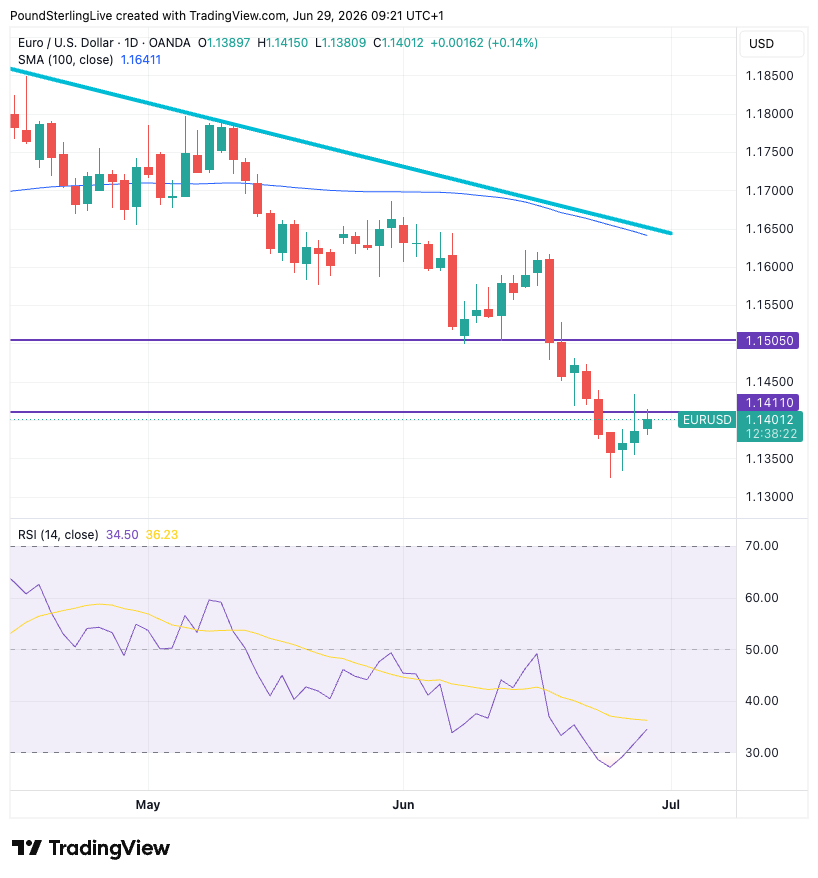
Last week's dip to 1.1324 took it into technically oversold territory as the RSI plummeted sub-30 to 27, which is historically a trigger for a mean reversion.
The improving RSI suggests a near-term recovery towards former support at 1.1505 is increasingly plausible as part of that mean-reversion move.
Given this, our Week Ahead Forecast eyes a short-term euro-dollar rebound that will allow the market to rebalance ahead of a more enduring recovery or a decisive extension of the downtrend.
Keep in mind too that all signs point to the month-end period being favourable to USD, which could encourage a reversal when the new month gets underway and that month-end demand dries up.
Nevertheless, the studies are clear: the broader technical picture continues to favour the downside while EUR/USD remains below 1.1505 and the descending 100-day moving average.
The break below 1.1505 has flipped that former support level into resistance, while the pair is attempting to stabilise around 1.1411 after finding buyers ahead of the 1.1350 area. Momentum remains negative overall.
Unless that recovery can reclaim 1.1505, rallies are likely to attract renewed selling interest, leaving the balance of probabilities tilted towards further weakness once the corrective bounce has run its course.
"EUR/USD has had a mild bounce, having traded as low as 1.1325 last week. But this move back ought to just be corrective . We’d need to extend up through 1.1469 again to really temper downward pressure," says Nicholas Kennedy, FX Strategist at Lloyds Bank.
Eurozone Inflation on Tap
In Europe the preliminary June CPIs are in focus and come at a time of increased nervousness about the region's inflation profile. Recall, June saw the ECB raise rates as concerns about entrenched inflationary trends grew.
This month's inflation series will therefore be closely watched. Spain starts things off (Mon), followed by France, Germany and Italy (Tue) ahead of the Eurozone reading (Wed), where a 2.95% reading is the benchmark.
"A further rise in services prices would agitate the ECB hawks, who have already professed to see second round effects in the tea leaves," says a daily brifing from Lloyds Bank.
All Eyes on Sintra
With inflation and the ECB in mind, it's a big week for European interest rate policy as the central bank's annual conference in Sintra, Portugal, gets underway.
For the euro, ECB President Lagarde's opening address late-Monday could be the most important, as she could touch on the ECB's latest thinking regarding interest rates.
"If any meaningful signals on the future path of ECB monetary policy are to emerge from the conference, they are most likely to come from Lagarde’s introductory speech," says a market note from UniCredit Bank.
The rule-of-thumb is that any newfound comfort with underlying inflation trends (owing to falling global oil and gas prices) would be taken as a sign the ECB is increasingly willing to wait before considering another move on interest rates.
That could weigh on the euro.
However, any indication that the ECB President is nervous about inflationary trends, particularly in services inflation, and the euro can benefit from the resultant rise in Eurozone bond yields.
Don't Forget U.S. Jobs Land on Thursday
The U.S. dollar is nevertheless likely to be the dominant partner in the euro-dollar pairing, and in this regard it's also a busy week Stateside.
The monthly marquee data release falls on Thursday when the non-farm payrolls numbers are released. After three consecutive months of strong payroll gains, averaging 188k per month, economists look for a gain of around 114k for June.
"While layoffs remain low, the NFIB survey of small businesses' hiring intentions started slowing a few months ago and suggests job gains will slow through August," explains a weekly economic overview from UniCredit Bank.
Should payrolls undershoot expectations, the dollar would likely drop and pare some of its recent gains.
The unemployment rate probably held at 4.3% in May, with average hourly earnings rising another 0.3% mom.
Ahead of payrolls, keep an eye on Tuesday's release of JOLTS job openings for May, which are expected to have dropped to 7,000k from 7,618k in the prior month.
The dollar has risen through June as markets account for above-consensus economic data and rising odds that the next move at the Fed will therefore need to be a hike.
The question for USD is whether this week's data dump can encourage a continuation of this trade, or whether it's now understood, in which case it will require a noticeably above-consensus run of data to keep the near-term rally alive.
"The Fed now faces a more complex policy backdrop. Inflation has risen sharply, reaching 3.8% in April from 2.4% at the start of the year, driven in part by the continued disruption in the Strait of Hormuz. With inflation pressures building and the labour market remaining robust, the bar for rate hikes continues to fall, increasing the likelihood of further policy tightening in the near term," says Isaac Stell, Investment Manager at Wealth Club.