Image © Adobe Images
Key Takeaways
- The UK borrowed £1.8 billion in July 2026, £2.3 billion worse than the OBR forecast, in a month that normally delivers a surplus thanks to self-assessed income tax receipts, reports Pound Sterling Live.
- Bond markets are reading Prime Minister Andy Burnham's talk of fiscal rule "flexibility" as a sign extra borrowing is to come, with ten-year gilt yields back above 5%, according to research from Quilter Cheviot's Richard Carter covered by Pound Sterling Live.
- Economists expect a modest 28 October Budget of targeted spending rises and smaller tax increases, because "investors ultimately care less about the precise design of the rules than about how much debt the government needs to sell," says WPI Strategy's Martin Beck in commentary covered by Pound Sterling Live.
July's borrowing overshoot hardens expectations that October's Budget will demand difficult choices, economists say.
The UK borrowed £1.8bn in July, show new data from the ONS, a month in which the Office for Budget Responsibility had expected a surplus, and the miss has landed in a week when ten-year gilt yields have pushed back above 5%.
The figure was £2.3bn worse than the OBR's forecast and £0.7bn higher than July 2025, an increase of 68.7%.
That timing makes the shortfall more awkward than the headline number suggests as July is normally one of the strongest months of the fiscal year because self-assessed income tax receipts land in it, so an overshoot in July is not a seasonal quirk.
Borrowing across the financial year to date now stands at £56.7bn against an OBR expectation of £54.4bn. June had come in £0.3bn below forecast; July has more than wiped that out.
Debt interest costs are already doing visible damage, reaching £7.7bn in July, with a capital uplift of £1.3bn reflecting the 0.2% rise in RPI between April and May.
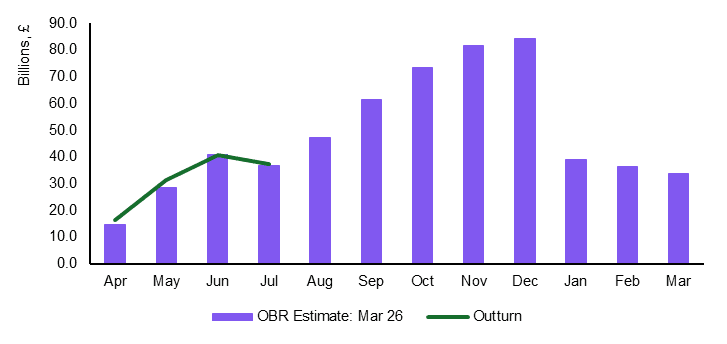
Image courtesy of Panmure Liberum's Simon French.
The Gilt Market is Sending a Strong Signal
The public finance figures land as the bond market continues to price a difficult fiscal trajectory for the UK.
Long-dated borrowing costs are elevated and sit near multi-decade highs, imposing additional borrowing costs while signalling the Autumn budget will be an uncomfortable one for the government.
Most of what Andy Burnham has announced so far amounts to a reallocation of existing funds rather than new money, but he has spoken openly about finding flexibility within the fiscal rules, and gilt investors have taken that as advance notice.
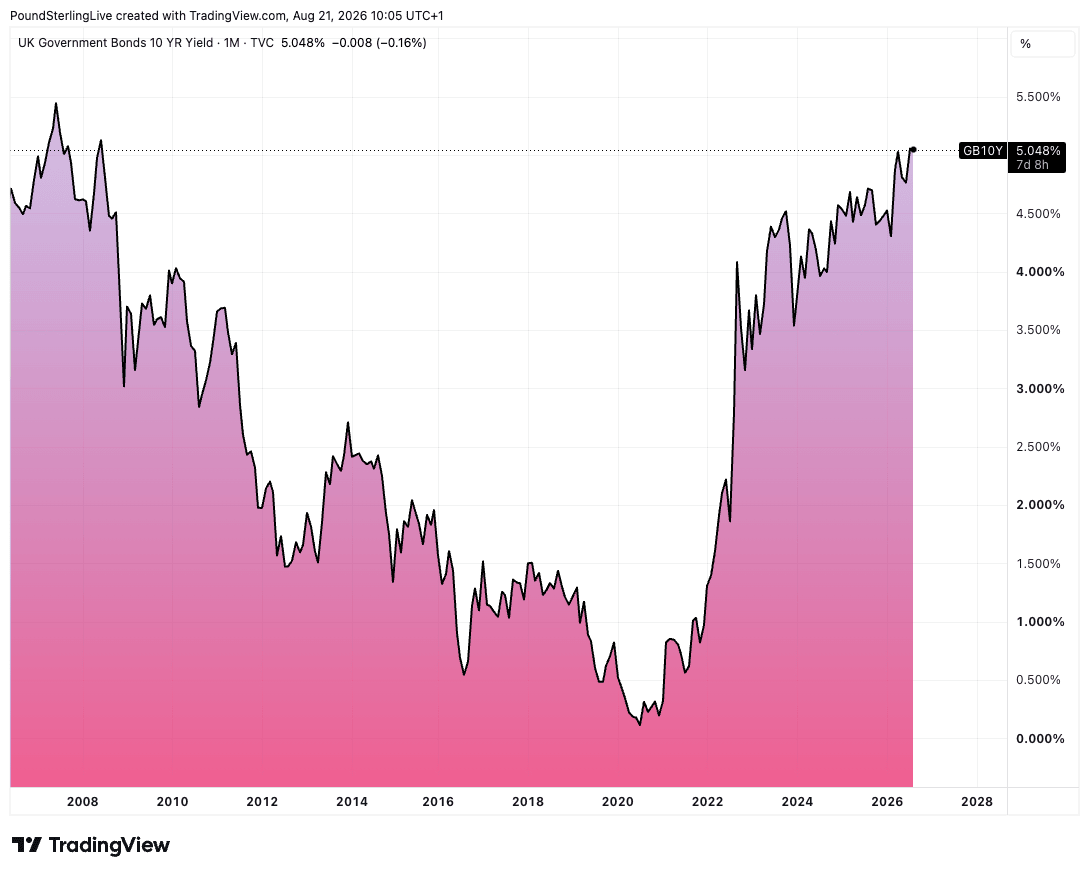
Above: GB ten-year borrowing costs (gilt yield).
Richard Carter, head of fixed interest research at Quilter Cheviot says "bond markets are taking this as a sign that extra borrowing is to come."
He identifies three pressures arriving at once:
- Negotiations between the United States and Iran have stalled, keeping geopolitical volatility in the system.
- Jitters around US bond yields are compounding it.
- And the domestic fiscal picture is deteriorating.
"Giving markets somewhat of a trifecta of negative news," is how he describes the combination, arguing it will tie the government's hands as it tries to move quickly.
The Case for Not Overreacting
"Current budget deficit for the UK public sector evolving almost exactly as the OBR forecast back in March," says Simon French, economist at Panmure Liberum.
"Indeed quite impressively small forecast variance. YTD current deficit of £37.5bn, vs £36.6bn forecast. Lots of reasons to be concerned about the UK fiscal path, but an in-year miss is not currently one of them," he adds.
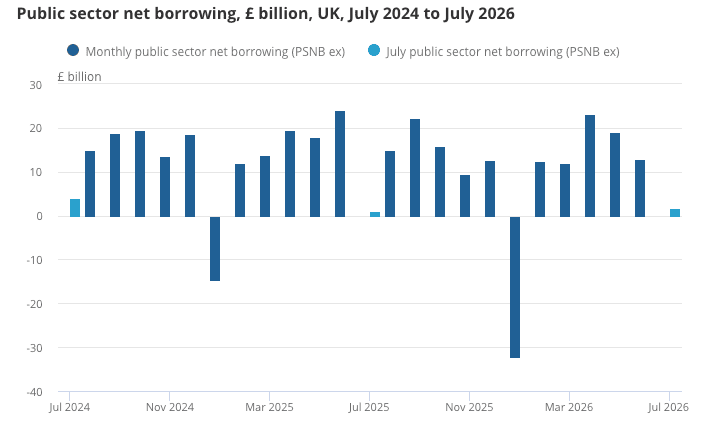
July is typically a strong month for borrowing.
Martin Beck, Chief Economist at WPI Strategy, calls July's figures an unwelcome surprise but cautions against reading too much into one month, yet his concern is what sits further out:
Ten-year gilt yields above 5% reflect energy-related inflation concerns, and those yields will feed gradually into a larger debt interest bill as existing debt is refinanced. At the same time the government faces pressure to loosen inherited spending plans, meet unfunded defence commitments and deliver on housing, infrastructure and public services.
That is a structural squeeze rather than a monthly one, and it does not resolve with a better set of receipts in August.
What This Means for the Budget
Beck's read is that markets are not currently pricing any dramatic fiscal shift, partly because they expect the administration to stick to the existing rules and avoid major increases in the largest taxes.
Planned changes to the fiscal framework, which loosen the definition of a current budget balance, should create some additional headroom on 28 October. His argument is that the Chancellor may not want to use it.
That points towards a modest package: targeted spending increases, a handful of smaller tax rises, and perhaps a limited increase in borrowing.
Large-scale capital spending, major tax cuts such as a rise in the personal allowance, or another change to the fiscal rules would each put renewed focus on gilt issuance.
"Investors ultimately care less about the precise design of the rules than about how much debt the government needs to sell," says Beck.