Image © Adobe Images
Key Takeaways
- UK retail sales fell 0.5% in July but analysts including Pantheon Macroeconomics and McKinsey play the decline down as a timing correction of the early summer surge, with the underlying trend still up, reports Pound Sterling Live.
- GfK consumer confidence jumped to -14 in August from -17 in July, beating expectations of -18, a rise dubbed a "Burnham bounce" though Berenberg attributes it to easing inflation and interest rate anxiety after the Iran war dip.
- The data run supports Pound Sterling Live's house view that surprisingly strong UK growth means the Pound can avoid the second-half slump consensus expects, with GBP/EUR at 1.1667 and GBP/USD up 0.8% at 1.3648 on U.S. bond buyback developments.
Heavy UK data morning in the UK: Three ONS releases have landed and the wire has already filled with reaction.
To start, the lay of the land reads as follows: pound-to-euro is looking to record a down-week with a loss of a quarter of a per cent on the cards, with the pair at 1.1667 at the time of writing.
The pound-to-dollar is up by 0.80% at 1.3648 thanks to developments in the U.S. involving bond market buybacks, more on that here.
Turning to GBP, the docket kicked off with the release of retail sales, which were down 0.5% in July after a 0.7% rise in June according to the ONS, itself revised down from 1.0%.
The reaction is unusually consistent in playing the disappointment down: McKinsey's Hai-Ly Nguyen calls it a timing effect.
Pantheon Macroeconomics reads it as a predictable correction of the early summer surge with the trend still solidly up.
The BRC's Harvir Dhillon frames July as modest growth. Martin Beck at WPI Strategy calls it a pause, with the caveat that Budget uncertainty could keep consumers cautious.
So in all, nothing for pound watchers to worry about.
"Given the broader resilience of retail spending of late, and the weather/events of July it’s hard to take too gloomy a take on this batch of data and we’d expect some recovery next month with the underlying trend still looking encouraging," says Lloyds Bank in a post-release reaction.
Public finances for July were released alongside retail sales and showed borrowing above expectations.
The UK borrowed £1.8bn in July, a month in which the Office for Budget Responsibility had expected a surplus, and the miss has landed in a week when ten-year gilt yields have pushed back above 5%.
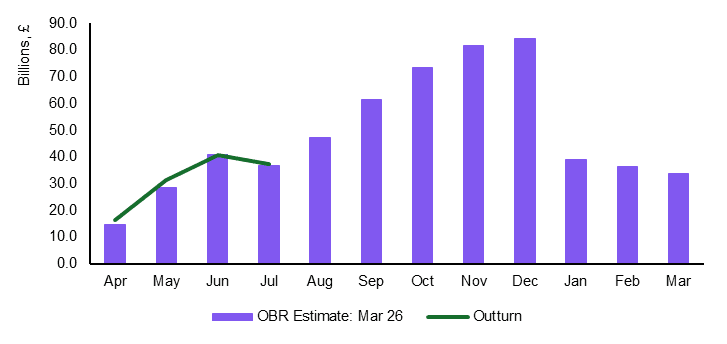
Image courtesy of Panmure Liberum's Simon French.
The figure lands near the OBR's projections, which underpins the official budget watchdog's impressive forecasting abilities. Nevertheless, there's a sense risks are skewed towards higher borrowing.
"Current budget deficit for the UK public sector evolving almost exactly as the OBR forecast back in March. Indeed quite impressively small forecast variance. YTD current deficit of £37.5bn, vs £36.6bn forecast. Lots of reasons to be concerned about the UK fiscal path, but an in-year miss is not currently one of them," says Simon French, economist at Panmure Liberum.
Richard Carter at Quilter Cheviot ties it straight to the gilt market, arguing bond markets expect more borrowing to come, in a week where gilt yields have been the story.
GfK consumer confidence, August shows a "Burnham bounce": the composite index rose to -14 in August from -17 in July, comfortably ahead of the consensus expectation of -18.
Pantheon attributes the surge in confidence to the new Chancellor, but expects it to fade.
Berenberg reads the move as the completion of a recovery that has been running since spring.
"Consumer confidence completed its recovery from the Iran war-induced dip," says Andrew Wishart at the German bank, tracing the path from a trough of -25 in April through -17 in July to -14 in August.
His explanation is mechanical rather than political; fewer headlines about surging inflation and interest rates have eased households' financial anxiety, and households report being content to save a little less as a result.
In all, supportive of the GBP narrative.
The dollar backdrop has turned
More important for global FX is that the buyback rally in long-dated bonds is already unwinding, and analysts are looking for further dollar weakness from here.
That can lift the pound against (obviously) the dollar, but also against the euro, yen and franc.
However, as long as sentiment stays supportive, the pound will likely be outperformed by the likes of the commodity dollars (AUD, NOK and NZD) and emerging market currencies.
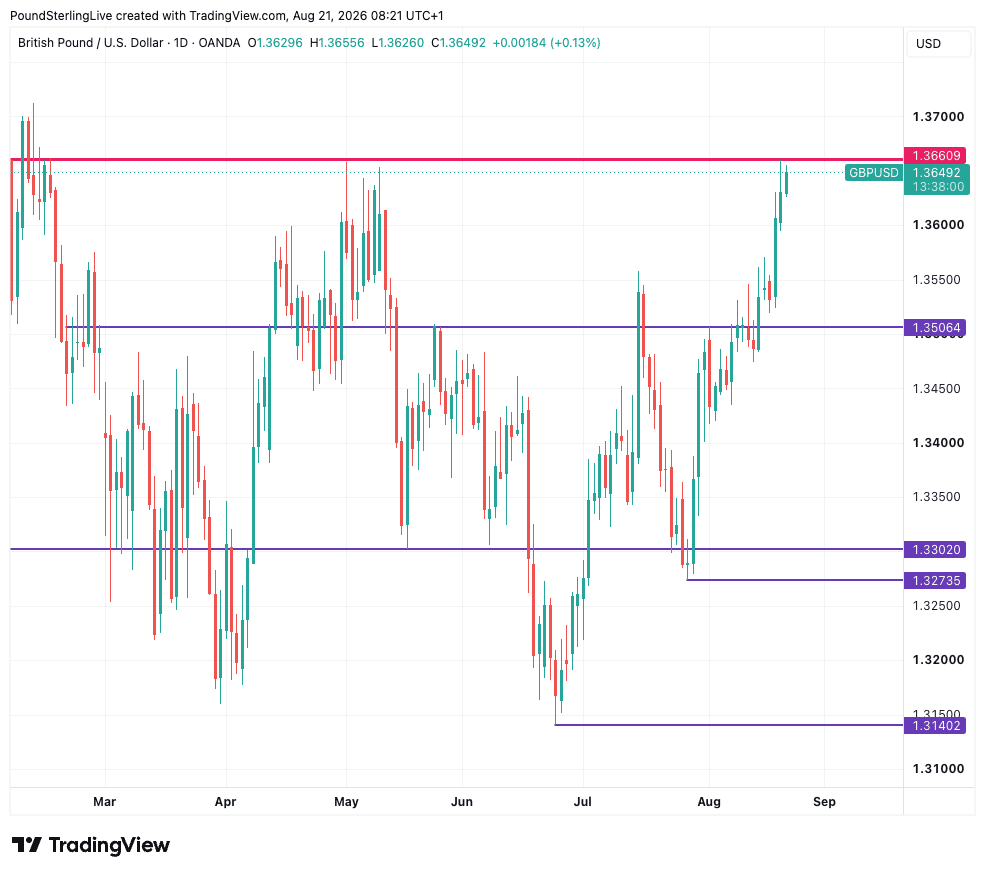
Above: GBP/USD rises into a key resistance point on the chart.
The Numbers Reinforce Our Constructive House Call
The evolving sterling story rests partly on CIBC's argument that the UK political risk premium had fallen and fiscal concerns had receded.
This morning's data offers no reason to cut against that insight and is consistent with our House View that a run of surprisingly strong growth data provides the clearest evidence pound sterling can avoid the H2 slump the consensus expects.
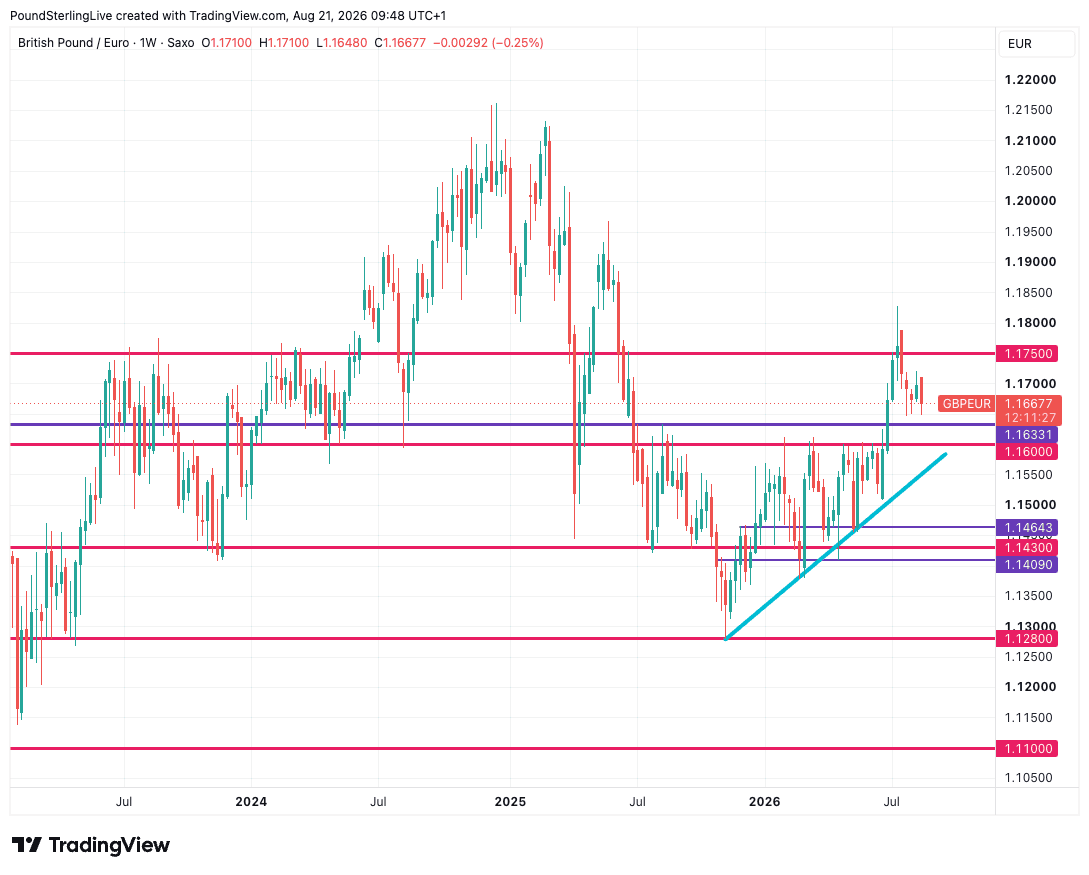
Above: GBP/EUR rally thwarted by resistance, but post-November rally still intact.