

Image © Adobe Images
The Bank of Japan is under pressure to commit to a December rate rise as it identifies the yen as a key threat to defending the inflation target.
The Japanese yen is losing ground again, and the Bank of Japan has named the currency as one reason it lifted its own inflation forecast at the October meeting.
The Bank raised its FY2027/28 inflation projection to 2.6% from 2.4%, citing higher oil prices, currency weakness and AI-related demand.
That revision carries more weight than it would have a month ago, because the same meeting produced the Bank's first statement in which it could state inflation had reached the 2% target.
"The BoJ noted for the first time that underlying inflation has reached its 2% target, marking a shift from creating inflation to containing it," says Standard Chartered, the UK-headquartered bank.
Governor Ueda named exchange rate movements among the upside inflation risks he is watching, alongside Middle East developments and AI-related demand.
Dollar-yen is at 158.40, down 0.19% on Wednesday, still below its 100-day moving average at 159.17 and some way from the 160.00 ceiling that has held since April.
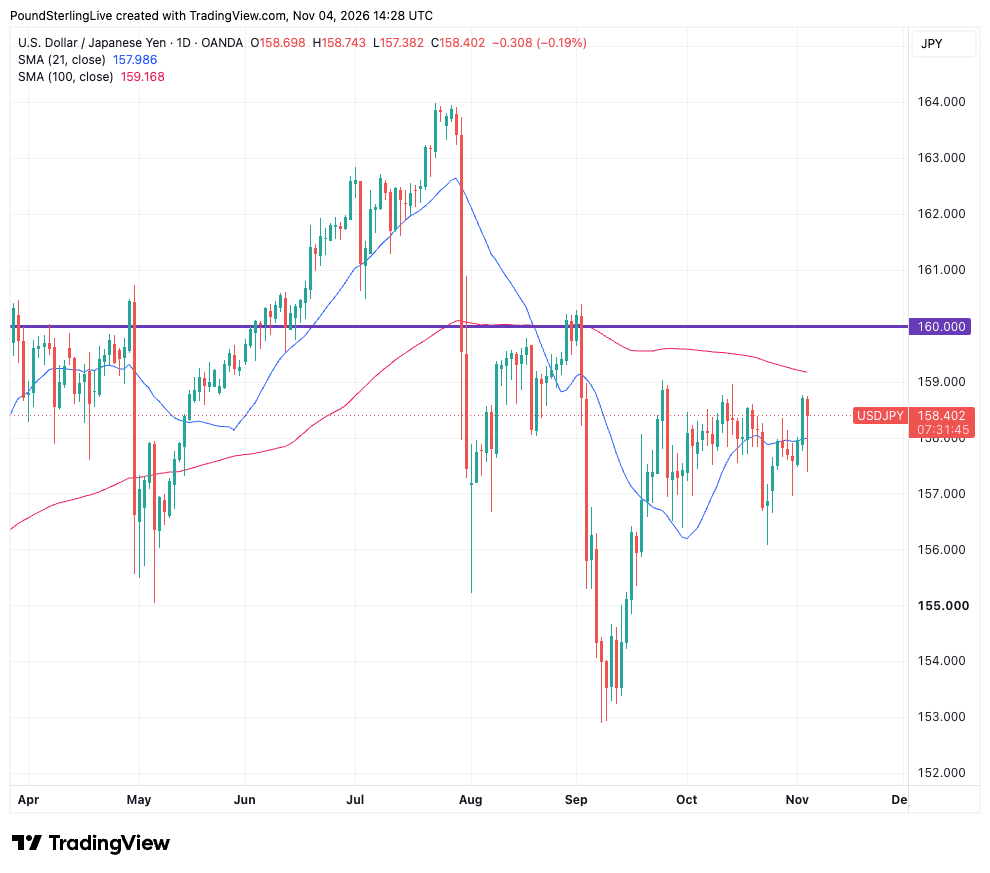
Above: USD/JPY daily chart with the 21-day and 100-day moving averages and the 160.00 level. Chart courtesy of TradingView.
The pound-to-yen exchange rate is up 0.34% at 213.61 and is now through its 100-day average at 213.10 for the first time since August, an indication of rebuilding upside pressure.
GBP/JPY has recovered more than six yen from the 207.00 low set in September, with the 21-day average turning higher at 210.53 beneath it, which puts the yen on the back foot against a currency whose own central bank is also tightening.
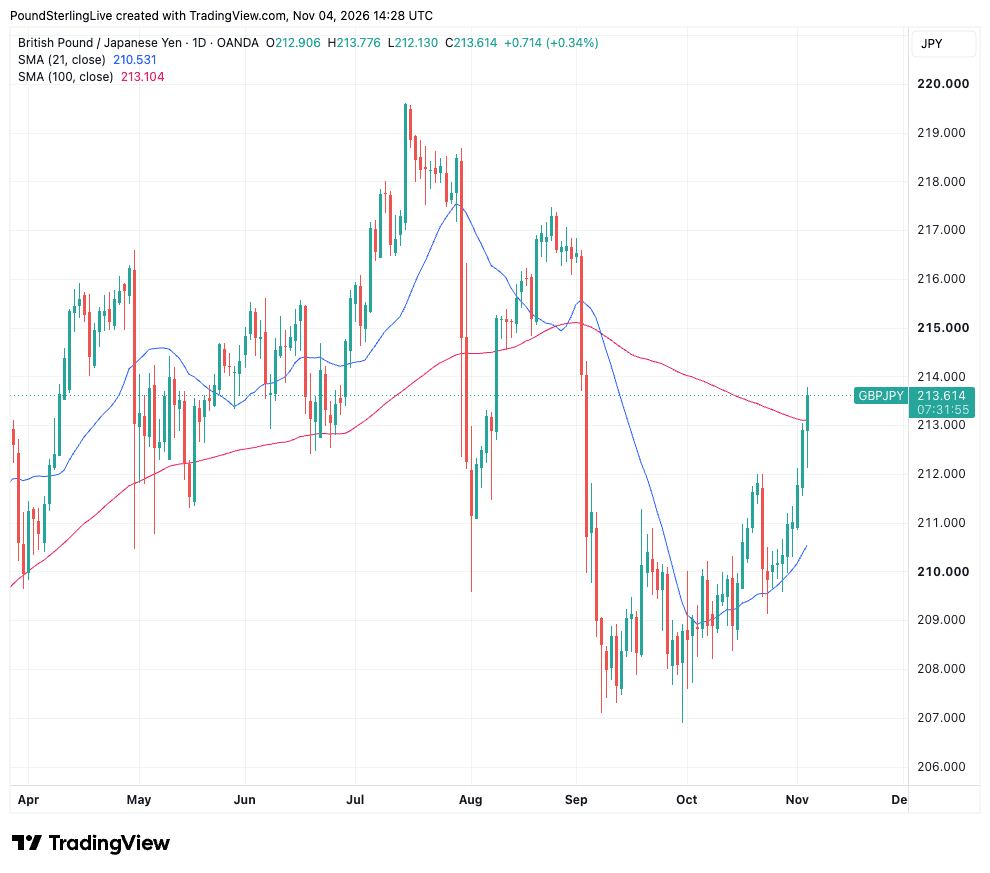
Above: GBP/JPY daily chart with the 21-day and 100-day moving averages. Chart courtesy of TradingView.
US Treasury Yields Outweigh the Bank of Japan’s Shift
Ueda confirmed the Bank has “roughly” reached the 2.0% objective, while achieving it sustainably remains a task.
The gap that matters sits at the front of the curve, where the two-year Japanese government bond yielded 1.88% on 2 November against a two-year US Treasury at 4.62%.
That 274 basis point differential is the carry an investor gives up to hold yen, and it is the widest point on the curve.
Further out the gap closes sharply, with the 10-year JGB at 2.82% against a 10-year Treasury at 4.96% on Tuesday, and the 30-year JGB at 3.94% against 5.33%.
Japan’s super-long yields have risen far enough to narrow the differential to 139 basis points, although carry funds at the short end where the Bank of Japan’s 1.25% policy rate holds the two-year yield down.
JPY Hawks Won't Give Up Yet
If the Bank of Japan can deliver more hikes, it could yet staunch JPY losses. Pantheon Macroeconomics reads the Japanese hold as hawkish in character, “the Bank appears to have accelerated its tightening cycle to roughly one hike every three months,” says the consultancy, which expects 25 basis points in December, taking the policy rate to 1.5%.
"We expect a structural appreciation of the yen against the US dollar and, to a lesser extent, the euro," says Volkmar Baur, FX and Commodity Analyst at Commerzbank, pointing to Japanese investors increasingly selling foreign bonds while major pension fund portfolio shifts have yet to materialise.
J.P. Morgan's G10 desk is also positioned for it, "all I am left with is short USDJPY where price action is frustrating but risks still appear on a number of factors be skewed to lower for me especially with good local interest to supply above 158," says the desk, citing tech and AI equity pressure, GPIF flows and Friday's US payrolls.
OCBC’s residual model shows the term premium on the JGB curve has narrowed notably over the past month, “the flattening momentum may be losing some steam,” says Frances Cheung, Rates Strategist at OCBC.
Analysts at UOB have widened their near-term dollar-yen range to 157.00 to 159.00 after the break above 158.60 this week.