
Image © Adobe Images
The New Zealand dollar risks a return to this year's lows against the pound as global stock markets slide and U.S. inflation data keeps the Federal Reserve raising interest rates.
The pound-to-New Zealand dollar exchange rate's direction this week depends on whether the stock market selloff deepens and Wednesday's October U.S. inflation figures keep the Federal Reserve raising interest rates.
Last week the pair touched 2.4062 on 18 November, but it fell to 2.3780 a day later after October's UK inflation figures undershot the Bank of England's forecast, before recovering to start this week at 2.3984 as a slide in AI-linked stocks weighed on the kiwi. The New Zealand dollar is a high-beta currency that investors buy when they are confident and sell first when stock markets fall. The Nasdaq dropped 5.3% on Friday as worries over the profits of AI companies deepened.
The recent recovery has kept GBP/NZD above its 21-day moving average, the average of the last 21 daily closes, which has risen steadily since late October and caught last week's dip as buyers stepped back in. Pound Sterling Live's modelling treats the 21-day as the level GBP/NZD returns to when it strays too far from it.
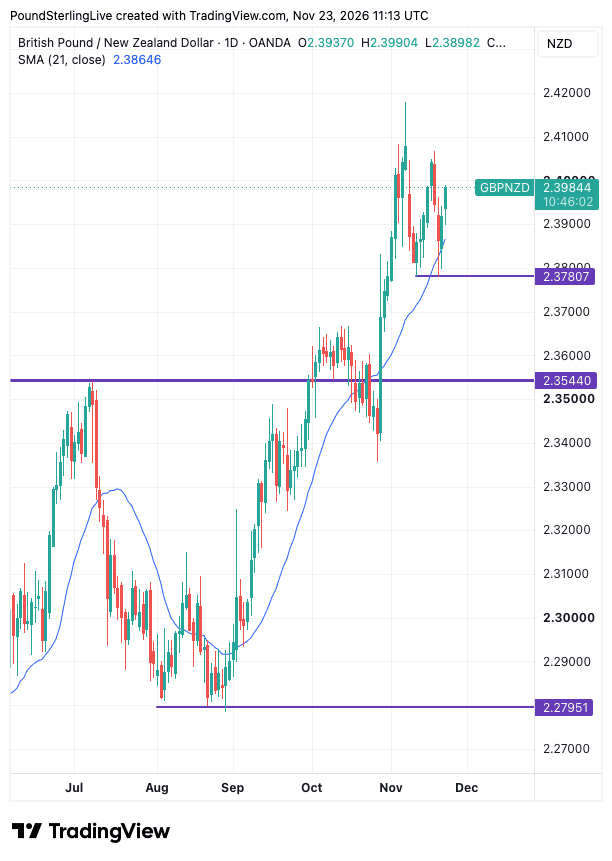
Above: GBP/NZD at daily intervals with the 21-day moving average (blue) and horizontal support levels (purple). Image © Pound Sterling Live, chart created with TradingView.
Last week's low at 2.3781, the upper purple line, sits just beneath the blue line and is the first support, a level where buyers stepped in to halt the fall on 19 November.
Resistance sits at 2.4179, the 2026 high set on 6 November and the pair's highest level since 2015, a level where sellers have so far halted the rally. A break above it would take GBP/NZD into territory it has not traded in for more than a decade.
Pound Sterling Live reads the chart as simply bullish, looking for GBP/NZD to retest its 2026 high this week before any meaningful setback.
A daily close beneath 2.3781 would change the near-term Pound to New Zealand Dollar forecast, because it would show sellers had broken through both last week's floor and the 21-day average and opened the way to 2.3544, the ceiling that capped the pair in July and October.
Further out, the rising 21-day average and a run of higher lows since August keep the multi-year uptrend intact.
Last week Pound Sterling Live's Week Ahead Forecast looked for a retest of 2.4179, and GBP/NZD reached 2.4062 on 18 November, 117 pips short, without a daily close beneath the 2.3781 level that would have changed the call.
The Kiwi Stays Under Pressure as Long as Stocks Keep Falling
The kiwi's direction this week will depend heavily on global stock markets, where a selloff in AI-linked shares has taken the S&P 500 12% below its 6 October high.
Commonwealth Bank of Australia expects NZD/USD to bounce if U.S. inflation softens, although "any recovery in NZD/USD will prove short-lived if AI concerns intensify and pull global equities down further," says the Australian bank.
Wednesday's October core PCE inflation figures, the Federal Reserve's preferred measure of underlying price growth, are due at 13:30 UK time, with consensus at 0.3% on the month and Commonwealth Bank of Australia forecasting 0.2%. Higher U.S. inflation keeps the Fed raising interest rates, which lifts U.S. bond yields, the return investors earn on U.S. government debt, and draws money into the dollar and away from currencies such as the kiwi.
Under the playbook, PCE figures above consensus would lift the dollar and weigh on the kiwi. Softer PCE figures would give NZD/USD room to bounce.
Australia's October inflation figures on Wednesday and thin trading around the U.S. Thanksgiving holiday on Thursday are second-tier events for GBP/NZD.
A December RBNZ Hike Would Cushion the Kiwi's Fall
Closer to home, money markets price around an 85% chance that the Reserve Bank of New Zealand (RBNZ) raises interest rates on 9 December. Higher expected New Zealand rates lift the return on New Zealand bonds and draw in foreign buyers who need New Zealand dollars to buy them, so that pricing gives the currency some support.
Goldman Sachs now expects the RBNZ to raise its Official Cash Rate, its main interest rate, to 3.00% in December and to deliver a final hike in March, a change it made "following increasingly hawkish comments from RBNZ officials," says the U.S. investment bank. Hawkish comments lean towards higher interest rates, which tends to support a currency.
Retail sales volumes rose 2.2% in the third quarter, well above the 0.5% consensus, Stats NZ figures released on Monday show. Under the playbook, figures above consensus support the kiwi.
"We expect that spending levels will continue to firm through the holiday season and 2027. However, that recovery is still likely to be gradual due to the combination of ongoing high inflation, a soft labour market and rising interest rates," says Westpac.
"For now, however, we believe the NZD's weakness has gone somewhat too far," says Commerzbank, although the German bank also judges that New Zealand rate "expectations appear too aggressive."
Bank of England Hike Bets Underpin the Pound
Turning to the pound, Bank of England policymakers appear before the Treasury Committee at 14:15 on Wednesday, after Monday's flash PMI figures showed the UK economy growing even as firms cut jobs.
"The combination of resilient output growth and stubbornly elevated inflation meanwhile makes another rate hike by the Bank of England at its December meeting a near certainty, and raises the likelihood of another hike in February," says Chris Williamson, Chief Business Economist at S&P Global Market Intelligence.
Higher expected Bank of England rates lift UK bond yields and draw in foreign buyers who need pounds. Under the playbook, hawkish remarks from the Bank would lift the pound. Dovish remarks, those pointing to a pause in rate rises, would weigh on it.
Pound Sterling Live's Pound to New Zealand Dollar forecast looks for GBP/NZD to retest its 2026 high at 2.4179 this week, for as long as the pair holds above 2.3781, last week's floor.