
Image © Adobe Images
The pound can keep its strength into 2027 as AI investment lifts UK growth and high UK yields draw in foreign capital.
Pound sterling can perform strongly against the euro, dollar and other currencies into 2027 if Britain's AI-led growth spurt proves durable, says a new FX market analysis from MUFG.
"If the recent improvement in AI-related activity and productivity proves more persistent than widely expected, it would reinforce our view that the UK economy is becoming more resilient and provide a further tailwind for the GBP in 2027," says Lee Hardman, Senior Currency Analyst at MUFG.
The prediction comes as the AI boom is most easily associated with the dollar, understandably so, as the U.S. is the originator of this technology and is where the AI giants list their stocks.
However, that investment cycle is starting to spread, and the UK economy, which is closely aligned to that of the U.S. via the services linkage, is clearly now benefiting.
For pound sterling, that's a boon.
Over the first three quarters, UK growth of 2.6% annualised was almost in line with the US at 2.7%, while significantly outpacing the euro area's 1.4%," he adds. Annualised growth is the pace the economy would grow over a full year at that rate.
Business investment has recovered after largely stagnating in the years following the Brexit vote: "Since the start of 2025, it has expanded at an annualised rate of 5.0%, accelerating to 7.1% this year and comfortably outpacing overall GDP growth. … The AI investment boom appears to be an important part of this turnaround," he adds.
The findings echo Pound Sterling Live's House View, set out in August, which argued that the UK economy was defying expectations for a second-half slowdown, with business investment rising and the spread of the AI trade from the U.S. into closely linked economies a likely cause.
The call put us ahead of consensus. Official growth figures have since borne it out, as we have reported.
UK Leads Europe in the AI Build-Out
Bank of England staff recently put a figure on the AI contribution, estimating in the November Monetary Policy Report that "novel AI-related activity accounts for just under a fifth of GDP growth since the start of 2026."
Nomura's economists reach the same finding: "There is growing evidence that the UK's resilience this year comes from AI investment and the AI build-out," says the Japanese bank in a recent update.
Data Center Map lists 608 UK data centres, the second most of any country behind the U.S. and ahead of Germany, China and France.
Faster Productivity Lets the UK Grow Without Extra Inflation
This year's growth has come with a jump in productivity, the amount the economy produces for each hour worked. Output per hour rose 2.5% in the year to the third quarter, on new Office for National Statistics methodology that places the UK second in the G7 for productivity growth over the past decade.
"This is potentially significant for the GBP because stronger productivity growth would allow the economy to sustain faster GDP growth without generating a corresponding increase in inflationary pressure," says MUFG's Hardman.
"A spurt this sharp raises an intriguing question: is AI starting to show up in the numbers?" says NatWest, the British bank, in a recent update.
However, Britain's AI Boom Is a Jobless One
Faster productivity lets firms produce more without hiring more workers. Pound Sterling Live has argued that the AI boom is a jobless one. AI lifts output and rewards those in work, but Bank of England rate cuts will not fix the unemployment it leaves behind, because businesses hold ample cash.
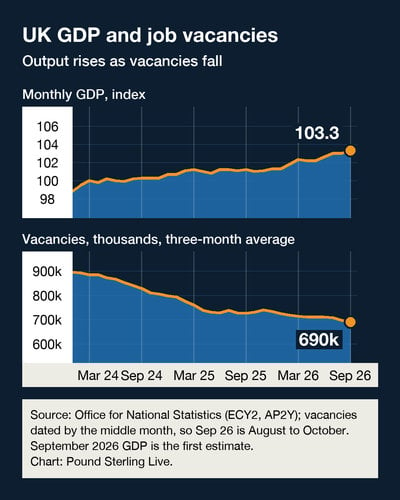
Above: UK monthly GDP index (top) and job vacancies, three-month average (bottom). Output has risen as vacancies have fallen. Source: ONS.
The Office for National Statistics' monthly GDP index rose from 98.8 in January 2024 to 103.3 in September 2026, on the first estimate.
Job vacancies fell from 895,000 at the start of 2024 to 690,000 in the three months to October, the lowest since 2014 outside the pandemic, labour market figures show.
Employment fell again in November even as factories enjoyed an AI-related investment spurt, Monday's flash PMI surveys showed, as Pound Sterling Live reported.
A jobless boom keeps Bank of England rates higher for longer. Higher UK rates keep the extra return investors earn on UK assets in place, drawing in foreign investors who need pounds to buy UK assets.
Productivity Could Ease the Pressure for More Bank of England Hikes
However, MUFG draws a different conclusion for interest rates from the weak hiring: "Recent labour-market data are also reassuring, with labour demand remaining weak despite stronger GDP growth. This gives us greater confidence that second-round inflation effects will remain contained in 2027 and could challenge current market pricing for three to four further BoE hikes over the year ahead," says Hardman.
Second-round effects are higher energy costs feeding into wages and other prices. Markets have already priced in those hikes, meaning investors have bought pounds in anticipation of them, so fewer hikes than expected would lower UK bond yields and weigh on sterling.
"However, stronger productivity growth is not unambiguously dovish for rates. If it reflects a lasting improvement in the UK's potential growth rate, it could also push up the neutral policy rate," he adds.
A dovish development points to lower interest rates. Potential growth is the pace the economy can sustain without stoking inflation. The neutral rate is the interest rate that neither speeds up nor slows down the economy, so a higher neutral rate means the Bank of England has to keep Bank Rate higher to hold inflation down.
The Bank raised Bank Rate to 4.00% on 5 November and described policy as restrictive, consistent with MUFG's estimate of a neutral rate of around 3.50%.
A Deeper AI Sell-off Could Hurt the Pound
U.S. tech stocks peaked on 6 October and have since fallen on concerns over the profitability of AI investment, analysts say.
The pound-to-dollar exchange rate has fallen 1.3% since then, but the euro-to-dollar rate has fallen 2.7%, so each pound buys 1.4% more euros.
"The recent sell-off in AI-related investments has again tested the GBP's resilience this year but has yet to materially undermine it," says Hardman.
"However, there is a risk that the GBP could suffer a sharper sell-off if global equity markets undergo a deeper correction that threatens financial market stability," he adds.
Crédit Agricole's positioning model, which tracks how heavily investors already hold a currency, shows the pound vulnerable to a setback. "All in all, the GBP remains in overbought territory," says the French investment bank, meaning investors already hold so many pounds that fresh buyers are scarce.
A carry trade borrows in a low-yielding currency to buy a higher-yielding one such as the pound. Investors sell those positions quickly when markets turn volatile, and Hardman says "higher-yielding currencies such as the GBP could be hit by the forced liquidation of carry trades."
"At the same time, UK yields would likely move lower as the market priced in a reduced likelihood of the BoE delivering the three to four rate hikes currently discounted into the UK curve," he adds.