

Image © Adobe Images
The pound risks further losses against the dollar as US business surveys point to strong growth and price pressures keep the Federal Reserve on course to raise interest rates.
The dollar held its gains against the pound on Monday afternoon after S&P Global's flash surveys showed US business activity grew at its slowest pace in four months in November, although price pressures stayed high enough to keep Federal Reserve rate hikes in view.
S&P Global's surveys matter for the dollar because strong growth and sticky prices give the Fed reason to keep raising interest rates, and higher US rates lift the return on dollar deposits and US government bonds, drawing in foreign investors who need dollars to buy them.
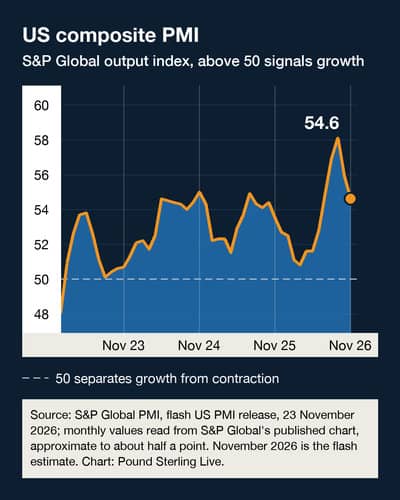
"Although output growth slowed in November, recent readings have been impressively strong, and the PMI surveys still point to GDP rising at an annualized rate of about 3% in the fourth quarter," says Chris Williamson, Chief Business Economist at S&P Global Market Intelligence.
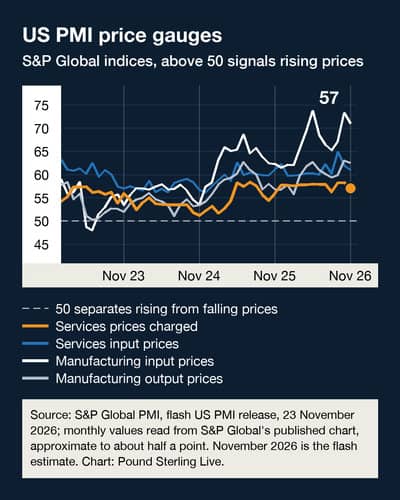
"A key concern is the elevated cost of living and resulting pressures on affordability, and the survey price gauges remain at levels consistent with inflation running well above the Fed's 2% target in the coming months, despite some moderation of the rate of inflation in November," adds Williamson.
Currency markets took the slowdown in their stride: the pound-to-dollar exchange rate traded at 1.3058 in the minutes after the 14:45 UK release, little changed from 1.3062 beforehand. The euro-to-dollar exchange rate held steady at 1.0937.
GBP/USD trades near the 1.3053 low it set earlier on Monday, its lowest since November 2025, and beneath last Friday's low of 1.3076, the level Pound Sterling Live's Week Ahead Forecast named as the one that would change its call for a relief bounce if the pair closed beneath it.
The flash services index fell to 54.7 in November from 56.1, below forecasts of 55.5 to 55.7, with manufacturing in line with expectations at 54.5, the S&P Global figures show. A reading above 50 on these surveys signals that activity is growing.
New orders grew at the slowest pace since July, with some firms citing higher interest rates. Exports fell for the first time in four months.
Price pressures cooled in November, helped by lower fuel prices, although selling price and input cost inflation both remained elevated.
GBP/USD will struggle to recover if Wednesday's October PCE inflation figures, the Fed's preferred inflation measure, confirm the price pressures the surveys describe.