Image © Adobe Stock
Highlights in the week ahead include the European Central Bank decision.
The euro-to-dollar exchange rate is expected to ease below 1.14 in the coming days as the reality of renewed oil and gas price rises starts to bear down more meaningfully.
The pair starts the new week at 1.1439, which puts it above Friday's close; a surprising development given the notable deterioration in the Iran-U.S. conflict over the weekend that saw a meaningful increase in strikes by either side.
Oil and gas prices have risen in response to the crystallising realisation that the Strait of Hormuz will be choked for an extended period.
"We do favour EUR/USD moving back below 1.14 on these high energy prices," says Chris Turner, lead FX analyst at ING Bank.
However, Turner does warn of a wildcard scenario where the latest deterioration in the Middle East prompts the European Central Bank (ECB) to raise rates as early as Thursday. Such a surprise could boost euro exchange rates.
Markets had expected a rate hike by October, but the ECB might feel that enough has happened in recent days to favour a pre-emptive move on rates in order to ensure inflation expectations don't deteriorate.
"We are cognisant of the risk of a surprise rate hike from the European Central Bank this Thursday," says Turner. "The ECB might take the opportunity of higher energy prices to get a second hike in earlier than September."
A preemptive move could jolt the euro higher across the board on the day and set it up for a firm finish to the week. For euro-dollar that could look like a close above 1.1450.
Despite deteriorating conditions in the Middle East, the dollar is looking a little worse for wear on Monday; in fact it's down against most of its G10 peers.
That's likely due to investors reckoning that the current lift in oil and gas prices doesn't necessarily mean U.S. inflation will respond: the inflation undershoots reported in June suggest the economy is particularly insulated to the effects of the Middle East.
That makes sense: the U.S. has an abundance of oil and gas reserves and is a net exporter, profiting handsomely from the current rise in prices.
The market therefore senses what we've seen over recent days won't be enough to meaningfully shift the dial at the Federal Reserve and encourage a number of rate hikes.
That's obviously weighing on the dollar.
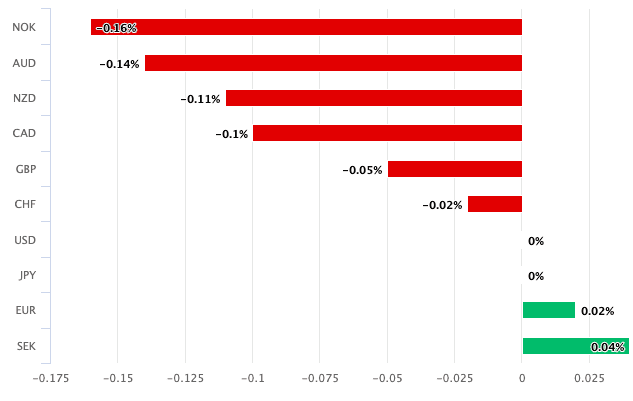
The USD underperforms on Monday.
Nevertheless, we're in a risk-off moment for markets, and that is consistent with USD strength. Also, the Eurozone is a net energy importer and rising oil and gas prices will likely hit confidence and activity.
"We do favour EUR/USD moving back below 1.14 on these high energy prices," says ING's Turner.
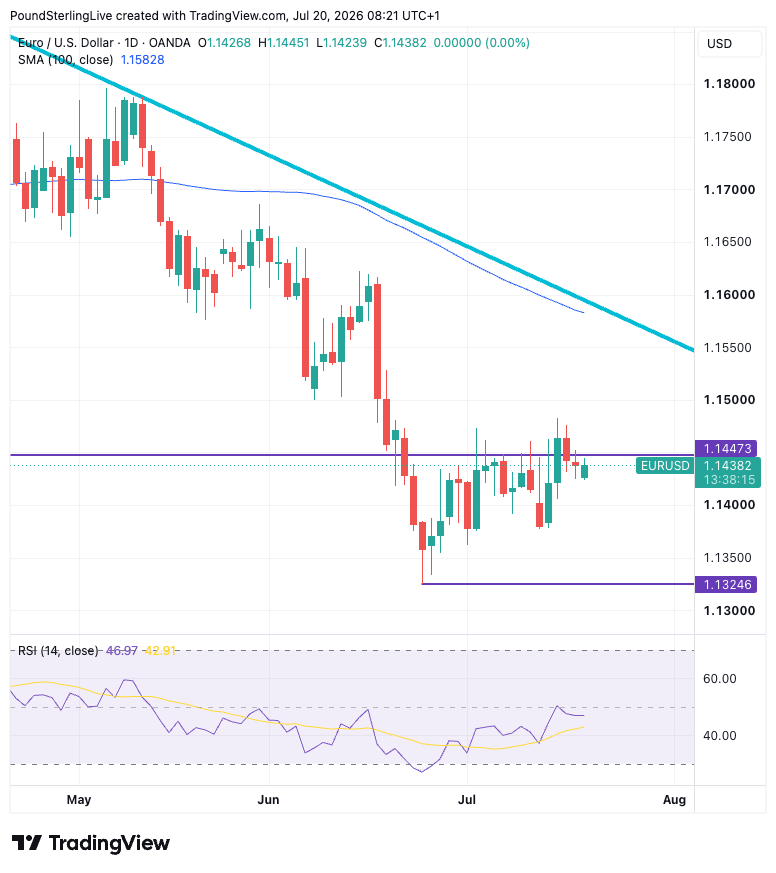
The daily chart (see above) meanwhile confirms EUR/USD remains in a well-established downtrend despite stabilising above the 1.1325 June low.
The pair has spent the past two weeks consolidating beneath a formidable confluence of resistance, with both the 100-day moving average (1.1583) and the descending trendline from the April high continuing to cap rallies.
Momentum has improved from oversold conditions, but RSI remains below 50, suggesting bears still retain the broader technical advantage.
The key question for the week ahead is whether EUR/USD can break out of its consolidation range.
The price has repeatedly found support around 1.1325 while struggling to sustain moves above 1.1447, leaving the pair trapped in a relatively narrow range.
A break in either direction is likely to dictate the next meaningful move. Given everything that we've seen, we'd be inclined to lean on the break resolving lower.

The Bank Consensus, Without the Terminal
The median, mean, highest and lowest from the October survey update, plus named point forecasts out to 2027.
Free information pack, issued by World Wide Currencies.