Image © Pound Sterling Live
The Pound is vulnerable to underperformance while the Bank of England stays sidelined, says HSBC.
Pound Sterling's interest rate advantage is quietly expiring, according to HSBC, which warns the currency is exposed for as long as the Bank of England declines to join the global hiking conversation.
The warning follows last week's Bank of England decision, at which "the Bank of England left the Bank Rate unchanged at 3.75%, with a 6-3 vote split, although a 7-2 split was widely expected," says HSBC.
On paper, a third dissenter was the hawkish surprise, and indeed it was precisely the trigger our week ahead forecast identified as capable of lifting the Pound on the day.
We noted the pound had also sold off into the event, perhaps in anticipation of a 'dovish' outcome, meaning a mean-reversion lift was likely on anything but the most remarkable of outcomes.
Looking ahead from here, the market is lending weight to the majority, not the minority dissenters on the Monetary Policy Committee (MPC).
"The message was clear. The BoE is still in 'wait and see' mode, even as energy prices remain highly uncertain," says HSBC.
"That stance matters for GBP because it shows the BoE's reluctance to 'lean against' any near-term inflation flare-up driven by oil and gas."
The price action agrees with that reading, with the Pound having fallen against both the Euro and the Dollar since the decision, at one point racking up six consecutive daily losses against the Greenback.
Growth Fears Trump Inflation Fears
HSBC says the vote split on the MPC maps a committee with a clear hierarchy of worries.
A hawkish minority continues to warn about second-round effects from the energy shock, but the broader Committee looks reluctant to tighten while the underlying economy is weak and policy is already restrictive.
"In other words, the BoE still sees the growth downside as the more immediate risk, and the inflation upside as potentially temporary," says the bank.
The stop-start nature of Middle East tensions complicates the picture further, with energy prices jumping on escalation headlines and retracing on de-escalation, a pattern on full display over the past fortnight as Brent swung from above $100 to below $84 and back higher on the fortunes of US-Iran diplomacy.
The Bank Consensus, Without the Terminal
The median, mean, highest and lowest from the October survey update, plus named point forecasts out to 2027.
Free information pack, issued by World Wide Currencies.
For the Bank of England, HSBC says, that volatility raises the bar for hiking.
The data give the doves cover: so far there are few signs that higher energy prices are feeding into broader prices, with disinflation still progressing after a third consecutive downside CPI surprise.
The labour market is meanwhile softening, especially in the private sector, where HSBC notes employment is 121K below its level of late 2024.
"That weakens the case for immediate tightening, and by extension weakens GBP's policy support," says the bank.
Last in the Hiking Queue
The most striking passage in the research is the expectations scoreboard.
"The OIS markets price 10bps of a hike in September (or a 40% probability, compared to 85% for the ECB and 64% for the Fed)," says HSBC.
Of Sterling's two main trading partners, the market sees the UK currency carrying the lowest probability of a hike.
Relative rate expectations are the engine of the move we have been documenting in the bond market, where the gap between UK and German two-year yields has compressed to 2026 lows as ECB hike bets build, and the UK-US equivalent has all but vanished.
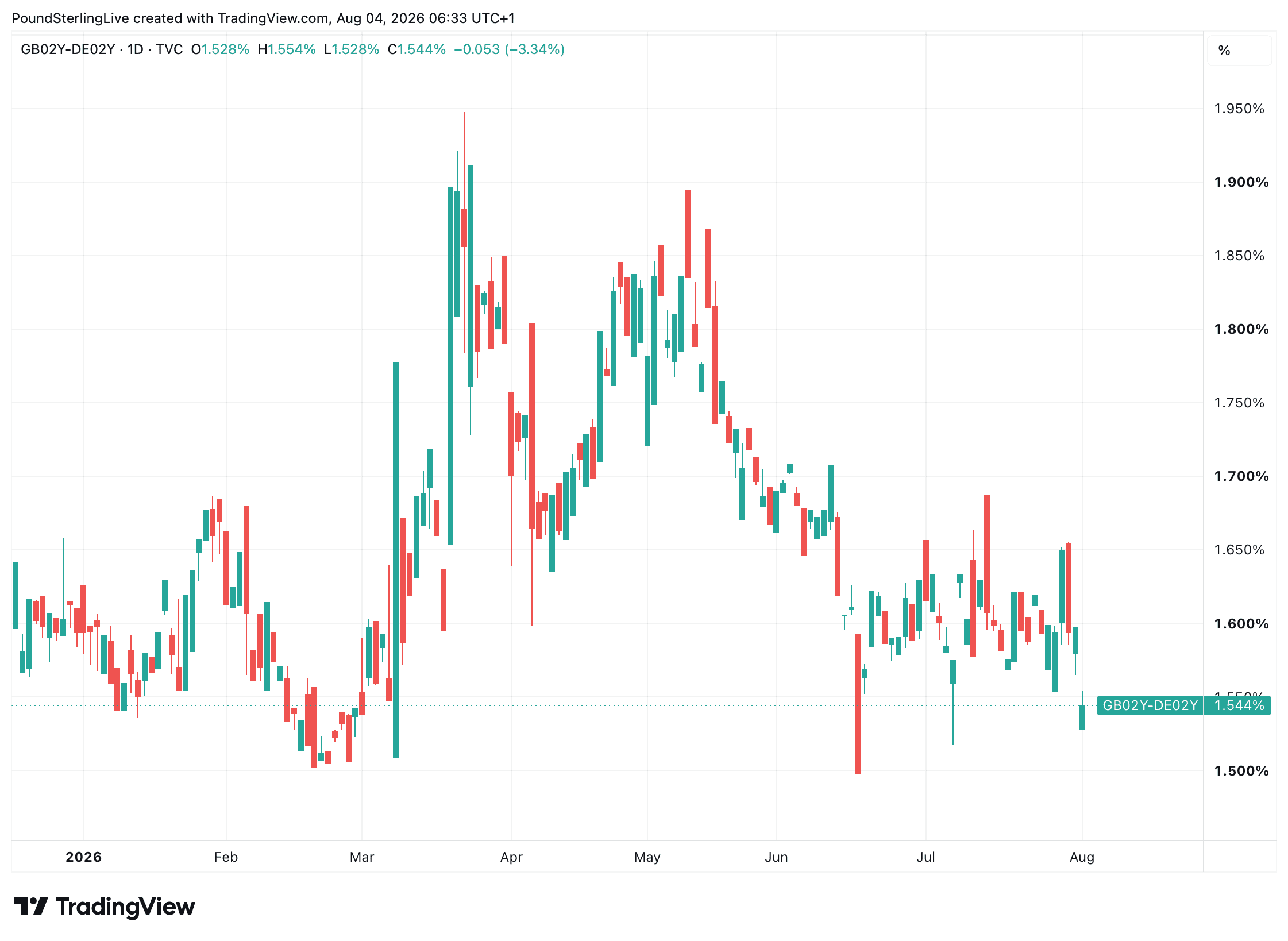
Above: GBP's short-dated rate advantage against EUR (proxied via Germany) fades.
The Pound spent July rallying on the premise that Britain's high inflation beta meant UK yields would rise fastest; the Bank of England's patience, set against an ECB at 85% and a Fed at 64%, inverts that premise.
"Higher rates have helped underpin GBP, but if the BoE stays sidelined while external shocks and domestic policy uncertainty persist, GBP is vulnerable to underperformance, particularly against currencies with firmer rate or growth support," says HSBC.
What Would Change the Picture
The vulnerability is conditional: evidence of second-round inflation effects, a sustained rather than stop-start energy shock, or stabilisation in the labour market would each strengthen the hawkish minority's hand and put the September hike, currently only 40% priced, back in play.
And not everyone shares HSBC's caution, Lloyds Bank's latest forecasts point the Pound-to-Euro rate north of 1.20, resting on the view that yields, not politics, will steer the currency and that the UK's rate profile still compares favourably over the medium term.
"The pound is effectively trapped between fear and greed. That means GBP moves will continue to be determined by changes in relative fundamentals and interest rates," explains Lloyds Bank's FX strategist Nick Kennedy.
He adds that "political sensitivities might generate some temporary chop but we'd assume yields will remain more sensitive and, in that sense, can be stabilising for the currency."