Image © Pound Sterling Live
Pound sterling has snapped a ten-day slide against the euro and looks to be building a new layer of support that could yield to a renewed push higher.
For the coming week, it's probably too soon to look for a resumption of the rally, and we'll be interested to see whether the support emerging around 1.1650 holds true.
A successful defence of this level will ensure a new phase of consolidation at higher levels, ultimately providing a new springboard for a renewed advance by the UK currency that delivers fresh highs, in keeping with the medium-term uptrend.
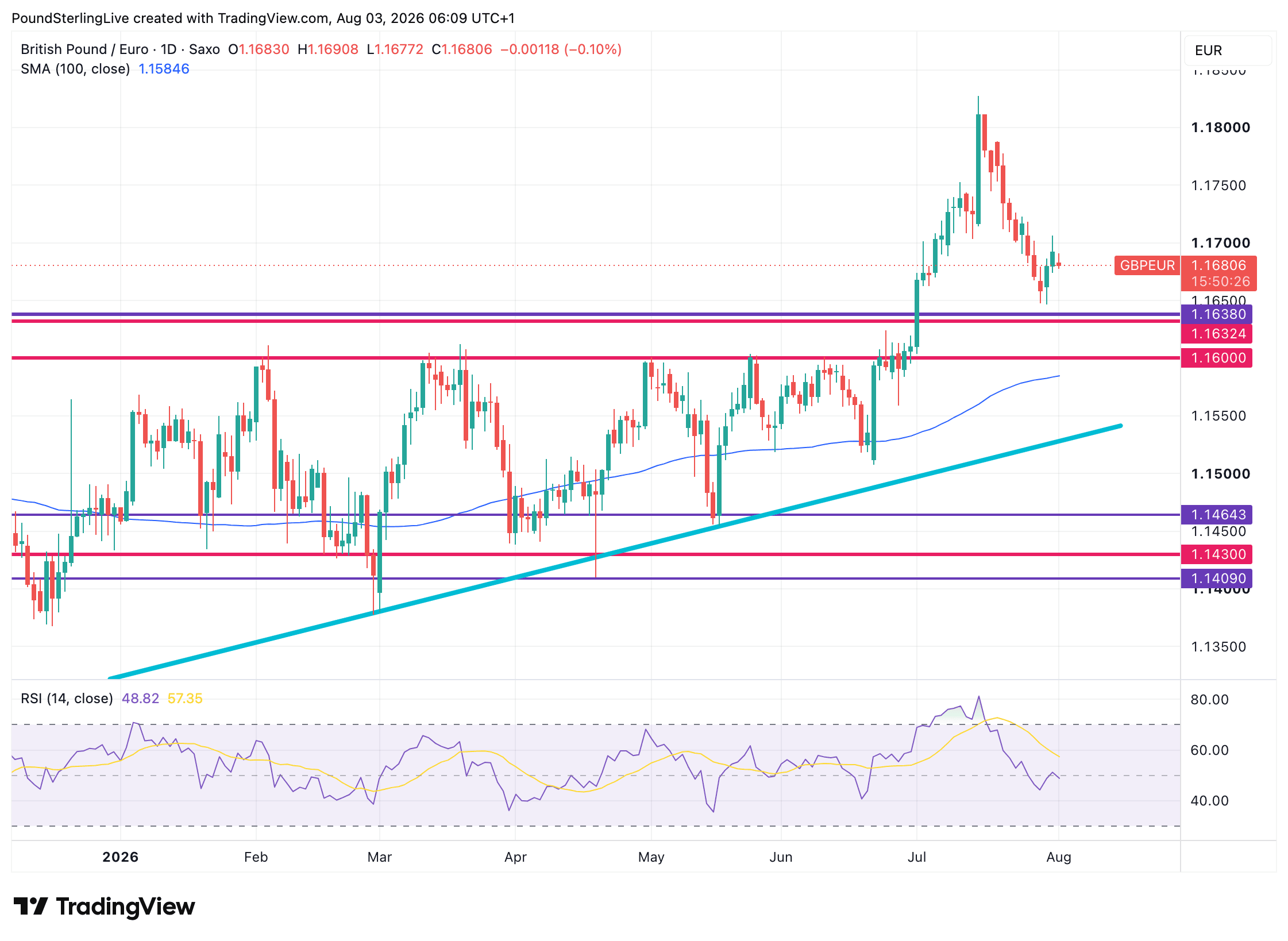
As the chart shows, the pound-to-euro pair last week found buying interest to be solid at 1.1650 and a move higher to 1.17 was recorded on Friday. The exchange rate starts the new week just below this important marker at 1.1680.
Pound sterling has therefore now surrendered much of the impulsive momentum that characterised July's breakout, with the pair retreating from the 1.1800 peak towards the former breakout area around 1.1630-1.1650.
Importantly, however, the pullback remains corrective rather than destructive. Price continues to trade well above the rising 100-day moving average, while the former resistance zone has so far contained the decline.
The key question for the week ahead is whether the market has now found value after unwinding the overbought conditions that developed during July.
Sellers Losing Their Grip
The RSI has fallen back to around 49, comfortably removing the overbought reading above 70 that accompanied the rally.
At the same time, price has begun to stabilise just above the former breakout zone, suggesting selling pressure is easing.
The technical backdrop therefore remains constructive, although there is not yet enough evidence to conclude the uptrend has definitively resumed.
The tactical picture is consequently more balanced than it was a fortnight ago.

The Bank Consensus, Without the Terminal
The median, mean, highest and lowest from the October survey update, plus named point forecasts out to 2027.
Free information pack, issued by World Wide Currencies.
Sterling has corrected without breaking the broader bullish structure, but buyers still need to demonstrate they are prepared to defend the breakout.
A recovery through last week's highs would argue the market has established a higher equilibrium and is ready to resume its advance.
Conversely, a decisive break beneath the former resistance zone would suggest the correction has further to run.
What We're Watching
There are not tier-one UK or Eurozone data points to watch this week, leaving a mix of global factors to take the driving seat.
Oil prices are volatile, with Brent crude prices rising above $90/b on Friday as markets priced in the risk of further US strikes on Iran.
They have fallen sharply on Monday after U.S. President Donald Trump signalled restraint if talks to reopen the Strait of Hormuz and curb Iran’s nuclear programme move quickly.
Rising energy prices are reflected in firmer Eurozone inflation rates: last week it was confirmed headline Eurozone inflation edged up to 2.9% y/y in July, while core inflation unexpectedly rose to 2.5%. Markets are pricing an almost 90% chance of a 25bp ECB hike in September.
Another hike will shore up short-term Eurozone bond yields, which can support the euro.
Intervention Means Euro Selling
Elsewhere, it's interesting to hear that U.S. authorities last week initiated the selling of euros to buy the yen in a coordinated effort with Japan to defend the value of the yen.
Using euros to buy yen confirms that the Americans don't want the intervention story to be one that's purely about a weaker dollar.
For the most part, the intervention hasn't hurt the euro meaningfully, and we're in fact seeing a strengthening technical setup on the euro-dollar charts.
Euro resilience here can limit the ability of GBP/EUR to rise.