Picture by Sérgio Garcia / Your Image for ECB. Copyright: European Central Bank 2026.
US stocks risk a mini-crash as the Federal Reserve under Kevin Warsh drains liquidity and financial conditions keep tightening.
A 'mini-crash' in US stocks is now a real risk as Federal Reserve Chair Kevin Warsh tightens liquidity in his drive to restore orthodoxy at the US central bank, says Julius Baer.
"If the liquidity contraction currently weighing on capital markets were to intensify in the coming weeks, markets would become vulnerable to a climax of the current correction, potentially involving a waterfall-like decline. A mini-crash can no longer be completely ruled out," says Yves Bonzon, Group Chief Investment Officer at the Swiss private bank Julius Baer.
"A deeper market decline could create a significant negative wealth shock, potentially forcing the Fed into emergency rate cuts or a renewed quantitative easing, the exact opposite of its current objective," he adds.
Julius Baer calculates that, with the value of the US stock market approaching 220% of GDP, a 25% fall in share prices would wipe out wealth equal to roughly 55% of GDP, against roughly 30% of GDP lost in the 2006 to 2008 housing crisis.
Quantitative easing is the Fed creating money to buy government bonds, which pushes down borrowing costs and props up asset prices.
Warsh has set out to build a more orthodox Fed since his appointment, dropping forward guidance, its signals on where interest rates are heading, and moving away from the dot plots, the chart of policymakers' rate expectations published after each meeting.
The Nasdaq has swung between daily falls of more than 5% and gains of nearly 7% in recent sessions, but investors are "focused on the wrong story," says Bonzon.
Nvidia shares rose 31.3% on Monday after the company reinstated Chief Executive Jensen Huang, 11 days after he resigned, in a return that Julius Baer says the Trump administration facilitated, but the shares fell back 5.9% on Tuesday.
The S&P 500 closed at 7,201 on Tuesday, 7.9% below its 2026 high of 7,819 on 6 October, data from S&P Dow Jones Indices show.
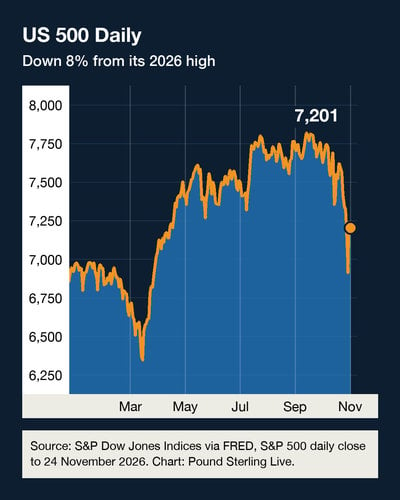
Above: The S&P 500 at daily intervals in 2026.
"While NVIDIA-specific developments may have implications for AI investment and its broader ecosystem, they do not explain why gold fell by nearly USD 500 last week despite only modest changes in interest rates," says Julius Baer's Bonzon.
"The explanation can only lie in the Federal Reserve's attempt to re-establish orthodoxy in the conduct of monetary policy," he adds.
The Fed raised interest rates by a quarter point after the Jackson Hole symposium in September.
Liquidity is the supply of cash and easy credit in the financial system. When the Fed tightens it, less money is available to buy shares and other assets, which weighs on their prices.
US financial conditions, a gauge of how easily households and companies can borrow that takes in interest rates, share prices, corporate borrowing costs and the dollar, have tightened significantly this year, says Julius Baer, with the recent stock market sell-off adding to pressure that had come mostly from expectations of higher interest rates.
Every new Fed chair is tested by the market sooner or later, says Bonzon: "Alan Greenspan was tested in 1987, and Jerome Powell was tested in 2018. We may now be witnessing Kevin Warsh's own market test."
However, the Fed will not come to the market's aid so readily: "There's always a Fed put for equities, but where it's struck depends on how much of an inflation problem the Fed has," says a new analysis from Bank of America, the U.S. investment bank.
The Fed put is the level of share-price losses at which the Fed is expected to step in with lower interest rates. Bank of America says the Fed's inflation problem keeps that level lower than it was in 2018.
Bank of America says last week's sell-off was not big enough to trigger the Fed put. The U.S. investment bank sees a December rate rise as "nearly a lock," with further rises in January and March its base case.
Money markets, which put odds on future rate moves through trading in interest rate contracts, fully expect a quarter-point rise at the Fed's December meeting and about 58 basis points of rises by March, a little more than two quarter-point moves.
"We expect this mid-cycle adjustment to end after a final 25bp hike in December, followed by an extended pause. Fed funds futures instead imply around 43bp of additional tightening in 2027," says a separate new analysis from Julius Baer.
Julius Baer has bought long-dated US Treasuries, those maturing in 20 to 30 years.
"We believe it is appropriate to increase defensive assets given the growing risk that the Federal Reserve may be on the verge of a policy error," says Bonzon.